
The April 2026 NHL Draft Rankings
At long last, I’m back, somewhat delayed, sharing my “midseason” 2026 NHL Draft Ranking! I hope you’re all enjoying your respective transition seasons as summer approaches here in Canada and are enjoying the stretch leading into what looks to be a remarkably exciting NHL Draft in Buffalo in 2026. If you’re as excited as I am, check out the NHL Draft Simulator I built over the last month or so!
This year’s class is looking absolutely fascinating. I think we’re looking at a 2021-style relatively balanced top-end of the class, with lots of potentially valuable players, with a bit of a murky vision of the end result come the 2030s. There are projectable players in the middle of a lineup in a number of roles, there are riskier extreme upside targets, and a bit of everything in between. I’m not sold on guaranteeing any team a game-changing talent in this class, but the potential is certainly out there. Beyond that top group, in my opinion all bets are off, and the marketplace is still wildly all over the place, and I am no different. My thesis in the current era of the NHL Draft landscape is that the CHL has taken a very large step back in quality thanks to the exodus of very talented players to the NCAA. From ages 17 through 21, we’re seeing a huge list of talented young players taking their talents to the college hockey circuit for a greater challenge, more time out of games to focus on training and development, and in many cases, significantly more exposure to both fans and scouts alike than what is available up in Canada compared to the size of the market in the US. When you see a number of CHL players ranked lower on my list than many others, that’s the fundamental explanation. For many high scorers, I just see too much uncertainty projecting them in key areas that hold me back from the level of comfort I’m looking for in an elite level pick. Some buck the trend as you’ll see, and you don’t have to agree with me, but it’s simply an explanation for a pattern that will undeniably be noted by many upon the release of this list.
Nonetheless, it’s looking like an exciting year. I’m excited to watch players on my ranking as far down my board as the third round, and while many don’t have a clear pathway to the NHL, they all have something to put forward as a key talent that can be leaned on and developed to hopefully play some kind of role in the toughest league in the world. I still struggle to sift through who my top priorities would be past as high as the top 10-15 picks in this class, and I think the volatility come draft time could make for a wild weekend in Buffalo. Last season, that excitement ended somewhere around the early 2nd round on my list. Does this indicate a “deeper” draft class? I believe it does, but it’s still way too early to know anything for sure. Playing your cards right, plenty of NHL teams could find themselves with a small handful of roleplayers that round out a pretty solid roster, even if you’re a contender and aren’t expecting much from your draft capital.
Before we get into the list, it might be helpful to take the time to briefly outline my philosophy so you can get in my head a little bit and understand where I come from a little better when I see the game. If you take 10 different evaluators, you’ll probably get some differences in priorities and preferences, so knowing what you’re getting into should add to the experience. At my core, I focus on possession. Hockey is a game in two fundamental states. You have the puck, or you don’t. The ultimate goal should be to find players who are as good at gaining and maintaining possession in some way, getting the puck into a desirable location, and getting the dang thing into the net as much as possible. In my view, the priority should be in that order. You can’t have the third aspect without the second, and you can’t have the second without the first. As such, I see speed, tenacity, competitiveness, and quickness as key, both mentally and physically. I don’t care so much about how big you are, how good of a shooter you are, how hard you hit, I just care about what you do on the ice and if you’re moving the needle in the right direction. In my experience, the best young needle movers with regards to competitiveness, pace, and creativity are the ones of who are often hardest to find when they grow up big and strong to be NHL players one day. I value players who elevate who they play with more than anything. They’re dependable every shift, they're focused on the ultimate task of the game situation, and they think creatively to make baby steps happen that ultimately lead to scoring chances, and ideally some goals go in here and there.
I’ll also note that the positions listed (outside of the imaged lower tiers) are almost universally those from the games I’ve specifically watched and tracked of these players. A defenseman is listed by either handedness or the side of the ice they play on should it be the opposite to his natural shooting side (i.e., RSD is a left handed defender playing on the right side).
This is the free version of my full ranking writeup, containing full reports for my first four tiers, roughly the entirety of my first round. If you’d like full access, subscribe below and unlock the full rankings with reports on over 100 different players below!
Tier 1 - By The Hairs of their Chinny-Chin-Chins
-
Stenberg has consistently been such an impressive all-around player this year and after seeing so much of him, I am still not exactly sure why he’s so impressive. His forechecking energy and turnover generation ability is awesome, tracking play with ease at the SHL level. His skill level may not match that of a Gavin McKenna, but the way which he uses it is so much more practical and effective in tougher scenarios. Knocking pucks down through feet and traffic, attacking players head on, protecting the puck down low, creating tight space for himself, it’s all there. the margins here between my first two tiers has gotten tighter and tighter over the last few weeks as I finish datasets on some other names, but Stenberg would probably be my choice first in what would be a strong top end of a solid draft class. He doesn’t waste his shots from the perimeter, he’s an excellent transition driver with diverse talents and a propensity for good stick checks, and if he can just improve his explosiveness to add another two-way dimension to his game as he has over the last 12 months, he could be a fantastic add to the top line of an NHL team in the mold of a Seth Jarvis-esque player with excellent value in many areas of the ice in many situations outside of raw point production.
-
Looking back, I absolutely do not regret having McKenna at 5 in December, but he has absolutely taken some great strides this season that alleviate a certain amount of concern about his game. The skill level is undeniable, and his ability to blend skill and playmaking on it’s own will make him a gazillionaire if things go right. He’ll score, fans will love him, and he has star upside. It’s as strong an individual trait as Connor Bedard’s shot in junior hockey was a few years back. That said, there are still significant concerns. I may be in the minority of not being a huge fan of the circumstances surrounding his arrest earlier this year, but beyond that, McKenna’s style of play is extremely improvisational (admittedly excellent at it though), which requires an outstandingly high level of talent against top tier NHL defending. McKenna relies often on having time and space to think, and using his skill to create gaps to defenders in a way that seems somewhat hard to see in the NHL without being one of the best in the world. The potential is there, but the data paints a very sketchy profile to project. Excellent offensive transition efficiency, but highly, highly reliant on pass receptions and chasing offense in the neutral zone. Tons of shots, but a majority coming from the perimeter. Some decent offensive zone turnover generation, but usually done off errant passes and sloppy board possession by the opposition. I don’t put a ton of weight into a lack of hits, but McKenna hasn’t thrown a single on in my sample. His defensive transition efficiency is among the worse in the draft, especially at the top, left behind on many attempts, relying on reach and soft stick checks, but also having pucks played through him positionally far too often. I’ve said for months that if I’m an NHL team, my gameplan is to vibe him out in an interview and go from there. If you get any inkling that there might be off-ice issues that become a distraction or detriment, then the downsides become far more troubling. If you come away thinking he understands his issues and that there may need to be some tweaks to get coaches to trust him more, then great! McKenna is a player who could take a good two-way top line that struggles to score and makes them into an elite unit. He’s clinging to this spot in a tier that is very close to the next one, but he’s going to be an absolutely fascinating player to watch develop and grow, and if things work out, he could be an enormous lightning rod for the sport as a whole. I have a bit more conviction in Stenberg, but it’s close.
Tier 2 - The Ones Right Behind Them
-
My god the things I’ve seen, read, and heard about this player while we all watch what the NHL is like and how the best play the game. We’re in a paradigm shift in the world of hockey and I’m sticking my neck out on a lot of these players trying to get ahead of where the paradigm is headed, and I think Lawrence is a prime example of that. Five players under the age of 18 are playing in the NCAA this season. Just 24 other players in the last 25 years have done the same. Younger players are playing tougher and more developed competition which I think is a great shift and we’ll likely only see more of it. For me, I see Lawrence’s journey from domination of the USHL to perceived NCAA struggles as a massive benefit. He’s getting ahead of his development curve, and even when you look at the data, his play with Boston University has by and large been outstanding. Lawrence is an elite transition driver with a speed and skill combination unlike arguably anyone in the class, huge offensive creation numbers on a team that struggled to finish chances he creates, a very strong defensive presence at both ends of the ice, improving shot selection skill, and all-in-all, just playing like arguably the most purely competitive team-driver in the entire class.
Here’s a thought experiment in honesty: If Lawrence stayed in the USHL and scored at his pace, landing somewhere in the range of 40 goals and 80 points threatening for the league lead in production, would there be equal concern about his game? When he jumps up in quality of competition and doesn’t shoot the lights out immediately, why does the evaluation suddenly completely shift? If we’re playing that game, many other players in the class don’t have the same pathway or exposure, but have the luxury of playing at a level where they can threaten for their league lead in scoring without the challenge of NCAA experience at 17 years old. I’m very bullish on Lawrence and think he’s a great player to build a line and team around in some way. A natural centre with a style of play at the position that perfectly lines up with my philosophy of the position, Lawrence is a gamer, and in my opinion based on his last few games I’ve seen this year, he’s much closer to McKenna and Stenberg than he is to the tier behind these players.
-
You want to talk impressive seasons, I’m not sure any player has taken as great a leap as Viggo Björck. Habitually found on the first line playing centre for the Djurgårdens men’s team in the SHL is no small task, and by and large he’s been excellent in that role. A very capable transition driver, especially offensively, Viggo Björck has an exceptional view of the ice with great awareness and timing on his passes, stitching play together and generating almost 50% of his team’s shot attempts in some way, all while just 30% of his shot attempts come from outside scoring areas. While on paper Stenberg has a slight advantage in key areas, Björck has more evidence of physicality and net-driven grind off the puck, with awesome give-and-goes all over the ice, and vastly improving the pace and speed of his game in the last year. His key weakness is a combination of being a bit undersized without elite agility and speed in his skating, especially for a centre. I am personally less concerned as there is physical growth potential, and plenty of time to develop those areas. The thinking ability, pass vision, overall energy, and off-puck skill is very tantalizing, and it seems very possible that Björck goes significantly later than I would take him, which a smart NHL team may be able to capitalize on come draft day. A strong U18 might change that perception as it might for Lawrence, but as of today, I’m surprised at just how down many are on him.
-
One Olympic appearance and a loan to Germany since my last ranking has only solidified my view on Smits as a top choice for a defenseman in this class. He’s exactly what I’m looking for in a two-way player at the position for the modern game. Great skating range, a great frame, strong skill and puck protection ability that I’d love to nurture more, an off-puck awareness that looks for great scoring chances with limited perimeter shooting offense leading to cheap and unprojectable production. If he does make a pinch, he doesn’t disappear, often using his range to get back and cover his position, with strong defensive efficiency. He’s a bit of a rover though, with a transition profile looking more like a forward than a defenseman, but he’s such an interesting two-way presence with a level of impact almost everywhere. His pass vision across longer distances could use some work, being a bit calmer on the puck in his own end, but he’s more than capable of keeping the game simple and straightforward with a good team-first focus. He really brings a Brent Burns type vibe to the game, with a bit of that offensive zone confidence that might scare many coaches, but if you give him some rope and time to develop, you might end up with a premier 70/30 offensive split defenseman that is a rock solid addition to any team’s top four. I mean, the guy went to the Olympics for the Latvians, played a ton, and I saw him shutting down some of the world’s best players, especially in their game against the gold medal winning United States. He certainly didn’t seem overwhelmed in his role, and clearly looked like a guy that could and should hear his name called awfully early this year.
-
Villeneuve moving down from 2 in December might sound like a big jump, but other guys have simply caught up and shown a bit more dependability in key areas than Villeneuve, but if we’re looking at players with the highest upside in the entire draft, Villeneuve is absolutely #1 among defenders, and at worst in the top 3 overall. He’s an unbelievably skilled and daring offensive defenseman, putting up offensive data in my dataset that goes well beyond any other defender I’ve tracked in the last few years. In fact, since re-scaling my offensive threat metric (slot passing + dangerous shots) to more accurately evaluate defensemen, Villeneuve blows everyone so far out of the water that I almost considered rescaling the information again. Scott Morrow is the closest comparable on paper and he was playing at the prep school level which, for all the stuff I’ve put out there on the QMJHL and the CHL, is a big step up from that circuit. 40% of his shot attempts are from scoring areas. He passes the puck almost twice a minute with strong completion metrics, he generates more slot passes than J.P. Hurlbert and Caleb Malhotra, generates more dangerous shot attempts than every player with a decent sample in my dataset outside of Stenberg, and McKenna, and rivals names like Preston, and Belchetz when it comes to individual scoring chances. The kid is a machine, and he gets there in a way that I think could work against NHL competition. Shifty like Lane Hutson, explosive out of his skill moves like Cole Hutson, and underrated defensive metrics make him a remarkable case study. He generates turnovers effectively at both ends, is no worse defensively in transition than the other defenders available in the CHL to a significant level, while registering more involvement defensively through the neutral zone than every other CHL defender likely to be in this range. He can be frustrating and easy to beat physically, which for some is problematic, but I’m a believer in tolerating some downside in order to accept immense strengths, and I think Villeneuve is going to be a player where the strengths wildly outweigh the issues, and his play since returning from injury, as well as his play at the CHL/NTDP series and last year’s World U18 tournament all solidify how special I think this player is. It’s a tight group at the top but he very quickly becomes one of the most exciting players available if the chips fall like my model estimates.
-
Another player where a small drop isn’t necessarily because of them not being impressive, but this year, so many names have clumped up at the top of my board that things have just come down to philosophical preference and vibes, to be perfectly honest. I really like Verhoeff, and if things break right, he could be a player I should’ve had a tier or even two higher. Nobody in the entire class is better at defending bluelines than Verhoeff, and he doesn’t do it strictly through his range and off-puck play knocking down loose pucks and errant passes. 32% of his defensive transitions are stick checks, and he’s successful 85% of the time. For a 17 year old in the NCAA, that is absolutely wild. He’s got a great shot that just didn’t come out much in my sample, but what did was his excellent offensive zone vision and playmaking. On a dynamic offensive team like North Dakota, his presence was a bit more limited than it probably could’ve been, but as a player with defensive acumen and offensive zone ability, there isn’t a ton more you could want. That said, Verhoeff isn’t without faults, and in my view, in some very key areas. His footwork and range are great in open ice through the neutral zone but his defensive zone explosiveness and strength have been a bit of a detriment, as has his overall reliability procedurally moving the puck around the defensive and neutral zone offensively. He gets a ton of puck touches but turns it over in those zones more than I would like, his physical metrics are worse than you might expect, and his skill and puck settling ability at low-pace is still something to be worked on after months of seeing him deal with that. There’s a lot going right with Verhoeff, and the upside is significant, and like Gustafsson, he may take a bit of time to really break out, but with the right amount of patience and the right areas of development, Verhoeff could be a great addition to any team’s defense corps.
-
Another youngster with some immense growth in his game since the beginning of the year, Malte Gustafsson has become one of the most curious players in this draft class. My shakiest viewings of him came outside the SHL oddly enough, with some skill issues controlling the puck and dealing with pressure, but once he got challenged in the best league in Europe, he really came alive. In terms of projectable defending, leading with stick checking and positioning, fading into physical pressure and separating bodies from the puck, Gustafsson might be the best at it in this class. Great rates of physicality, strong transition efficiency going both ways, very strong pass completion rates, and flashes of some offensive zone magic all make for a very intriguing player that might be one of those guys who all of a sudden at 23 or 24 has a breakout NHL season and becomes an obvious top-end defensive player. I don’t know how much offense there will be down the road, but the ability is there, and his SHL team generated less offense per minute on the ice than almost anyone else I’ve tracked, and I don’t think you can lay that at the feet of a 17 year old defender with very good defensive metrics on that team. I may end the year with him a biiiiiit lower on my final board, but I’ve become enamoured with Gustafsson’s development and what he’s capable of when playing against very strong competition. His U18 tournament should he make an appearance will be very interesting and I expect him to be one of the more developed two-way presences out there.
-
Reid comes in around the same slot, even after others have had him as high as 1st overall. I like Reid, to be clear, and I think there isn’t a better straight line puck rusher in this draft, outside of maybe Xavier Villeneuve. He has an explosive skating ability that can build speed through the neutral zone with good skill in combination, using his frame to protect the puck effectively, and using his feet to patrol the neutral zone with ease. He’s efficient off the puck, with good shutdown ability and solid blueline defending results, but he largely achieves these results without close-quarters physical contact, and that’s where I find Reid’s game falters somewhat. Faster, more skilled OHLers have found their way through his physical pressure more often than others in this range. His offensive output also relies on perimeter shooting more than I’d like, especially when there is some good playmaking ability if he takes a step up from the blueline. He’s an intriguing package that reminds me a bit of a Morgan Rielly type, and say what you will of his game at his age now, but Rielly had a very good, long run as a legitimate top four NHL rushing defenseman with blueline-based offensive ability and powerplay upside. I think Reid could be that as well, and I can’t imagine he ends the year any lower than he is here.
-
Two things: Yes, I may have been a bit overzealous with putting Preston at 1 in a bigger first tier in December, but I still believe he might be the most undervalued player in the entire class. Seeing him ranked in the second round by many is borderline outrageous, as he went from one team that struggled to score and generate offense with him to a team that missed the playoffs and had the same problems. This is why I track the data I do. Preston played just 10 games with the Giants, but in that time he scored in 9, had 3 multi-point games, and had points on 44% of Vancouver’s goals in those games. It’s a smaller sample, but of all the players I’ve ranked, that is the highest value out of anyone playing on this continent. Yes, that includes Malhotra, Klepov, the Rucks, Hurlbert, and even Gavin McKenna. Preston has star upside, and every time I hear him speak and play hockey, I still see a potential regen of William Nylander there. The skill, speed, confidence, dual-threat offensive output, dominance of the neutral zone offensively, and underrated competitive nature are things to bet on to say the least.
So, why is he down here instead of at 1 still, well, the top has become much more crowded, and it’s undeniable that Preston is a frustrating player. If he isn’t moving his feet, he isn’t contributing much of anything, made all the more frustrating by seeing just how intense and hard to play against as he can be at times. One of the bigger hits I’ve seen this year came at Preston’s hand when down something like 7-1 at the end of the game. Clearly frustrated, capturing that intensity when things aren’t out of hand is something a good coach should be able to scrape out of him. There’s just too much to like with Preston, and if he’s a lottery team’s 2nd round pick, that’s astounding value if things break right. Like McKenna, it comes down to your perception of his willingness to learn, adapt, be a professional and be the best version of himself he can be. If he does, he very easily might be right up there with the top names in this class when all is said and done.
Tier 3 - The Scoring Fancy Boys
-
Novotny is one of the biggest rollercoaster rides of the year for me. For long stretches of games until recently, I was wondering what the heck happened to him after coming across the pond. It seems that a quick run to another successful World Junior tournament playing a significant role rebooted his “try hard” meter because the last few times I’ve seen him, he’s simply been outstanding. Dynamic, aggressive, making great forechecking reads, generating a ton of offense from scoring areas, chipping in through the neutral zone off the puck well, there’s plenty to love. His puck carrying results leave a lot to be desired, skating into pressure and trying to do too much himself with 50% of his attempts being carries with under a 50% success rate. Novotny, like others in this tier, is about his potential if he hits. Like others, the shot selection and defensive zone involvement needs improvement, as does his hockey sense through the neutral zone, but he’s one of a small handful of players who can seize a possession and dominate his competition, chaining play after play together generating excellent offensive results when all is said and done. I’ve got a few more games to watch and track of him, so there’s still room for him to shift around, and it may be somewhat significant, but the best moments are so, so good. I’m just constantly reminded of supremely individually talented wingers who need some development in the finer details like a Noel Gunler, and worry there’s a similar case in Novotny, but past traumas can’t prevent current excitement. If I get hurt again, so be it, and I can see how it might happen, but Novotny has taken a turn for the better in my experience, and the excitement in his game is worth betting on.
-
Upside is the name of the game for Cullen, and boy is there a lot of it. I liked Cullen a ton last season with the U17 team and for one of the youngest players in this draft, he has grown into one of the most impressive players on the NTDP, especially as a passer. Cullen has excellent offensive transition metrics across the board and is one of the most effective carriers in the class. His defensive game certainly needs work, but he has that Mitch Marner-esque ability to see the ice beyond what’s right in front of him. Working off defenders using skill to create passing lanes, hanging onto the puck for an extra split second to hit a secondary option, faking out opponents and changing lanes remarkably quickly, his on-puck talent is undeniably. A wicked wrist shot release is part of the equation too, but his selection needs work like many in this range. I’ve seen him play college opponents and he doesn’t look out of place, and at his best he is one of the most impressive NTDP players with the puck on his stick to say the least. He needs time to grow and round out his game, but he brings so, so much to build on in areas that really matter in this sport as an offensive player. I’m excited for his potential and while I might have him a bit lower at the end of the year, I still believe that his projection could be very, very positive.
-
Hermansson is another player whose rise this year has only complicated the top end of the class for me. He’s gone from an undeniably skilled and impressive scoring winger to a very capable play driver with great vision and playmaking ability, even under pressure. His transition game is exceptional at the HockeyAllsvenskan level, and on paper he might be one of the best passers through the neutral zone that I’ve tracked to this point. He’s a tremendous player when you look at the fundamentals, and while his defensive game is a question almost all-around, it isn’t so behind his offensive game that everything becomes problematic. Half his team’s offense comes from him somehow, and if he can just attack the middle of the ice a bit more with and off the puck there’s room for even more to like. He and Preston suffer from shot selection issues here and there, and while Preston’s raw shooting ability makes it a bit more tolerable, Hermansson isn’t quite there, and for that among other reasons I lean slightly more in Preston’s favour. If what you’re interested in is pure pace, skill and procedural offense, Hermansson is a great bet that has matured his game significantly to my eye in the last few months.
-
Belchetz is very odd. I think he could be a great complimentary presence on any line for an NHL team. There’s a bit of everything: Skill, physicality, shooting ability, playmaking ability in tough spots, efficiency in transition, and very little that doesn’t appear “good”, but there’s still something about him that I’m not sure I can put my finger on. His offensive threat metric is average with a 50/50 split between playmaking and shooting, which trails others, but he’s still generating 42% of his team’s shot attempts. I think it comes down to his overall pace of play being lower than expected and never really developing much, along with a big of a case of stone hands in transition on the receiving end of passes, where he trails many others in terms of that offensive efficiency. That said, it’s entirely possible that Belchetz’s skill, frame and physical potential might be more than enough to make it work against the NHL regardless of his upside impact. I’ve yo-yoed on him a ton, but I lean towards the idea that he’ll figure out some kind of way to be an impact in the NHL. For example, I would think a good role for him is a physical defensive zone player who is a leading pass target on breakouts with good forechecking energy and puck protection against bigger opponents, with an ability to make simple but effective plays in scoring areas, with good shooting power on the side for the fun part. Is that the most impactful thing out there? Maybe not, but it’s valuable, and he could be quite good at it.
-
I’ve really, really tried to see the “Best Centre in the Draft” in Malhotra and I just can’t do it, especially when looking at the other centres I’ve seen do their thing in tougher leagues on much worse teams. He continuously underperforms others in this range in very key areas: Defensive transitions, playmaking, and pass reliability. He’s adequate in the defensive zone, but he’s also back there a ton, at least significantly more than you’d think for a team as good as Brantford. He has had serious problems closing gaps off the puck and challenging puck carriers, let alone causing turnovers, but it isn’t all bad with Malhotra whatsoever. I see the appeal. He’s very comfortable facing pressure, absorbing opposition and making plays, he’s got some great hands able to throw pucks around the ice even when you think he can’t do it. As I write this, I think about how much I thought the exact same thing about Brantford’s elite player last year, Jake O’Brien, and the similar gaps in his game that there were. It’s a very good package of traits to build around, but the overall picture is very murky in my view. He’s really pushing the tier above, but I have seen too many off-puck gaps that hold him back from the tier above. If he goes very, very high, so be it, but I’m not there yet and I’ve almost got a full dataset on him to back up my thoughts. He doesn’t waste his shots when he does take them, and his offensive transition ability is undeniably strong, but the other areas cloud the projection a bit too much for him to round out the tier above.
Tier 4 - Bloop Singles and Home Runs Swings
-
Mutryn comes in right around where he was in December, largely because he’s one of the easiest players to project in this range. He’s pure energy and beef, and I love it. I am sacrificing some of my principles a bit with Mutryn this high because many of his data points are just plain not good, or at least not exemplary. He needs to be more physically engaged and make better reads in the defensive zone, he needs to get more aggressive through the neutral zone defensively, and he needs to power his way to the net on his puck touches more, but my god if there’s a Stanley Cup Playoff “will your way to winning the game” style of player in this class, it’s Mutryn. He’s throwing his constantly, causing turnovers in the offensive zone all the time, generating slot passes on 21% of his total pass attempts, and his game is all about capturing the best parts and seeing them more often. He got pulverized in so many metrics, but you see what he does on the ice and how he does it, and you just can’t help but be drawn to what could be possible. He isn’t some troglodyte flying around recklessly killing everyone, as there is an amount of skill and puck protection that needs to be more evident. People are looking for the next Tom Wilson, and it took time for him to sort out his offensive game, but once it clicked, it really clicked, and Mutryn might be on a similar path if all goes well. Luckily for him, Boston College looks to be a great landing spot for a big, heavy presence with flashes of finesse as names like Hemming and Letourneau have been making great gains in the same system.
-
Yes you read that right, in my sample, Vertti Svensk has not only played defense on the wrong side of the ice, but he’s played Liiga games on both sides of the forward position. He is a bizarre player and I fundamentally cannot understand why others haven’t found him as impressive as I have. Sure, there are issues defending on the rush when pressured, but you could say the same about Chase Reid and he might go top 3. That’s not to devalue Reid, to be clear, but Svensk seems to be written off for that shortcoming. For defensemen in this draft, the fundamentals might be among the best in the class. He’s an unbelievably explosive skater with great skill, comfortable at all kinds of paces of play, and he uses his feet to defend remarkably well, at least better than you would expect when you see him at his worst. His team was stuck in the defensive end a ton, but he broke up half of the cycles his team has faced in my sample, which regardless of position is gross. He’s got a large amount of tracked hits and offensive zone turnovers generated, with almost half of his shots taken from scoring areas. At the junior level, he’s got points on 35% of SaiPa’s points, which for a defenseman is top class, and having seen him there a few times, it’s obvious how he’s able to do it.
It has been wild watching him this year. Seeing him on the wing sent me off the deep end, and he clearly struggled at first, but every game at that position since, he’s looked more and more comfortable with a simply spectacular performance in Liiga at that position last time I saw him. Frankly, if this is the path he’s on long term, whatever, so be it, I don’t care. He’s gross, tons of fun to watch, and just based on fundamentals alone, he’s a player worth betting on and seeing where things go, especially if he’s drafted around where he’s projected to go, if he’s drafted at all.
-
Hemming has finally played some games, and he has not disappointed at all. Ruthless defensive impact at the college level ain’t easy, and he brings a somewhat limited, but interesting overall package of talents to the game that could easily do nothing but trend upwards. It’s important to remember that Oscar didn’t turn 17 until the middle of August last year, leaving an enormous amount of developmental runway, especially for a big guy. Hemming is physical, anticipatory off the puck, a dependable if a bit simplistic offensive transition weapon, and his shot is a nice stamp on top of it all. The big ticket area I’d be developing is his touch on the puck and the skill level he brings. He could be a bit too clunky on receptions and carries through the neutral zone, losing control too often and leading to unnecessary turnovers. Even on passes, Hemming seemed to have issues making quick reads, moving the puck and hitting targets with clear, crisp pass attempts, but again, this guy is barely eligible for this year and he’s a college hockey player. The story is a bit of a wild card, but the potential that could be percolating will be an intriguing one to NHL teams. He will likely be a player I watch quite a bit down the stretch and at the U18s considering his shortened season, but I can pretty easily see a player that at worst is a late first rounder with big development potential.
-
Since returning from injury, Ryan Lin has absolutely blown me away far more than I expected. My first few viewings of him were not necessarily negative, but projecting him to the NHL was nearly impossible as he was. Smart, well-positioned, and tactically sound, Lin had plenty of good ingredients, but a lack of defensive zone cycle involvement, getting absolutely destroyed possessionwise, and far more limited 5v5 offense than you would think were big, big concerns, but the agility and skill level in transition seems to have taken a jump, and while I still have some doubts, this is the area of the draft where the guys that make you go “wow” here and there should be at the worst. A good passer with excellent playmaking ability for a defenseman, Lin still lags some key indicators I look for in a defenseman, but with improvements to his range and skating ability should only make those areas better and better. I’ll be watching him at the U18 keenly, and I would expect him to be a major player for the Canadian team should he make an appearance.
-
Suvanto constantly flashes an impressive floor, with great off-puck presence, physical play, decent scoring chance generation on his own, and some flashes of simple but effective centre that could round out a lineup well. He’s a bit of a return to form for the traditional big Finnish centre who may not have the flash of others, but has the pressure management, size, strength, and team-based approach that that nation specializes in. I don’t know how much offense you’re going to get out of him in the NHL, but the ingredients are there, especially when you consider how young he is. This range of the class is so, close, and I can easily see the case for him being a tier higher if you believe in his trajectory. He’s a well-rounded and projectable talent that could help skilled players score, complement other physical players, or simply bang in chaotic goals off of point shots or perimeter playmaking.
-
Håkansson drops a bit from the top 10 as other names have really come along nicely in the time since December. His World Junior performance was rock solid as he usually is, showing poise, calmness, range and strong defensive abilities. His loan to Almtuna in HockeyAllsvenskan challenged him with more ice time and playing the right side of the ice, and he was clearly a bit uncomfortable in the role, struggling to settle the puck along the boards at times, panic passing to nobody out of the defensive zone, and getting turned around on the rush too often, but to me that just means you keep him on his strong side and call it a day, probably. He’s a player that brings more offensive potential to the game than you might think, with some good slot passing ideas that popped up once in a while off deceptive skill and fluid footwork on the blueline. He’s a dependable passer, an impactful defender, a confident puck carrier, and while he’s more advanced in age than others in this range, I think there’s a solid bottom four defenseman who might be able to do a solid job killing penalties and largely go unnoticed in a good way at the NHL level.
-
Plante has shifted around a bit here and there but he’s right where I left him in December. Similar to Mutryn, his profile is very straightforward, and similar to Mutryn, I love it. Dissimilar to Mutryn, Plante excels on my tracking sheet in many areas, and honestly my brain constantly keeps shifting to a Zach Benson type in Plante if he really hits. The energy, forechecking ability, raw determination and ability to play bigger than his size just makes so much sense to me, even if the raw skill isn’t close to where Benson was at this age. Plante is relentless with some of the best forechecking results I’ve tracked, driving 40% of his team’s offense on the ice, with 20% of his team’s offense coming directly from Plante in scoring areas. That is an outstanding metric to work with, and he’s doing it from in front of the net more than many others out there. His playmaking is slot driven with very strong rates, completing a solid amount of those attempts, leaving him with an offensive threat metric approaching 30, indicating a scoring chance or slot pass every 2 minutes or so at 5v5 for a forward. That may not sound like much, but over a 14 minute game, that’s 7 slot pass attempts or scoring chances, all done at 5v5. Plante’s brothers have set a fantastic example for him with their efforts and Victor will be joining them in Minnesota next season where I expect him to bump, grind, and annoy his way onto the scoresheet. What’s holding him back from a higher rank? He is a bit small for his style of play, the dynamic play in his game is questionable (I’ve seen many pure speed/energy guys struggle to translate into a good role over the years), and his play on the offensive side of the game is significantly more impactful and apparent than on the defensive side. That can be improved, and if Plante takes the same kinds of strides his brothers have taken, he may turn out to be the best of the bunch.
-
Goljer has floated around this range into the 2nd round all season for me and the last few times I’ve seen him, I’ve been on the optimistic side of the curve in the last few months having seen him post-World Junior. He was not too notable nor impactful at that event in my viewings, but his play in Slovakia desperately trying to keep his team in the top division gives me a level of reassurance that this is still a very strong defensive player with very intriguing upside. His size, youth, reach and skating range are all exciting talents to work with, and he has found many ways to stop opponents in their tracks without overcommitting physically and falling out of position. His pass vision is largely calm, well-thought out and accurate in most games, and it’s very difficult to ascertain his true offensive impact as his team, like other defenders this year, simply did not land scoring chances whatsoever. He was responsible for 30% of the shots his team has taken with him on the ice and much to my chagrin, he’s very limited on paper with regards to shot assists, but that also may have something to do with being surrounded by one of the worst teams in Slovakia’s top division. It is nearly miraculous that he managed to keep around a 50% shot differential considering how often he was found in the defensive zone doing whatever he could to break things up on his own. He is one of the busiest and most successful defenders in that area of the game in my dataset, and I believe it. Great awareness and sense off the puck puts him in good positions for well times knockdowns or stick checks, and he gets the puck moving up the ice effectively once the turnover is generated. I’d love to see him stretch out a bit and work on strengthening every stride to improve his puck carrying potential, but there is a good set of fundamentals that hopefully can work their way into an NHL lineup once he develops a bit more strength and gets some good experience at better levels of play.
-
I’ve come around on Carels a bit this year, but not because I think he’s some kind of elite offensive dynamo like his production would indicate. He does have bonkers rates off playmaking attempts for a defenseman and generates a good amount of shot assists as well as peppering the net with plenty of shots of his own from the blueline, but I just don’t think that side of his game truly translates as an offensive NHL defenseman. He wouldn’t be the first productive CHL defenseman to regress into more of a solid defensive one, and I believe this very well could be the trajectory, which puts him significantly lower on my list than everyone else. The skill and explosive feet necessary for that kind of a defender just isn’t there to my eye, and a lot of his offensive attempts that aren’t point shots seem to be throwing pucks into the middle of the ice with a hope and a prayer, which is difficult to find repeatable long term. Think names like Bogosian or Ceci and you might see more of where I’m coming from. Say what you will about those players, but they’ve had long careers and keep getting jobs, yes, even Cody Ceci, for their defensive results. In Carels’ case, this has been the area that has really jumped out at me. I’m often very scared of how flat-footed and inactive Carels can be on defensive transitions, something that is often borne out in the data, but the way he monitors his lane to the net, closes gaps to opponents and erases players with physical energy is really strong, and definitely projectable. I can see why NHL teams are really interested in this player, but as I’ve said many times, my gamble this year is that the CHL has taken a big step back and will continue to do so, which may completely reshape how we evaluate players, and I’m betting that Carels might be a product of a low quality of competition, at least offensively. Defensively, I believe in him and he’s right here with the other defense-forward defenders I like from around the world, but he’s almost certainly gone before this point, and time will tell whether my gamble was a good one.
-
In the last few months, I’ve seen a lot of Cole Hutson, and going back to my memories of him at 17, the strengths and the issues that I noted at that time, watching Tommy Bleyl in 2026 strikes an odd amount of similar chords as Cole did. Relentless confidence, attacking opposing defenders head-on, swinging the puck around their pressure, creating chances for others as well as himself. Good knocking the puck downin the offensive zone with a killer wrist and slap shot combination, Bleyl is absolutely not shy about trying to embarrass his opposition in the offensive zone. On the other hand, similar to both Hutson brothers, his defensive game in my opinion lags the others in this class by quite a bit. He’s very slight and easy to knock off pucks in my experience, with little physical energy to speak of and a very passive, positional approach on the rush, getting caught flat-footed, out of position or beaten to chipped pucks by pure speed from quick opponents. I had him a tier lower, but the upside clearly put him ahead of that group, but I also don’t feel the same level of conviction or certainty about those ahead of him. I could see him drafted around this range and for all the doubts I have and still have, the excitement factor is still obvious, and that carries value at this point on the list. If Cole Hutson can use his feet off the puck to be a physical player now better than he did at 17, Bleyl can too, and if there is at all any truth to the two being somewhat similar in approach, we could be in for a treat watching him shred the NCAA for a little while. Beyond that, who knows…
-
Andersson leads this tier, and this wasn’t the case before I started putting this together. Adam Andersson might be one of the most underrated players out there this year and it’s blowing my mind people aren’t seeing what he could be in a few years and valuing him as such, especially NHL Central Scouting. Let me know if this is attractive to you: A 6’3” centre born in July who has pace, skill, slippery playmaking, and is obviously driven to be a net-front scorer on and off the puck, who on paper dominated his opposition in my sample with a 75% shot attempt percentage at 5v5, almost 80% offensive transition efficiency with almost a perfect 33/33/33 split between passes, carries and receptions, who can make good off-puck reads at both ends of the ice to break up cycles and generate turnovers. Sounds pretty good to me, and honestly if his U18 showcases what I’ve seen in the last few viewings, he very well could land even higher on my list in June. The last few games I’ve seen of Andersson, his ability to generate offensive opportunity has grown by leaps, almost as if his coaches got in his ear reminding him that he is indeed, quite good at this sport, and can be a bit more confident and daring with his possessions. The puck protection, skill level, pace of play, it’s all awesome with him. Now the growth needs to come in transition defensively, and developing a bit more of a physical edge to his game, as he can be a bit too inactive, flat-footed and hesitant to use his natural tools to his advantage. He’s young, skilled, beeg, a centre, and has clearly taken good steps this year, but if people want to keep overlooking him because he was barely over a point per game in the Swedish junior circuit, so be it, but I’ll take him.
-
Every single time I’ve watched this player I am simply blown away. No, not when he’s playing carpenters and painters in Division 2 playing at home (where he led his team in scoring on their way to Division 1 promotion), but in all the ice time and data I’ve tracked when he’s gone anywhere else in Sweden and beyond to play hockey. Internationally, my tracked games are stellar, and he didn’t look out of place on a line with Elton Hermansson. His loan to Växjö has borne fruit, with 9 points in 5 games at the U18 level to this point, and a goal in his only U20 game, but having seen that game and a handful of U18 games, Sörensson could easily come out with even more on the scoreboard. Electrifying, dynamic, skilled, explosive and relentlessly confident, he will take time to learn how to play at a truly high level of play, but I’m a big, big believer in this guy. For a player coming from the doldrums of Swedish hockey to a premier club in the country and look like the best player on the ice for their junior team is no small feat, let alone his international appearances. Now, I must also note that there is chatter of issues that may limit his attractiveness to the NHL (nothing to be mad about, to be clear), but from the information gleaned in those conversations, other players have overcome the exact same situation and it’s gone largely unnoticed. At this point, he’s arguably the highest pure upside bet, and the most exciting player left that I haven’t written about yet to my eye. The hands, feet, dual-threat offense but ruthless shooting ability are all great, and I’d be more than thrilled to land him with a Team Scouching pick in the 3rd round and beyond.
-
Another 17 year old coming out of the NCAA, Morozov is going to be interesting to watch develop over the next few years. He brings size, clear physical intensity, shutdown defensive potential, and a decently reliable transition threat that should do a decent job eating some minutes in the NHL if a team’s strategy has a role for a player like him. His offensive metrics by and large are a complete black hole, but part of that may be his surroundings. I personally am not sure I completely buy that explanation, but it’s possible. At the end of the day, the profile is simple but effective. Big, physical, decently range-y with simple and effective passing work that doesn’t really drive much in the offensive zone at 5v5, but still manages to show potential to be a bit player, and at this point in the draft, getting a decent and dependable NHLer that can stick in your lineup is a win.
-
The big Lithuanian shoots up to the top of this tier, but the grasp isn’t particularly strong. Similar to Morozov, but on the wings, Simas Ignativicius is a fairly straightforward but effective complimentary player who has played both sides of the ice in a fast, skilled top Swiss division. As time goes on he has certainly not looked out of place, with very smart procedural playmaking around the ice through his passing, pulling the puck around defenders and forecheckers to find lanes and options. He has a decent amount of forechecking and physical results as well, with some nice off-puck instincts around the net to get to scoring areas and look for quick shots or tips in shooting lanes. Nothing is particularly standout with Ignativicius but I mean that in a good way. He’s a decently mobile, intelligent passer who, similar to a player like Hemming could use more skill development on pass receptions especially. Too many pucks bled through him for my liking, and considering how he thrives off his awareness and pass vision, he’ll get more reps to show that off if he can settle play a little bit better than he does. He’s big, pretty physical, smart on the puck, and a good coach should be able to extract more out of him as an off-puck scoring area threat that could slot in… somewhere doing… something…
-
Another very straightforward and simple profile, but a good one at that, Juho Piiparinen comes in quite a bit lower than in December, but once again, it’s more that things have compressed around him moreso than him not being particularly good. Piiparinen is rarely out of position, rarely making mistakes, is fluid on his feet, and drives very efficient defensive zone results, with flashes of offense that come out in ways that, while I’m not sure he’s going to be a big time NHL scorer, are impressive nonetheless. As a depth defenseman with good range, a great mind, and a diverse array of areas where he’s comfortable, Piiparinen might be another one of those defensemen in this class who you don’t notice a ton, but next thing you know he’s played 700 games and is a millionaire. If the expectation is a minutes eater who could kill penalties, with the youth and frame that provides interesting development potential, Piiparinen could easily be a target higher than this. If you buy the potential that the offense he shows in the junior league is projectable to the NHL, then he absolutely could be a guy that flies off the board pretty quickly. I am a bit more conservative in my projection, but it’s hard to see him falling any lower than this slot for me.
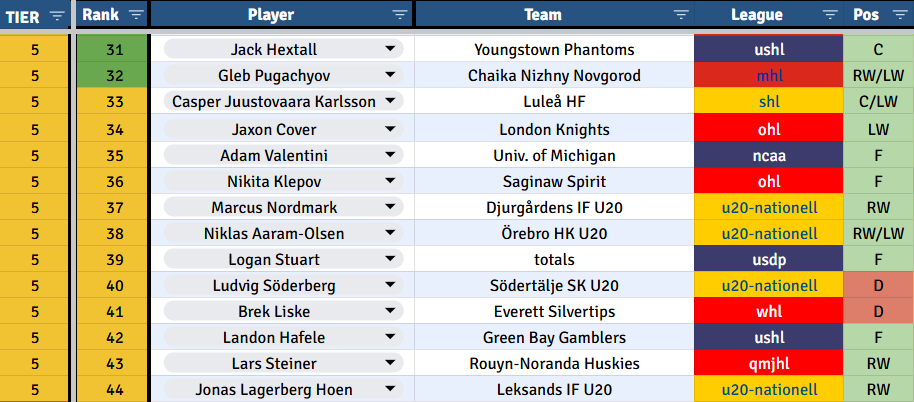
Tier 5 - The Smart, Energetic, Fun Bunch
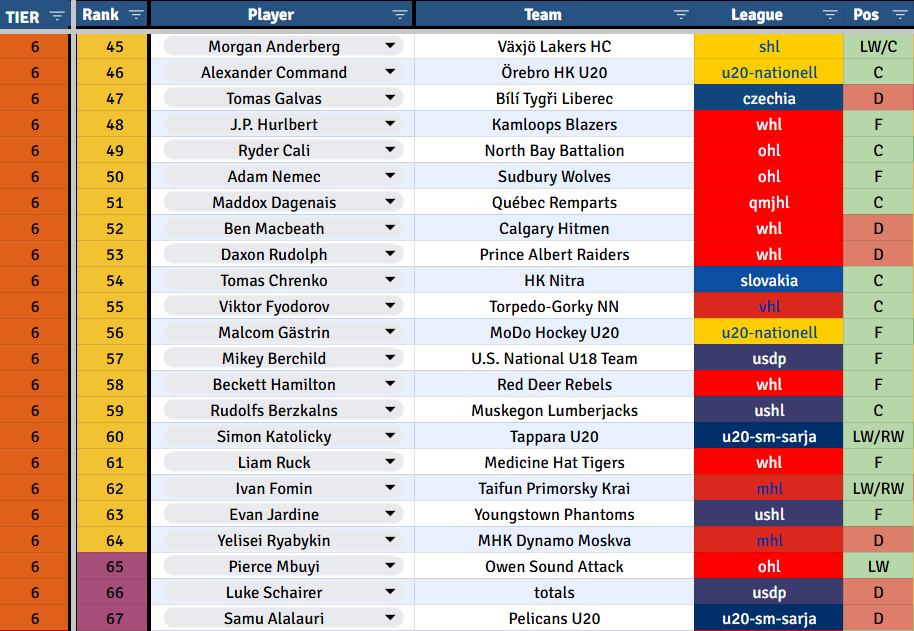
Tier 6 - The Maybes and Big Maybes
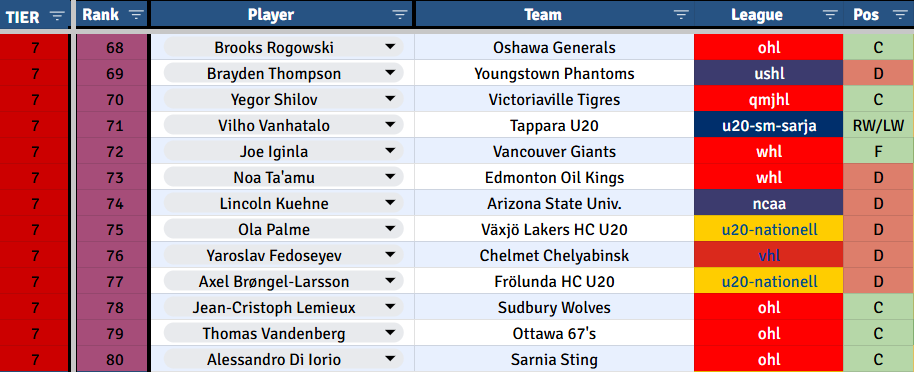
Tier 7 - What’s Your Thing?
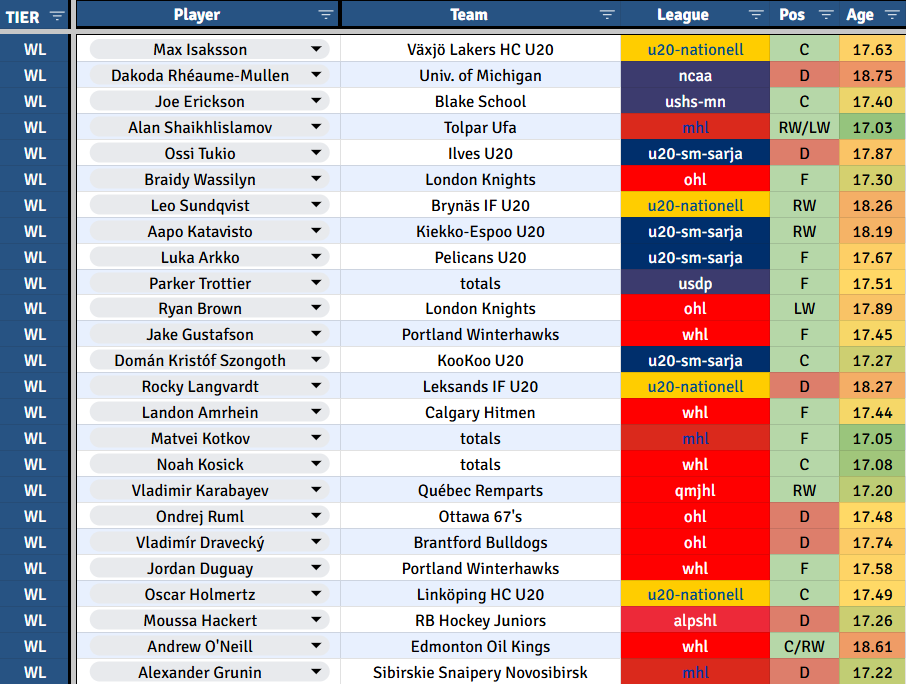
The Watchlist
The Watchlist is a collection of players I’ve enjoyed that I may not consider actually drafting, but show enough where they may be interesting re-entry candidates or late round swings.
Thanks for checking this out! If you have any questions, takes or thoughts, let me hear them on Scouching Live, Monday nights at 8pm EST, and Thursday afternoons at 2pm EST! Subscribe to Scouching on YouTube now!
Goalies
I’m no expert, but I think it’s a pretty strong year for goaltending around the world and these are the names I’ve liked in roughly an order in which I’d prefer them:
Dmitri Borichev
Yegor Rybkin
Tobias Trejbal
William Lacelle
Vladislav Yermolenko
Ryder Fetterolf
Xavier Wendt
Harrison Boettiger
Marek Sklenicka
Brady Knowling
Martin Neckar
Gleb Peshkov
Dmitri Ivchenko
Pyry Lammi
Matvei Karbainov