
2026 IIHF World Junior Hockey Championship Recap
Another year, another brilliant tournament in the books. The 2026 instalment of the IIHF World Junior Championship might be looked back on as a classic tournament featuring a bundle of NHL-level talent that could have long, storied careers that to many had there start here in Minnesota. Over 30 players are eligible for the NHL Draft for the first time in 2026, which is quite unusual, but more unusual is that many of those 30 were among the key players for their teams, if not some of the most important players in the tournament. Latvia nearly shocked the Canadians again, the Czechs did shock the Canadians again, a talented USA team hit the notorious Finnish Wall, and many other teams did nothing but battle their way to the result they earned. Names like McKenna, Björck, Stenberg, Verhoeff, Reid and others made names for themselves with those who don’t follow the draft as much as us junkies, and the level of excitement for the upcoming event in June is absolutely starting to percolate. For whatever it’s worth, a huge thumbs up to every athlete, coach, organizer and manager involved in this event. The coverage in my country (TSN in Canada) was second to none, nearly every game was entertaining, and this tournament continues to be a treat during the holiday season. To the Swedes who pulled off their first medal since I was in University, a huge congratulations with an all-time high quality team that shook off perceived demons and marched their way to the championship. The Czechs came so, so close to making history after another incredible win over Canada, with arguably the best roster they’ve brought in a very, very long time. The Canadians fully deserved their bronze medal result with a commanding performance against Finland after falling just short of knocking off their Czech enemies in the semifinal. Finland had a championship quality team if you ask me, and going home with no hardware in a tournament this competitive is absolutely not a failure.
To recap, we’ll take a look at each individual team with some thoughts I came away with, and hand out my personal awards at the end! Thanks so much for stopping by, and catch us on YouTube for Scouching Live Mondays at 8pm and Thursdays at 2pm! If you’re able, consider subscribing to the site to get some cool perks and data you won’t get anywhere else.
Relegated - Denmark
MVP - Oliver Dejbjerg Larsen (F)
My #10 ranked team that was well behind anyone else this year unfortunately ended up relegated as expected. They made things interesting for a time in their relegation match against Germany before a 4-1 third period loss, but staying in the tournament was just not in the cards. Giving up 36 goals in 5 games while scoring a third of their goals in the relegation game is not a recipe for success. Anton Larsen stood tall in net, facing no fewer than 36 shots in a game, doing what he could to keep his team in contention, so we’ll have to see if his performance makes any waves with scouts going into his first year of NHL Draft eligibility. Other teams were just too physical, fast, skilled, and intense for the Danish to really push back over long terms, but there were stretches where they found ways to get through opponents and create offense, especially some big goals from my near-MVP of the team William Bundgaard. I’ve seen him play here and there over the last few years and his size, shooting ability and net-driven offense stood out, with slot passing under pressure and helping push the game in the right direction as best he could for his roster. Linemate Oliver Dejbjerg Larsen lands my MVP pick though, with a level of pace and skill that many teammates lacked that found him on the scoresheet more than anyone else. Impressively an even plus-minus on a team that was routinely blown out, Larsen drove play well and had strong inside playmaking that tried to generate some level of offense for his group. The Danes have a number of players eligible to return for next year’s Division 1A tournament, including Larsen and… Larsen… but the competition might be tough for them to return in 2028. It isn’t impossible, so we’ll have to wait and see, but the team that was likely to be sent back to Division 1A was sent back to Division 1A, and it wasn’t particularly close. The surprise berth last year is something to be proud of, and lining up against teams like Canada and Finland is no small feat.
Saved in Relegation - Germany
MVP - The Goaltenders
As expected in my preview post, this team was not necessarily gifted up front, scoring the fewest goals of anyone in the preliminary round before blowing out Denmark to stay in the top division, but their goaltending trio certainly helped them tread water including potential returnee Lukas Stuhrmann who faced a shot per minute in relief during an 8-1 drubbing against future champions Sweden. Just 11 players on the roster registered a point, but there were still some key contributors who led whatever pushback the Germans could muster. It was fun to see Dustin Willhöft back in the black and yellow, zipping and zooming around the ice, creating great chances with his high energy in a small form factor, and will likely be a key factor in the 2027 tournament after a 7 point performance in Minnesota. NHL Draft picks David Lewandowski, Carlos Händel, Maxim Schäfer all performed admirably too, Schäfer especially in my view. Big, strong, powerful skating with pro-style net-driven attitude certainly was a net benefit for his team and filled in a key gap and was part of a smart strategy to literally try to push back the opponents as best he could.
Picking a single person as MVP is too tricky so I went with the three goaltenders they brought. I’m surprised they rotated through all three, but they all showed exceptionally well, especially Lennart Neiße. Appearing in two games, facing the equivalent of just short of 50 shots a game, and still having a .900 save percentage is nothing short of miraculous and you wonder what sticking with him for the whole tournament might’ve led to, but right behind him was 2025 starter Linus Viellard with strong performances of his own, including landing the key win against Denmark in the relegation game. Germany wasn’t a particularly threatening quarterfinal team, but they were a class above the Danes, which is all they needed to stay up in the tournament. Four point performances from Willhöft and Lenny Boos catapulted them into next year’s tournament, but looking at their returnees and the future of German hockey at the junior level, we might be looking at a similar result in a year barring some heroic goaltending from Stuhrmann.
Quarterfinal Elimination - Latvia
MVP - Alberts Smits (D)
Once again one of the youngest teams in the tournament, the Latvians certainly had a tournament to remember on some level. A stunning late tying goal against the Canadians and holding them to a 2-1 win in overtime is something to hang your hat on. A victory over Denmark is all they needed to punch a ticket to the quarterfinals before being dispatched by the future Swedish champions in a 6-3 loss despite a strong third period effort. Goaltender Nils Roberts Maurins was strong at times but inconsistent, although all things considered, Latvia’s offense trailed everyone else in the group by at least half by the end of the preliminary round. It’s quite difficult to keep the goals against average under 2 when you’re facing nearly 40 shots a game in most competitive matches. Bruno Osmanis was certainly a key player with the trademark speed, skill and quick release from mid-range being a weapon for the Latvians as he continuously chipped away at teams one goal at a time here and there. 2026-eligible big centre Rudolfs Berzkalns picked the best possible time to land his only point of the tournament, tying Canada with under two minutes left in a 1-0 game, and other large names Kristers Ansons and Olivers Murnieks often found lumbering into traffic, attacking defenses and landing good scoring chances. The eyeballs were on none other than Alberts Smits, and in my books he did not disappoint at all with smart small-area passing work, strong rushes through the neutral zone, and trailing only Germany’s Carlos Handel in average ice time in the tournament. He was given a huge role and for a barely-18 year old defenseman on this team, he performed amicably. The skill, offensive zone attacking mentality, and calm presence were highly noticeable. As a group, the Latvians came together and fought to stick in games as a unit to mixed results. 2027 draft-eligible Roberts Naudins also flashed some strong moments of strength and power that caught attention here and there especially jumping from prep school hockey to this kind of a stage. Naudins, Murnieks, Berzkalns and Smits all are certain to return next year, and luckily those names were among their best. Will it be enough to win their first quarterfinal at this level? It may all come down to goaltending with untested Ivans Kufterins eligible to return but the intriguing Patriks Plumins poking around acting as Kufterins’ backup in the 2025 U18 World Championship.
Quarterfinal Elimination - Switzerland
MVP - Lars Steiner (RW)
I may need to learn to stop underestimating the Swiss in this tournament. They were surprisingly effective last year, but this year was a totally different level. There was a real thought in my mind that the Swiss might be able to knock the Czechs out of this tournament in the quarterfinals, and I might have taken things a little too far in that regard. While they were dispatched easily by the Czechs 6-2, the Swiss were a rag-tag, aggressive group of players who pressed opponents above their weigh class effectively. They were speedy, aggressive on the forecheck, and what they may have lacked in dangerous offense, they certainly played the shutdown role effectively. Victories over Slovakia and Germany aside, the Swiss nearly stunned the Americans in a 2-1 loss, and held an elite Swedish group to a 4-2 score. There were strong performances on the defensive end from the skilled Leon Muggli, dynamic and shifty Ludvig Johnson, and a surprisingly gritty performance from Daniil Ustinkov that helped keep the team hanging around more advanced competition. Christian Kirsch and Elijah Neuenschwander, both NHL Draft selections stood dependably tall in net, and through it all the Swiss may very well have simply just fallen slightly short of matching the truly best in the tournament.
Lars Steiner took home my MVP award as he played with some great physical energy, serious power off the wings and looked much, much more like the player I remember from before his injury earlier this season. It was a true return to form for him and he was rewarded as one of their leading scorers. He may very well be a major player in the 2027 tournament if his quickness takes another step and has a finisher to lob the puck to. Switzerland lacked a true goal scorer with just two players scoring two goals to lead the way, and the addition of one or two real finishes might unlock some serious headroom for thsi group next year. The eyeballs were often trained on 2027 eligible Jonah Neuenschwander who was back for his second World Junior Tournament. In fact, if Neuenschwander returns as many times as he could, he will set the record with five appearances at the tournament. Last season I felt Neuenschwander was a bit raw, physically outmatched and lacked a true separation skill at this tournament, that’s understandable considering he was just a very large 15 year old. This year, he’s added a whole new level to his game thanks to his experience at the National League level. He’s approaching 40 games of experience in one of the toughest leagues in the world, and you can clearly see the benefits. He looked faster, stronger, much more effective at protecting the puck, and while he only landed a single assist here, he still showcased a combination of size, skill, and pace that absolutely bodes well for his future as a prospect. He certainly made himself a curiousity at the very least, if not a very strong contender in next year’s class, and a staple of this team in next year’s tournament. It’ll be a big test in 2027 however, as all three goalies and all but 5 skaters are ineligible to return. There will be plenty of new faces, and Switzerland hasn’t been earth-shattering in the U18s, but there will be some bright names leading the way and hopefully can surprise once again.
Quarterfinal Elimination - United States
MVP - James Hagens (F)
In the Russia/Belarus-free era of this tournament, there is always going to be at least a single team that is capable of taking home gold that gets sent home in a quarterfinal. This season it was the repeat champions from the United States. It was a painful, bitter defeat at the hands of the Finns in overtime after a miraculous Ryker Lee goal to tie the game late in the third period. To come so close and fall so short is a disappointment, but I’m glad to see there doesn’t seem to be too much of an overreaction to this result. This American team came in a little weaker than years prior, especially outside of their very, very talented forward group with somewhat questionable goaltending on top of it all. In this tournament that’s a difficult hill to climb, and unfortunately for the States, it just wasn’t meant to be. That having been said, there were absolutely some stellar performances to keep in mind. Cole Hutson was once again tremendous in the three games he played, thankfully not missing a step after a dangerous looking puck to the head and ending up in the hospital. The rush speed, skill at that speed and ruthless offensive pace is a sight to behold, and my kicking myself for underrating him a bit too much continues through 2026. He really came alive during his draft year into his U18 and ever since he hasn’t looked back. I wouldn’t be surprised if we see him in a Capitals uniform by the end of the year and he’ll certainly have some great mentors there who should be able to line up with his style of play perfectly. Jacob Chychrun comes to mind as a high offense, shot heavy presence on the blueline, and the league is better when there are more Cole Hutsons in it. Will Zellers found himself on the scoresheet more than twice the amount of anyone else on the team, which is par for the course for the smart, aggressive finisher who clearly benefitted from a talented group of skilled playmakers around him. I also really enjoyed watching Brodie Ziemer, who wearing the captain’s C did not look out of place as the smart, well-rounded possession hound with good pace in his game and more than enough physicality, skill, and deference to linemates to make things move in the right direction. The line of Teddy Stiga, L.J. Mooney and Ryker Lee might have been one of the most delightful in the entire tournament, with ridiculous amounts of energy, speed and skill that certainly had their share of big moments on both sides of the puck. The physical players also were standouts, as I felt A.J. Spellacy deserved a bit more puck luck thanks to his raw motor and strength, driving the net constantly and only landing a single goal for it. Shane Vansaghi had his fair share of destruction on the ice as well, as did William Horcoff and even LA Kings pick Brendan McMorrow. Almost the entire forward core was a ton of fun to watch, and from top to bottom there was something to take home.
The defensemen on this team were better than expected, and I was pleased to see how much trust Luke Osburn got, at times on the powerplay, and quarterbacking great rushes with his fluid footwork, skill level and a heck of a shot from the point. There was no production, but I remain a big fan of him. Draft Nerds will obviously be focused on Chase Reid of the Soo Greyhounds, who I felt had a very strong tournament that firmly put him in the conversation of some of the best defenders in the draft. While I believe he trails the poise, calm nature of other names like Hakansson and Piiparinen in this class, he brings a skill level and puck protection ability that makes him much more of a lethal offensive threat at the moment, and you absolutely saw that as Reid found plenty of success quarterbacking the American powerplay. There is a very intriguing player here, and this only feeds into how exciting this draft class is to watch.
The Americans may have had their tournaments cut short by the Finns, a story all too common over the years, but they absolutely showed a tremendous amount of talent that should bode well for the American National program for the years to come. Picking an MVP was basically impossible as this team largely won by committee, and Hutson was a close selection, but the constant aggressive and speedy threat of James Hagens really caught my attention. The budding physical game he started to develop last year came into focus more in this tournament, and he continues to show high end playmaking tools that elevate everyone he plays with. It was a tough call, but on a group like this, Hagens seemed to stick out just a hair more than others. As a team, the speed, skill, flash, and excitement that this group brings will always stand out, and from my perspective watching this year’s U18 club, there’s more of that on the way…
Quarterfinal Elimination - Slovakia
MVP - Tomas Chrenko (C)
For the 10th time in 11 years since winning a bronze medal in 2015, the Slovaks were once again eliminated in the quarterfinal. On the bright side, they brought the youngest team in the tournament, and some of their best performers were among the returnees. Up front, I felt Samuel Murin showed some really speed and physicality that teams like Slovakia desperately need, and Alex Misiak, Andreas Straka, and Tobias Tomik all brought clever passing ability and systemic playmaking talent. Matus Lisy showed his mobile, skilled abilities on the defensive side of things, and while Adam Goljer had a bit of a rocky tournament, he’s still quite young with plenty of development time left, and still showed defensive smarts that should grow in the coming years. Luka Radivojevic looked every bit as skilled, fluid and creative as I remember, but even more aggressive and high-pace than he was last year. He may be a bit small, but I think his play at this tournament warrants a close look at his play with Boston College. He was slippery, quick with his decisions, and finished over a point a game quarterbacking a surprisingly threatening Slovak powerplay. Adam Nemec, another 2026 eligible also performed well with his highly intelligent pass-first game, aware of surroundings and driving play effectively for the Slovaks. My MVP of the tournament, Tomas Chrenko fell just a goal short of tying for the scoring lead, thanks to a hat trick against Germany and landing two against the Americans a few days later. Chrenko certainly boosted his profile here, even aside from his shooting ability, with a skill level and creativity unlike many of his peers. The big question remains if he can project to NHL level pace of play, but for the time being, he looks to be a serious asset for the Slovak national team for next year. As is tradition, personal favourite Michal Svrcek had so many looks and opportunities but just couldn’t find the back of the net. The Slovaks had fewer really great scoring chances against Canada than you can count on two hands, but the one starting and finishing a few of those sequences was Svrcek, thanks to his tireless effort and skill level. I was screaming for him to shoot the puck more on the powerplay than he did, but I guess when you’ve got a shooter like Chrenko and an offensive defender like Radivojevic out there, you’re not the highest priority. I’m still a big fan and felt he showed well, but he’s had a rocky year and am hopeful for a big back half after this tournament.
It’s very likely that this Slovak team might be enough of a threat to medal next year, honestly. They’ve gotten to three straight bronze medal games at the U18s, and their 2007 and 2008 group seems primed to be a tremendous group for next year. Pradel and Henriquez are strong goaltenders who will return. Chovan, Svrcek, Straka, Misiak, Dubravik, Nemec, Chrenko, and Tomik are almost three full lines of competitive forwards. Goljer, Lisy and Kalman are more than capable defenders with Radivojevic who may have played his way back into NHL Draft discussion this year. Lucian Bernat, Matej Stankoven, and 2009-born Oliver Ozogany could also be very big additions to the group, and it would be foolish to underrate the 2027 group. This year’s team set the stage and provided valuable experience to valuable names, and I already can’t wait to see what they can do in Alberta next year.
4th Place - Finland
MVP - Petteri Rimpinen (G)
It may seem disappointing to go from a silver medal to a 4th place finish, but I believe this year’s Finnish group is something of a return to form, and sets the stage for at least one very, very strong group coming back for 2027, and hopefully beyond. Their gold medal hopes came down to the only shootout finish of the tournament, and after nine long, dramatic rounds, they came just about as close as you possibly could. The Finns were heavy, hard, but had some really impressive skill, especially on the defensive side of the game. Aron Kiviharju put an exclamation point on his junior career with an excellent performance, showcasing the creativity and skill that he’s always had, but at a breakneck speed with mobility that it seems has really improved since his draft year. Personal favourite Daniel Nieminen had a strong tournament, looking way more physical than I remember, and even if he ended up off the scoresheet, he still landed a player of the game performance against the mighty Swedes. Arttu Välilä played the hero, scoring the decisive overtime goal against the United States, and landing his other goal against the Canadians in their bronze medal loss. He was dynamic, fluid and confident, and definitely showed better than I expected going in. Emil Hemming reminded us all that he’s still playing like a first round pick, combining size, skill, shooting ability and strength well, and making an impact often even if he wasn’t leading the team in scoring. The Finns were the traditional heavy, physical and team-focused group that has led them to victory in years prior, with peripheral talents that carried quite a bit of exciting skill, like Jasper Kuhta, Leo Tuuva, Matias Vanhanen, and Joona Saarelainen.
Had that shootout just tipped the other way like it so desperately could have, I think there’s a great chance this group beats the Czechs at their own game in what would’ve been an epic gold medal matchup, but hockey is fickle, and shootouts can be unpredictable. It was a hard fought, well earned finish for the Finns, and while there was no hardware, this was an exciting and impressive group that had as good a chance as any to win the whole thing. Like Slovakia, some of Finland’s key performers are likely to return, even if just 7 names are eligible. Lasse Boelius flashed some of the skilled offensive ability he’s always had, and Max Westergård and Matias Vanhanen were major sources of skill and pace that Finland desperately needed to be successful. The really intriguing bit is going to be the return of Oliver Suvanto and Juho Piiparinen, who were both standouts in my opinion. Suvanto went so far as to be named one of the best performers on the team with his humongous size and great smarts up the middle of the ice. The next tournament likely brings names like Oscar Hemming, Vertti Svensk, Ossi Tukio, Samu Alalauri, Jere Somervuori and others who should all be exciting additions that keep Finland firmly in the discussion of gold medal contenders. There may not have been hardware for the Finns here, but a failure this tournament was not.
Bronze Medal - Canada
MVP - Michael Hage (F)
After two years without a medal, Canada finally found their way back to the podium, taking home the bronze. The Canadians were simply offensively dominant for long stretches of the tournament, scoring no fewer than four goals in all but one game. A bizarre, 2-1 overtime win over Latvia aside, the Canadians were an exceptional group of scorers as expected, backstopped by a pair of high end goaltenders who kept them in games at key moments time and time again. Unfortunately, this tournament always becomes a game of individual wins, and Canada fell flat in the match that mattered most, failing to dispatch their Czech rivals once again in a 6-4 semifinal loss. It was a shattering result for a team with gold medal aspirations, but this was not a team without weaknesses. The Czechs put on a forechecking masterclass, driving through the Canadian defense consistently, attacking defenders down low and Canada significantly struggled to get breakouts moving, leading to too many turnovers and 50/50 situations that turned against them over time. That said, if this team got the puck past the centre line with possession, you were toast. If you took a penalty, you were toast. They were 50% on the powerplay. They landed 12 powerplay goals, and shot 17% overall, and had the second best penalty kill in the tournament behind the Swiss’ ridiculous 94%. While the 3rd period of the semifinal against Czechia got out of hand and disappointing for both the team and fans alike, this was not a Canadian team marching to the penalty box time and time again like years past with just 21 shorthanded situations faced, putting them right in the middle of the tournament, and we saw the benefits of such an approach with just how ruthless this team was against their opponents. They easily handled the Finns in the bronze medal match, marching to a perfectly acceptable results considering the strength of this tournament in 2025.
Michael Hage was absolutely sublime, with ridiculous skill and transition pace that they desperately needed, and paired very well with likely top 2026 NHL Draft pick Gavin McKenna. For many, this was an opportunity to see him for the first time, and while I’ve been skeptical of his game this year and he isn’t my #1 at the moment, you definitely saw what makes him so special, and what can make him a bit frustrating. The creativity and pure skill level are easily 10/10. Making plays and offensive zone awareness, especially on the powerplay is truly second to none. He’s an incredible playmaker to say the least, and there’s plenty of value there, and I certainly am not jumping on the trope you’re seeing of McKenna being some kind of enormous bust or disappointment. To me, he was Gavin McKenna. You get what you get. At times, he’s special, elite, unique and absolutely automatic, and at others, you may be pulling your hair out. There are players like that in the NHL, and he remains a top tier talent in this year’s draft, but to see others slowly drift towards my conclusion that this class is more open-ended than we think is selfishly somewhat assuring. The Canadians got great performances out of almost every forward given the roles they were in. I can’t really sort through the list and be picky. From Iginla, to Beaudoin, to Martone, to Misa, to O’Reilly, to Reschny and beyond, by and large, it may have been one of the most talented offensive groups we’ve seen in years in all the different ways you can score in this game.
All that having been said, I think it’s high time for many to realize that this is just the new reality we are in. Since Canada went to 10 straight gold medal games in the 2000’s into the 2010’s, they’ve appeared in 6 in the last 15, failing to medal in 4 tournaments. Just like any other team, the Canadians are likely to have areas of strength, and areas where they are equal to or trail their competition on any given roster, and the Czechs have masterfully handled what seems to be repeated issues with the Canadians over the last three years. There has been a lot of talk about what Canada could do to “fix” things and return to hegemony, and I worry that the issue is far too structural, decentralized and nuanced to find a way to be dominant and surpass the world like they did in my youth. If I had to pick one area that is a consistent worry, it would be on the defensive end of the game. There was plenty of skill, plenty of finishing ability and plenty of creativity from many defensemen on this team this year, but one discipline I’ve noted the Czechs mastering is forcing Canadian defensemen into unfamiliar defensive zone situations under pressure. If you watch teams like the Czechs and Swedes, you notice how many times the defensemen are patient with the puck, making reads on retrievals and using partners effectively to maintain possession, and opening space off the puck and utilizing it effectively. There seems to be a major focus at getting the puck up the ice as much as possible, and under strong forechecks, you end up panicking and flipping the puck 40 feet in the air, hoping a Michael Hage snags it in stride and attacks the offensive zone. I could be wrong, but it really didn’t feel like there was as much of that with the best of the best in this tournament. The actual defensive zone coverages and rush defending were also areas of weakness that I’ve noted in my own work with CHL defenders over the years, and I still remain steadfast that there is a fundamental misunderstanding what makes a defenseman effective, and how to analyze them at this age. The ability to use footwork and lateral motion to guide play to the boards, stay calm but keep gaps tight, and defending with the feet and stick, not the arms and reach are major factors that drive good results, and it seemed that that was another key weakness for this group.
The Canadians weren’t “bad”, they didn’t “fail”, they aren’t “busts”, nothing like that could be further from the truth, but this tournament was simply exceptionally competitive, and Canada, like any other team, was not perfect and had gaps. When they weren’t in the driver’s seat, which wasn’t often, their opponents found ways to break them down and get through to the final. A bronze is a great result, and the future continues to look bright. Jack Ivankovic is likely back and will be a huge part of the team next year. Keaton Verhoeff, Cole Reschny, Braeden Cootes, Brady Martin, Caleb Desnoyers and perhaps even Gavin McKenna will return, and there’s plenty more on the way from the 2007, 2008 and even 2009 age group that could push this team back to gold medal contention. A fantastic team that was tremendous amounts of fun to watch, but like anyone else, they are not invincible, and someone has to lose a semifinal game.
Silver Medal - Czechia
MVP - Tomas Galvas (D)
Before the tournament I was very clear that this is a gold medal calibre team, and clearly I was onto something. The Czechs have a brand and they stick to it. Despite less than stellar goaltending, it almost didn’t matter, as the Czechs played an exceptional shut down game, led by a great group of defenders that stymied opponents time and time again. Adam Jiricek and Tomas Galvas were absolutely stellar, combining good defensive ability with skill, creativity, and raw energy that was exciting to watch. Radim Mrtka and Matyas Man showed strong defensive ability, standing tall and shutting down play, and I wouldn’t be surprised to see Man get some consideration as an NHL draft pick. I’ve liked him going back to last year and while he may be a longshot, there’s a simplicity and effectiveness in his game that absolutely stood out. Up front, the Czechs were lethal at times, with excellent performances from Adam Benak, Vaclav Nestrasil, Tomas Poletin, Max Curran, Petr Sikora, and 12 point tournament MVP Vojtech Cihar. Cihar came up huge with two goals against the Canadians, but this was a deep group of very strong talents across the spectrum of this sport. Some were more physical, some were more skilled, some were pure speed, and some were a well-rounded combination that simply got the job done.
While Cihar got the MVP nod, I cannot help but be absolutely thrilled with Team Scouching favourite Tomas Galvas. Listed as the name I would’ve taken at 200th in the 2024 draft, Galvas once again showed why NHL teams should take a flyer on him. He led the tournament in scoring from a defenseman, but where Zayne Parekh was a shot-first, confident attacker, Galvas was a clever, sneaky and skilled presence who was wandering into scoring areas, making plays down low, while chipping in very well defensively. Cihar was great, and definitely great when it counted, but in my view the real success of this group stemmed from the best names on the backend, and Galvas led the way. Jiricek would also be an acceptable option here, but boy was Galvas ever cooking all over the ice in every game. He isn’t eligible to return next year, but I would not be surprised to see him on the men’s national team at some point in his future, if not in an NHL sweater. I’ve loved him for years and it’s nice to finally see him get some good looks. On a similar note, what a great performance from Adam Jiricek, just as many were forgetting about just how promising he was looking before a gruesome knee injury ended his excellent 2024 World Junior. He really seemed like a comfortable, smart, and dangerous two way threat that is a trend I hope continues into an NHL career with St. Louis in the near future.
The Czechs are clearly stamping themselves as a force to be reckoned with once again, and with 12 names eligible to return, including Cihar, Nestrasil, Benak, Mrtka, and draft eligible Adam Novotny, it’s entirely possible that they end up right back in a gold medal game. Two strong goaltenders in Marek Sklenicka and Frantisek Poletin are on the way to fill their key weakness, but you should absolutely look out for Dominick Byrtus, Ondrej Ruml, and 2009-born Lukas Kachlir to fill in the shoes of Jiricek and Galvas, and a potential top 2027 pick in Petr Tomek also waiting in the wings for next year’s tournament. The Czechs aren’t going anywhere, and I can already tell that they’re not to be underestimated in Alberta.
Gold Medal - Sweden
MVP - Ivar Stenberg (RW)
For the first time in over a decade, the Swedes have flipped off the hockey world and won themselves a World Junior gold medal. This year’s group was truly special in so many ways. Tournament-best consistent goaltending from Love Härenstam with some excellent modern possession-style defenders in front of him, with a balanced group of physical, skilled and competitive forwards ahead of them, the Swedes gained steam as the tournament wore on, with just two games finishing a goal ahead. Their debut against Slovakia, and their shocking semifinal shootout victory over Finland. Yes, they came a hair’s width away from ending with a bitter bronze medal game appearance, but… they didn’t, and they clamped down and controlled the gold medal game against an excellent Czechia roster, using their firepower to attack their weakpoint on their way to a championship.
So many names on this roster stood out. Alfons Freij was sublime, with excellent puck skill and a great mind for how to use it, creating offense constantly and absolutely reassuring me of my bullish ranking of him back in 2024. Sascha Boumedienne was highly creative and had some impressive offensive zone moments that were among the best in the tournament. Anton Frondell has a cannon of a shot and we saw it time and time again with a heavy, physical style of play that should be able to transition to the NHL seamlessly. Captain Jack Berglund was also a pleasant surprise for me, with a great combination of physical tools and skill, bulldozing his way to the net countless time and bringing a dimension that this team has been looking for to get over the hump. Victor Eklund was just as impressive and exciting as he was last year, and while he can’t be on the 2027 roster, he certainly made a name for himself as a premier forechecker that was behind a tremendous amount of Sweden’s success, complementing the more finishing-oriented names he shared the ice with.
The real story with Sweden lies in the 2026 draft eligibles though. What an incredible performance from all four honestly. Casper Juustovaara Karlsson, a surprise addition even to me, showed exactly why he was there with a physical forechecking game with some net-drives that led to some key goals for the Swedes, including the opening goal in the gold medal match shorthanded. William Hakansson was not only humongous, but mobile, stable and flashed that rush offense that makes him so intriguing offsetting some of the more finesse and skill-oriented defenders on this team. Viggo Bjorck and Ivar Stenberg though, oh my goodness what a pair of talents these two are. Bjorck was one of the few 2026 eligibles that blew out my expectations here. I thought his size and lack of high end quickness and agility would be limiting factors at this tournament but the smarts trumped everything. Slick passes, careful timing, deceptive skill, and an underrated off-puck game were all top-tier abilities from start to finish. He’s only gotten better and better since last year, and he has quickly risen up my board in the time since and I strongly believe he isn’t all that far off the top group in this class, especially with his developmental trajectory being a smaller member of his family and still a young-ish name for the draft. Ivar Stenberg on the other hand absolutely solidified himself at #1 on my board for the time being. He was there before the tournament, and he’s still there now. The two-way, dual-threat offensive game he brings is simply second to none. I’m not sure he’s truly a superstar level, top of the league quality play driver, but he seems to just always know what to do to keep play moving forward. He’s not as hyperskilled as McKenna, but I think he uses his skill level in much more realistic and practical ways through traffic and along the boards. He’s not the fastest player in the world, but he protects the puck so well and finds passing lanes so easily, that as a complimentary forward, there isn’t much more you could want out of a guy. There’s a real Seth Jarvis-type vibe out of him to me, and while that might not sound particularly appealing as a 1st overall pick, I think this draft is a large group of players at the top that have similar values to that level of NHLer. A top-tier offensive talent with enough defensive ability to flex that talent. He started slowly, but once the playoffs hit, he just kept snowballing as his confidence rose, culminating in a three point gold medal performance that cemented his status as a premier prospect for this upcoming draft. The best part? He can, and very well could come back next year. Not only can he come back, but Boumedienne, Harenstam, Frondell, Nilson, Genborg, Bjorck, and Juustovaara Karlsson, are all among the names that could be on this roster next year looking for a repeat. It’s an exciting time for Swedish hockey, and I already can’t wait for the next iteration of this tournament to see how things shake out for all these countries.
Will’s All-Star Team
Ivar Stenberg (SWE) - Michael Hage (CAN) - Victor Eklund (SWE)
Adam Jiricek (CZE) - Tomas Galvas (CZE)
Love Harenstam (SWE)
MVP: Ivar Stenberg (SWE)
”Who Dat” Player of the Tournament: Vojtech Cihar (CZE)
Biggest Surprise Performance: Jack Berglund (SWE)
Scouching’s 2026 World Junior Hockey Championship Preview
We’re back for another year of the World Junior Hockey Championship, and this time we’re going to the State of Hockey, Minnesota, USA. A place I’ve always dreamt of going, the setting alone sets the stage for what could be one of the classic World Junior Championships. I’m always excited for this tournament, but this one is different. A significant number of 2026 NHL Draft prospects aside, these rosters are really, really close in terms of paper value in my books, especially from my #2 team to #5, and potentially even my #6 if things go right. I can’t recall the last time I had this much trouble ordering and ranking these teams, and it only got harder and harder the longer I worked on this. Every team brings some kind of advantage over another, and it could all simply come down to a bounce here or there, or a goaltending performance for the ages and things get completely flipped upside-down.
There are 30 players on rosters at time of writing that are eligible for the 2026 NHL Draft, and while quite a few are on lower-end teams and unlikely to be picked, the number that are on medal contenders is definitely higher than usual. So if your favourite NHL team is struggling, watch as much as you can because almost every team has something you can probably take home with you.
Before we get into the writeup, just a note that “AvgNHLeS” is a league, position and age-adjusted “score” of a player’s production but it isn’t a be-all-end-all and is useful for a baseline analysis. Enjoy the writeup, enjoy the tournament, and have a great holiday season!
10th - Denmark - 4.01 Avg. NHLeS
Player to Watch - Mads Kongsbak Klyvø (LW)
As much as I love travelling to Copenhagen and bobbing around Denmark on DSB trains, I would be stunned to see Denmark stick in this tournament after this year. Last season’s Division 1A victory came as a serious surprise to me with a strong group of NHL-Draft quality Norwegians falling well short of expectations and delaying their appearance in the World Juniors until 2027. The Danes are bringing a number of depth Metal Ligaen players and a handful of Swedish junior league names of varying quality. Defenseman Emil Saaby Jakobsen might be a curious draft eligible name, entering this tournament with high production in the lower tiers of Swedish junior hockey, but having checked him out a bit, I’m not convinced he’s going to be able to carry this group on his back. He has an intriguing set of feet that he uses to cover ice laterally well, especially with some decent skill with the puck, and certainly a willingness to put the puck on net, but he hasn’t played at a level comparable to this in his life. The only notable name on this roster is big winger Mads Kongsbak Klyvø with a powerful, nasty game that may be able to push back against some of their opponents during this tournament. The Florida Panthers draft pick has yet to dress for a game, but has managed to bring some level of impact in the warmup games Denmark has played to this point. A recent 6-1 loss to Switzerland with fewer than 10 shots on goal along with three straight losses in November to Norway, Latvia and Austria by a combined score of 16-4 doesn’t particularly spark a tremendous amount of hope, but the beauty of this tournament is that you never really know what’s coming. It isn’t likely, as goaltending can take you deep in this tournament, and Denmark is bringing inexperienced names with limited exposure to high levels of hockey, and these netminders are likely to face a lot of hockey pucks every game. With Slovakia, Czechia, Sweden and even the Swiss as opposition, the Danes don’t have an “easy” game ahead of them, let alone a likely competitive one, and as much as I’ve tried when digging in on this team and reflecting on my notes on their returnees from years prior, it seems very unlikely that Denmark returns for the 2027 tournament barring a spectacular relegation game performance.
9th - Latvia- 8.33 Avg. NHLeS
Player to Watch - Alberts Smits (LHD)
The Latvians were an unbelievably young group in 2025, featuring 14 names with prior World Junior experience, and they contend for the same label once again in 2026. This Latvian group could be a big surprise, just as they were last season after nearly stunning the Swedes in an unexpectedly close quarterfinal matchup. This season however, the Latvians are bringing a number of players from last year who were key players on the roster. Bruno Osmanis and Olivers Murnieks were two of the three players that landed more than two points last season, and gargantuan 16 year old Roberts Naudins is coming in the middle of a very successful year with Shattuck St. Mary’s on the US prep hockey circuit. Roberts Janis Polis has always been an intriguing player in my viewings and Daniels Serkins is likely to play a bigger role after a strong powerplay heavy performance at last year’s U18 and leading the team scoring.
Based on my work so far this year for the NHL Draft, the real names to watch on this roster are returnee centre Rudolfs Berzkalns and potential top-10 defenseman Alberts Smits. There may be a handful of decent offensive names here, but in terms of driving results on both sides of the puck I don’t think the Latvians will rely on others much more than these two. I haven’t been too thrilled with Olivers Murnieks’ play in Saint John this year, but Berzkalns plays a similar but pivotal role in a much more effective way to my eye. His boardwork is high end, he’s huge, has a budding physical edge to his game, but the puck protection and pure speed in his game is hard to ignore. I wouldn’t be surprised to see NHL boards have him higher if Latvia plays him as much as I think they should. A great north/south player with some huge upside, Berzkalns is a player I wouldn’t be shy about playing against some good competition, and I imagine he’ll get plenty of chances to earn that role. Alberts Smits on the other hand might be one of the most hilariously entertaining performances from a defenseman that we’ve seen in this tournament in a few years. Smits is a smart short area passer, running good breakouts and steadily building his defensive game in Liiga, but his offensive zone game is absolutely wild. He’ll attack the net, drift into scoring areas if he sees space, and seems to pick his spots very effectively. He should be a lethal powerplay threat especially working off a shot-heavy defense partner in Darels Uljanskis. Smits has cracked the Latvian National team at points this season and not looked out of place, and his performances at the Finnish U20 level are laughably successful. Going back to junior competition should provide a huge amount of freedom and opportunity and he may very well cement himself as a top selection in this year’s draft class with others as he has with me this season.
The tipping point will be their game against Germany, who will likely be a tough test with a decent forward group of their own and almost certainly stronger goaltending. Montreal draft pick Mikus Vecvanags has had solid international performances and Ivans Kufterins is facing plenty of pucks with Kamloops in the WHL, but I still have more faith in any of the three German goaltenders in my experience. The Latvians, Germans and Swiss are very, very close in my books and as I wrote this, they’ve all swapped positions with one another. I think the Latvians could very well work their way into the quarterfinals and potentially shock their opponents, but the chances are slightly lower than the higher end defense and goaltending in Switzerland and certainly the goaltending in Germany. Smits, Uljanskis, Osmanis, Murnieks and Berzkalns might do enough to make it happen, but I think the real story might just turn out to be the Alberts Smits Party as he likely plays 45 minutes a game locked on the ice for every powerplay.
8th - Switzerland - 8.63 Avg. NHLeS
Player to Watch - Lars Steiner (RW)
Swiss hockey seems to be in a weird spot in 2025. There are some names that are certainly intriguing and have caught NHL eyeballs, but in terms of truly high end upside, depth and growth, there doesn’t seem to be a tremendous amount to chew on. The 2026 Swiss roster is bringing strong goaltenders in Christian Kirsch, Elijah Neuenschwander, both of whom split the net for this team last year, but they were busy with very little support from the Swiss offense. The story may be a bit similar this season, with little in the way of true offensive difference-makers, but if Jamiro Reber finds his pace and drives the net more than I’ve seen, he may make a difference. Loris Wey and Robin Nico Antenen are older names who have been on my radar for their energy and skill level, and Jonah Neuenschwander is a promising 2009-born player with size and puck protection ability that may be able to provide his team a boost. The intriguing group of defensemen may be able to insulate the Swiss goaltending well though, featuring three NHL Draft Picks and a few that fall just short of that benchmark. Ludvig Johnson is a 2024 Team Scouching pick who showed extremely well last year in my view, and earning himself a selection from Utah in 2025. I would expect him to be a major part of the Swiss powerplay, especially if Leon Muggli isn’t fully up to speed after playing just two games thus far this season. A really dynamic, skilled and confident offensive defenseman, Johnson is one I’m certainly watching. Daniil Ustinkov and Basile Sansonnens bring complimentary defensive ability, with Ustinkov bringing high upside skill and pass vision, but he can certainly come and go in frustrating ways. Nik Lehmann is a 2026 Draft Eligible coming out of a full time job in the National League. Not an easy feat for a defenseman and he could also bring some nice complimentary ability, and Niklas Blessing being an older name who can also bring even more offensive pop from the defensive side of the puck. Lars Steiner is the name I’m going to be watching closely. Some of his performances with Rouyn-Noranda this year have been a heck of a lot of fun, throwing his body around a ton, playing with skill through traffic and efficient offensive transition work. I’m not sure how much he’ll score at this tournament, but he’ll be a major player and likely a leader on the ice as a forechecker and puck transporter that will be relied upon to facilitate his team’s gameplan.
The Swiss are a curious group this year. While I don’t think they’re a serious medal contender, they have bits and pieces that could add up to an upset somewhere along the way. Strong goaltending, a relatively deep group of defensemen, and experienced, solid forward group might be able to sqeak something out. Insulate the goaltenders, use your defensemen to drive the puck to the net on the powerplay, and try to tread water at 5v5 would be the gameplan for me. It’s possible, but it may be a 5th straight quarterfinal loss for the Swiss in the cards.
7th - Germany - 6.14 Avg. NHLeS
Player to Watch - David Lewandowski (LW)
The Germans barely scraped their way back to this year’s tournament after squeaking out a relegation game victory over the Kazakhs in Ottawa. I had a front row seat for that game and while I have a soft spot for the Kazakh universe, the Germans are bringing a roster that should have no problem remaining in this tournament for next year, and while a playoff spot may be a bit of a reach, a key victory over Latvia is not out of the question, and from there anything is possible. Germany is bringing a fair number of intriguing players, especially at the forward and goaltending position that may be able to make some waves. Edmonton Oilers pick David Lewandowski is back after a strong 2025 performance with a well balanced offensive game using size and smarts to his advantage and will likely be leaned upon here. His Saskatoon teammate Dustin Willhöft may be small, but he’s dynamic, shifty and highly skilled and could be a good complimentary contributor offensively. Elias Schneider, Gustavs Griva and Maxim Schäfer and three other solid offensive players that have had success in North American junior hockey this season with Schäfer especially bringing some good power forward potential with pro hockey experience. The Kose Twins and 2027 NHL Draft prospect Max Penkin are also coming from long stretches in the DEL this year with some measurable success as well. Likely headlining the team in key moments of these games will likely be Montreal draft pick Carlos Händel. A skilled, aggressive offensive defenseman, he brings some dynamic ability that should bring a boost to the German powerplay and a bit of pop to help their solid forward group.
The real star of the show could very well be in net. While Linus Vieillard is returning from a strong 2025 tournament, all three German goaltenders have shown strong capability and may be able to steal a game here and there. I’ve really liked what I’ve seen of Lukas Stuhrmann from last year’s U18 tournament as well as his performances since moving to the Finnish Arctic Circle to play for Rovaniemi’s RoKi this year. Used to high workloads and keeping his team in games, if needed, he’s a dependable name to call upon. Lennart Neiße is huge, returning from last season’s team, and is doing the same as Sturhmann in the 2nd division of German professional hockey with high workloads and strong results. The Germans may not be a medal threat, but with great goaltending performances, and potentially competitive offensive names, they are not to be underestimated. While I have them penciled in for the relegation game, the split between them, Switzerland and Latvia is not particularly large.
6th - Slovakia - 7.71 Avg. NHLeS
Player to Watch - Adam Nemec (LW)
At time of writing, the youngest team in the tournament could also be one of it’s surprises. Featuring four strong 2026 NHL Draft candidates in Tobias Tomik, Tomas Chrenko, Adam Nemec and Adam Goljer, the Slovaks are bringing a lot of solid talent that could really punch above their weight class. Michal Pradel has been a very successful goaltender for this team internationally, even in high workloads, and two strong goaltenders are backing him up should things not go according to plan. Their 2025 NHL Draft class candidates are also a strong group that I’ve enjoyed watching over the last two seasons. Jakub Dubravik is a speedy attacker on the wing, Andreas Straka brings strong pass awareness, Matus Lisy and Luka Radevojevic have intriguing skill at the defense position that could boots the team’s outlook. Jan Chovan and Tomas Pobezal are also solid pieces to bring that can compliment others.
While my eyeballs will be trained on what the 2026 eligibles can do in Minnesota, one of my favourites from the 2025 NHL Draft in Michal Svrcek is on the roster, and coming from the hardest level of hockey of anyone on the team. Yes, I can Google his production this year too and he’s been pointless at the men’s level, but having seen plenty of him, the talent is undeniable with high end skill, remarkable forechecking energy, an excellent shot and playmaking upside. Brynäs wasn’t using him after adding former NHL talents in the offseason, and Västerås has done nothing but struggle and haven’t used him on the powerplay outside of in one of his games with them so far. I could easily see him be a major player for this team that regains a level of confidence and success that just hasn’t been there this season. With good playmaking teammates, Svrcek could be a serious part of the roster that helps Slovakia go as deep as they can.
The Slovaks are another intriguing group that I think sits perfectly between the Denmark-opponent tier of teams profiled previously, and the potential medal contenders above them. They have the capability and the manpower to surprise the teams ahead of them, and should be able to easily handle the teams behind them. A surprising victory over the Czechs or Swedes could give them a strong matchup in the quarterfinals, and from there anything is possible. That said, this is a group that has lost in the quarterfinals in 10 of the last 12 World Junior tournaments, and while that outcome is likely once again, they have an upstart group of youngsters that might be able to surprise their opponents with some goaltending that has stolen games before. Their U18 team has gone to three straight bronze medal games since being promoted from Division 1A in 2022, and with a number of names coming from the most recent group, this is a team that could be worth betting on the upside if they wake up on the right side of the bed on the right day.
5th - USA - 16.85 Avg. NHLeS
Player to Watch - James Hagens (C)
This might be a surprise to people but the more I looked at the rosters of other teams and compared them to the rosters of the Americans, at the very, very least, this is where the tournament becomes extremely competitive. The NTDP teams of the last couple seasons have been somewhat less impressive than previous classes, but they still have a tremendous amount of firepower that could easily score in bunches with home ice advantage in Minnesota. Don’t get me wrong, there is a good chance this team finds themselves in the gold medal game, but looking at the combination of questionable goaltending and a shallow defense group, that could be a very difficult combination of issues to overcome in a short tournament like this.
On the plus side, Max Plante is a Hobey Baker contender with a solid, smart and high pace offensive game, William Horcoff has been on a shooting bender with the size and frame to eat valuable minutes and raise hell off the puck. James Hagens had an elite level performance last season and hopefully will be paired with his old friend and 2025 Gold Medal overtime goal scorer Teddy Stiga logging plenty of tough minutes. Cole Riserman is an elite finisher, L.J. Mooney will be all over the ice every shift, Ryker Lee has absolutely electrifying skill, and down the lineup they have some serious beef in A.J. Spellacy and Shane Vansaghi. The forward group is as deep as you’ll find in this tournament with all kinds of different brands of player, so scoring goals shouldn’t be to big of an issue for them.
The issues really stem from everywhere else. There are good names here, with Cole Hutson coming off an MVP-level 2025 tournament likely leading the way, it isn’t like there’s nothing. Chase Reid may be a top NHL Draft Pick this year with a smart offensive game that should also help boost the team’s talented forward group on breakouts and in the offensive zone. Logan Hensler and Blake Fiddler are rock solid, inoffensive defensemen who have had perfectly solid seasons with their club teams and should log solid minutes as well. I’m personally a massive Luke Osburn fan, as he’s a player who simply seems to understand the game and see the ice exceptionally well, with skating tools to maximize the potential in that awareness. He’s having a strong freshman year with Wisconsin and I hope to see plenty of him in what will be his last crack at this tournament. The actual defensive suppression ability of this group is a bit of a questionmark. Adam Kleber and EJ Emery will likely be called upon for this part of the game, but balancing which offensive defender’s ice time to sacrifice in order to bring more defensive stability will be key. All-out offense in front of a tandem of Hank Kempf and Caleb Heil might not be the best strategy, even if Kempf is getting plenty of practice under heavy workloads on a weak Notre Dame program this season.
The US could repeat as gold medalists and I wouldn’t be surprised with the firepower on the roster. You can get away with scoring more than the opponent in this tournament, but there are some strong, balanced teams this year that could push the US to their limit. We’re in for an exciting tournament and many of the most exciting moments may well stem from games involving this team.
4th - Czechia - 17.00 Avg. NHLeS
Player to Watch - Adam Jiříček (RHD)
The biggest team on average in this tournament is also the oldest, and are the first in a tier that I could easily see challenge for a gold medal in Minnesota. The goaltending group isn’t quite up to par of the Finns or Canadians, but the roster in front of them is a deep, strong and diverse group of talents that could very easily outwork and outscore any opponent. Vaclav Nestrasil is a big name to watch coming from a remarkable freshman campaign with UMass with size, skill and finishing ability that could be a huge difference-maker for this group. Top 10 NHL Draft pick Radim Mrtka will likely play a ton of minutes and chip in on both sides of the puck, and Scouching favourites Tomas Galvas and Adam Jiříček likely to also be huge parts of the Czech blueline. Pretty much up and down the entire lineup, the Czechs have a strong roster capable of going as far as a gold medal game this season. The weak points are very limited, especially outside the net, and the depth is absolutely apparent. Their defense group might be among the most balanced in the tournament, with a third pair that could be relatively interchangeable with the top pair regardless of who’s on it. 2026-eligibles Jakub Vanecek Jakub Fibigr and Vladimír Dravecký are no slouches defensively, with Max Psenicka and Vashek Blanár being large wild cards that make for a heck of a group that could easily frustrate opponents ahead of them on this list.
The offensive group shouldn’t be slept on either, with names like Jiří Klíma, Petr Sikora, Adam Titlbach and Adam Novotny all bringing slick skill and good energy to the game that could keep up with “better” opposition. Adam Benák has been spectacular with Brantford and should easily be a huge scorer with the Czechs this year. There are just not many holes to poke here for this team top to bottom
The 4th spot for the Czechs is done extremely reluctantly. I don’t like it and have been flipping the teams from 2-5 around a ton in my preparatory work. This tournament can often come down to a goaltending performance and I just don’t have the same trust in their group as I do as names like Rimpinen, Liv, and any of the Canadian names. That said, if they find themselves in a quarterfinal against the Americans, I could see them upsetting them just as they have to the Canadians in years past. It’s going to be an exciting group for the Czechs and I hope they finish higher than this slot, as the team they’ve built has surprised in the past, and look even stronger this year.
3rd - Finland - 10.01 Avg. NHLeS
Player to Watch - Petteri Rimpinen (G)
In terms of NHL Draft talent, the last handful of years haven’t been particularly promising at the high end but 2026 is a different story. Last year’s silver medalists Finland are bringing simultaneously the most experienced World Junior team with 10 returning players, but some very intriguing youngsters for their first appearances at this tournament. Juho Piiparinen and Oliver Suvanto are two personal favourites of mine, and could be seriously impactful for this team considering their surroundings. Piiparinen has excellent defensive awareness and pass vision, and flashes of offense that could be a huge benefit for the Finns. Suvanto is a refrigerator on skates, impossible to get on top of, playing that traditional, typical Finnish style of play to it’s maximum, showing a ton of potential for future growth. Looking up and down the roster, there are still a remarkable amount of really solid hockey players. Max Westergård is a fun, skilled player who should thrive at this level, and Matias Vanhanen is in a similar boat after an exceptionally successful WHL career with Everett. Lasse Boelius is a very skilled offensive defenseman who is daring an confident, and Mitja Jokinen, Daniel Nieminen and Aron Kiviharju augment that defense group in a positive way and could make them more of a threat than other teams might be used to. The Finns have plenty of names that can also play that resilient, physical and team-first style of play that has brought them great success in the past. Emil Hemming, Heikki Ruohonen, Julius Miettinen, Jasper Kuhta, Atte Joki and the aforementioned Oliver Suvanto are large players capable of fighting off the best with their strength and skill.
The success of this team might hinge on individual performances from returnee goaltender Petteri Rimpinen. Rimpinen was simply exceptional last season, turning away 112 of 122 shots in the three playoff games Finland played, and will likely be leaned upon for another strong showing to bring Finland back to the medal rounds. The top group of team is very close, and very competitive, and Finland brings a goaltending advantage that two of the three teams ahead of them don’t carry, and it could easily be possible that they walk away with the gold medals when all is said and done. This country thrives when they need to steal a goal or two to grind out a win, and they have the personnel to do so this season, even if they aren’t my top rated team going in.
2nd - Sweden - 13.74 Avg. NHLeS
Player to Watch - Ivar Stenberg (W)
The Swedish group scores lower, but that’s largely due to a large contingent of SHL talent coming to this tournament, suppressing their numbers on paper. Don’t be mistaken, this is a strong Swedish group at pretty much every position. They’re bringing four 2025 draft-eligibles this season as Sweden is in the middle of a very strong cycle of high-end talent. William Håkansson is a dependable, strong and mobile defenseman with plenty of size and range. Viggo Björck is a potentially dominant pass-first forward that commands open ice and has ruthless offensive ability. Casper Juustovaara Karlsson is an excellent forechecker who can make life miserable for opponents while also showcasing some good skill and evasiveness on the puck. He’s a huge sleeper for me this year’s NHL Draft and I hope he gets to showcase what I’ve seen of him this year against the best in the tournament. Of course, leading the way for this group is Ivar Stenberg, a potential candidate for #1 overall, and as of this tournament, my personal #1 pick in the draft. Stenberg has a special quality about him where the game just seems to come so easily to him. He can do almost anything you need him to. His off-puck reads are exceptional. His forechecking ability is always visible. His skill under pressure through traffic is elite. He spots space offensively well, and his playmaking ability has just grown and grown in major SHL usage this year. As a complimentary two-way winger, Stenberg should be a huge impact player this year for the Swedes this year if grouped with the right set of linemates.
It isn’t all about the kids though. The depth of this team is also second to none with options down the middle including the physical Anton Frondell, the high skill/high pace Milton Gästrin (or Lucas Pettersson for that matter), the intense and brilliant Eric Nilson, the smart and energetic Linus Eriksson, or the the heavy, annoying Jack Berglund, there’s a mix here that should push deep into this tournament. Heck Viggo Björck could chip in up the middle for this team if given the opportunity. Defensively, it’s a deep, solid group featuring dependable two-way presences in Leo Sahlin Wallenius, Victor Johansson and Alfons Freij. Sascha Boumedienne could bring offensive flair along with Felix Öhrqvist as well, pressuring opponents and attacking the offensive zone with skill and creativity.
The goaltending trio might lag behind the rest of the team however. Herman Live has been their go-to this season so far internationally, but he hasn’t shown the level of dominance that other goaltenders have had at this tier. The Goos/Härenstam duo have been shaky at times as well, but in my view all that Sweden needs is competitive goaltending performances. This is a team loaded with various brands of talent from top to bottom, and while there isn’t much separating any of these top five teams, this could easily be the group that finds the Swedes in just their third gold medal game in the last twelve tournaments. It’ll be tough, but it’s very achievable. At the very least, draft geeks will get a look at some of the more underrated names in the class.
1st - Canada - 21.89 Avg. NHLeS
Player to Watch - Gavin McKenna (LW)
Another year, another Canadian team looking like the best group on paper. Sure, there are jokes about how this team has been knocked out in two straight quarterfinals by the Czechs, but it doesn’t change the fact that in terms of pure talent, Canada looks quite unmatched in the 2026 tournament. People constantly analyze the line combinations on this team, and my view is it is likely impossible to have a bad mix with this group. You could throw them in a Boggle bubble and create any combination and it could work. So many first round picks that absolutely deserve the label, a handful of players with NHL experience, a larger-than-normal cohort of college players, and a Dale Hunter-led coaching staff gives Canada a bit of a different baseline than previous years.
The goaltending trio is nothing short of elite, another welcome change for the Canadian program and any one of George, Ivankovic or Ravensbergen are dependable names to have lined up against anyone. The defense group playing in front of them might be the weak point of the roster, but they haven’t looked “poor” by any stretch in the warmup game footage I’ve seen. Aitcheson, Carels, Parekh, and Reid all bring dynamic offensive ability that other teams will need to keep an eye on and take advantage of if an opportunity arises. Ben Danford is a stable, strong defense-first presence that actually has good results in that area. This may be the only potential gap in the Canadian roster, but they’re still one of, if not the top group of defensemen in the tournament.
The real magic is up front. Everywhere you look is high-end talent in some area of the game. It feels like every player is a centre, and I couldn’t care less who actually plays in that slot. Michael Misa should be a leader offensively for this group with his tactical brilliance, Porter Martone should be a handful for opponents with his power and skill level and Michael Hage looks to be a potentially elite offensive producer in this tournament with how dynamic and reliable he is up the middle of the ice. Even the physical names show great results rather than being big for nothing. Carter Bear, Cole Beaudoin, Brady Martin, and even Sam O’Reilly all show a more than capable ability to punish opponents all over the ice. Every single forward on this team could get their own writeup in how they could be difference-makers to be honest.
All eyes will be firmly fixed on Gavin McKenna however. Returning from last year’s disappointing roster, McKenna will be looked to as a major point producer for this group. Many draft analysts are hoping McKenna’s performance here will re-solidify his standing as the #1 overall pick in this year’s draft, and while I’ve been critical of his standing in that discussion going back to last season, I could very easily see him generate the results that get him into that discussion. Personally, my issues with McKenna could very easily be masked in this tournament on a team of this quality, but it could set the stage for a major 2nd half boost with Penn State that hopefully brings a more dependable overall game rather than the offensive zone playmaking focus he has shown in my viewings. He’s absolutely elite in that area, and taking penalties against Canada are basically a no-no, I’ll just be looking for important details in his game that I just haven’t seen in the NCAA to this point.
As is always the case, the only thing getting in the way of the Canadian roster is going to be themselves. International referees will call penalties more tightly, and Canada often seems caught off-guard by this. They’re unbelievably talented, but overhandling, overconfidence, and a reliance on pure skill has burned them in the past. The Czechs barely squeaked out a win in the quarterfinal last year, but another offensively loaded Canadian team struggled to score consistently against high end teams, and while my concerns about that occurring again are low with this group, the beauty of the World Juniors is that you never know. Ever. This team is a gold medal favourite, they should at least compete for hardware of some kind, but it’s all going to come down to their mindset, readiness, and the details of the game.
I can’t tell you how much I think this tournament could be an all-timer. We had some serious excitement last year, but this is year might be one for the ages. While Canada looks to be a favourite, there are many contenders for the throne. The US has plenty of offensive flair and firepower. The Finns have a trademark physical, grinding group that is always a threat. The Swedes are as deep as they’ve been in a while with diverse ability and plenty of bright young talent. The Czechs are also remarkably deep with players who have developed exceptionally well in the last 24 months. Heck, even the Slovaks have the exuberance of youth and at the least could set the stage for a much scarier 2027 roster once these guys age a year. Alberts Smits is going to be there, and he’s at least going to be highly entertaining and used a ton.
For draft geeks, many will be watching names like McKenna, Carels, Verhoeff, and Stenberg, but I urge everyone to really keep an eye out for all the other potential standouts. 30 players are eligible for the 2026 NHL Draft including 13 on my top tier of teams and four potential top-50 names on the Slovak roster. We haven’t seen 30 draft eligibles since 2022 where a Czech team with 8 of those 30 went all the way to the bronze medal game. Before 2022? You have to go back to before I graduated high school in 2008 to find that many draft eligibles led by Steven Stamkos. It’s going to be a good one folks, so strap in, grab a hot beverage, and have some fun.
Happy Holidays, and we’ll see you in 2026!
Scouching’s 2026 NHL Draft Rankings: The First… Draft
Good day to you and a very merry holiday season to all! We’re back for another season here at Scouching and we’ve been in full swing for months, hard at work compiling data, grinding video and talking with all you lovely people and it’s so good to be back on the grind. We’ve had hours of fun in the Scouching Subscriber Discord server talking, reviewing and analyzing players from all over the world and it’s become a real highlight of operating this business so thanks to all who participate! There’s no need to be shy, and we’re in there at least twice a week together.
The 2026 NHL Draft class is shaping up to be one of the more intriguing in my experience as an analyst. While I may hesitate to boil this all down to a “deep” class, whatever that may mean to you, I can pretty confidently say there are a lot of very interesting talents in a variety of complimentary roles that have very curious styles of play and upside. Seeing how this class turns out will be absolutely fascinating considering all the variables at play. There aren’t many truly high-end centres available, which teams will always clamour for, and if that trend holds, some very talented players might go later than we think. There is no shortage of excellent talent from Europe either, with a roaring comeback out of Finland after a weak season or two, a strong lineup of Swedes shuffled in among a fun U.S. National Team and a very strong crop of CHL players as that league. This draft class appears to be really, really special at the top in my books, featuring multiple players that would certainly threaten almost any player drafted in the last few years in various areas of the game. The promise of this group is impossible to ignore, but there are caveats with many. It’s fun, active class to watch with plenty to be curious about, and as the World Juniors approach, we’ll be lucky enough to see a number of these kids play against some serious international talent, reflecting just how much potential there is in this bundle of athletes.
Before we get into the list, it might be helpful to take the time to briefly outline my philosophy so you can get in my head a little bit and understand where I come from a little better when I see the game. If you take 10 different evaluators, you’ll probably get some differences in priorities and preferences, so knowing what you’re getting into should add to the experience. At my core, I focus on possession. Hockey is a game in two fundamental states. You have the puck, or you don’t. The ultimate goal should be to find players who are as good at gaining and maintaining possession in some way, getting the puck into a desirable location, and getting the dang thing into the net as much as possible. In my view, the priority should be in that order. You can’t have the third aspect without the second, and you can’t have the second without the first. As such, I see speed, tenacity, competitiveness, and quickness as key, both mentally and physically. I don’t care so much about how big you are, how good of a shooter you are, how hard you hit, I just care about what you do on the ice and if you’re moving the needle in the right direction. In my experience, the best young needle movers with regards to competitiveness, pace, and creativity are the ones of who are often hardest to find when they grow up big and strong to be NHL players one day. I value players who elevate who they play with more than anything. They’re dependable every shift, they're focused on the ultimate task of the game situation, and they think creatively to make baby steps happen that ultimately lead to scoring chances, and ideally some goals go in here and there.
I’ll also note that the positions listed (outside of the imaged lower tiers) are almost universally those from the games I’ve specifically watched and tracked of these players. A defenseman is listed by either handedness or the side of the ice they play on should it be the opposite to his natural shooting side (i.e., RSD is a left handed defender playing on the right side).
Tier 1 - The Stress Zone
-
I’ve taken quite a bit of flack for sticking my neck out on Preston this year, but I simply can’t throw the potential of a player like this aside. Preston is a truly special talent with the advantage of relative youth, and brings a style of play that should translate to the NHL effortlessly. His quickness, skill level, creative vision and finishing ability are truly elite, and while there are frustrations with consistency at times, when he’s on, he’s more on than anyone in the class. I am thoroughly convinced that the surroundings on Spokane this year are not a fit for a player like Preston. Plays go unfinished, breakouts go uncontrolled, and yet he still leads the team in scoring and in my view was the best forward in the CHL/NTDP series a few weeks back. Yes, he isn’t a centre, yes he’s not the biggest player in town, but he’s a player I’d want to draft and develop. The similarities between him and a young William Nylander are absolutely present, and many people had their doubts about Nylander in a similar fashion to Mathis Preston. This tier is a strong group of six truly special players that I could argue in any order, and while I’m not 100% sold on Preston being the first name I’d call, the upside is immense. It’s really, really close, but there’s a truly special combination of skill, speed and creativity that is hard to find. He has a competitive physical streak in him that I would love to see come out more, but at the end of the day, what’s there on almost every shift has impressed me immensely to this point, leaving Preston with a soft hold on my #1 slot as of today.
-
Another player who was floating around a little lower on my list before the CHL/NTDP series, Xavier Villeneuve was the brightest star on either roster to my eyes. At the least, he had the brightest moments of anyone. Villeneuve is a delightful offensive defenseman who is endlessly compared to Lane Hutson, even by the man himself, but I see more in Villeneuve’s game that is projectable than Hutson at this age. Hutson was a pick for me in the 20s that year, and in retrospect he should’ve been higher. Defensemen like that are rare, and in today’s NHL, shifty, skilled and deceptive play is a great way to generate offense. Villeneuve brings a more explosive set of feet, an even more creative mind, and a scoring area-drive that Hutson simply didn’t have at that age. The big concern at the time was Hutson’s rush and in-zone defending which needs to be at least adequate in order to get the offensive opportunity he thrives in. Villeneuve seems to have a bit of a better understanding of modern neutral zone defending for an offensive player like him, tracking player laterally, chasing after puck carriers, scooting across the ice forcing dump-ins and stick checks on a number of occasions. His physical play is questionable, and he can be turned around in close quarters but that is almost unanimous to almost every defenseman in this class. Early in the year it seemed Villeneuve was trying to do way too much on his own and take on a huge amount of risk, but he seems to have found a better comfort zone and has evolved into an offensive wizard. Some may question his projection considering his competition, but that CHL/NTDP series certainly featured plenty of opportunity for Villeneuve, and just like at last year’s U18 World Championship, I thought he thrived. It’s a close range, but he’s got the most “star” upside of any defenseman in this draft in my view.
-
It’s a testament to this group that I have Ivar Stenberg at #3 this year. You don’t have to twist my arm whatsoever to have him at #1, and I really considered it for a while before locking these in. Stenberg has been, to put it simply, frickin’ excellent in the SHL. That is not an easy thing to accomplish, but Stenberg has brought an elite combination of practical skill, energy, puck possession abilities and smarts that has filled the net in the toughest league outside the NHL. Stenberg may lack truly elite footspeed and physical intensity, but that’s about where the questions end. There is truly an elite complimentary winger here, and I mean that in the most positive way imaginable. He may not be a deadly transition threat on his carries, but he is devastatingly smart moving the puck and picking defenses apart, he has excellent vision on board cycles, he’s got a strong forechecking approach, and has been an absolute machine at generating scoring opportunities in the offensive zone through passing and net-front chaos. The thing I love the most about Stenberg though is his comfort through chaos. The NHL is a crazy, physical and fast league, and often times, the ones who can control a puck through that chaos are the ones who thrive. Pure skill gets beaten by practical skill, especially if the player isn’t an elite skater, and Stenberg might seem more capable and calm with sticks flying all around him than he is in open ice. He’s such a hard player to get a read on as an opponent, and such a difficult offensive presence to stop, and while he isn’t perfect, he’s elite at what he does well. If his top speed can increase, the sky is the limit. I love him, and I wish I could rank all of these guys #1.
-
It’s usually a pretty good sign when I go into watching a player with tempered expectations from the previous year and being completely blown away the next year. That was me with Lawrence at the Hlinka Gretzky Cup back in August. Lawrence and Preston were simply fantastic at that event, and for long stretches this year, Lawrence has held my #1 spot. He’s a natural centre, and the type of centre I value the most. The kind you win with. He’s energetic, physical, clever, uses his linemates effectively, and is simply exceptional in almost every area of the ice. His shot selection is questionable in my opinion, but there aren’t many players this year where I’ve sat back and gone “this guy just might win his team the game on his own”, and Lawrence is certainly the leading member. Strong on both sides of the puck with refinements to make in the offensive zone, Lawrence has the benefit of youth and strong surroundings to make great things happen this year while he’s on the ice. While he might be a bit of a tough sell for me to put at 1 over someone like Stenberg or Villeneuve, if you love centres, you’ll love Lawrence, and NHL teams love their centres.
-
McKenna slips in at 5, but there are absolutely areas of his game that would absolutely find him picked first in the draft. To put it simply, McKenna’s playmaking vision and execution are unparalleled. He’ll find seams in the offensive zone to exploit that might be as wide as two hockey pucks and he’ll find a way to thread that needle for an easy point on the board. His stride seems more fluid than last year with better acceleration and transition pace, and as I’ve said many times, the top of this class is extremely close. My whole thesis since August has been that there is a group at the top that can be discussed, rather than McKenna running away with it, and it seems others are starting to see what I’m seeing. McKenna is a heavily, heavily offensive leaning player, with a reliance on linemates to find him in the neutral zone, he’s a confident skilled player but lacks the explosiveness to power through defensive structures on the rush reliably relative to other elite players, and his shot selection is somewhat questionable. I do all of my work watching players at 5v5, and it absolutely doesn’t surprise me that McKenna is automatic on the powerplay, but that wasn’t unexpected. He’ll ideally spend way more time at 5v5, and I see key areas of the game where McKenna seems to be deficient. I need to be clear that I have no doubt that McKenna has a clear pathway to being a very valuable NHLer. Nobody has vision, skill and playmaking sense like McKenna does, at least not since Ivan Demidov, but my lens is always through “how can I beat this guy if it’s the Stanley Cup Playoffs”, and the names ahead have a shorter list of options than McKenna, which seems to be the tie-breaker in a class such as this. I expect a huge World Junior for McKenna, and eyeballs will be on him in the inevitable playoff performance(s) that will be a redemption story for him and the Canadians. In my book, I’m more interested in how his second half goes with Penn State, and if his 5v5 game evolves into something more projectable in more facets of the game. Still an elite talent and very well could be my #1 by season’s end, but right now, there are questions, and bigger questions than those of the players ahead of him. Others seem to be sniffing around the same read as I have, but I don’t think there is concern about what kind of a player McKenna could become.
-
Keaton Verhoeff has been a very difficult read for me this season. Similar to McKenna, there are areas of the game where Verhoeff is elite. Getting the puck off the boards with control, cleanly finding space in the offensive zone, working through chaos and absolutely rifling a hockey puck are all serious, meaningful and projectable strengths with Verhoeff. I’ve seen him as high as #1 on lists this year, and I can clearly see why. He’s young, huge, quite mobile and shows flashes of skill that very few others have had in combination. I get a bit spooked by his dependability breaking the puck out comfortably and cleanly, and his defensive imposition and physical play is surprisingly underwhelming for a player like him. That said, Verhoeff has always been a development case for me. There’s a strong chance he continues to grow and develop this year and finds an excellent comfort zone in the NCAA by the end of the season. Should that occur, he could find himself as high as #1 on my own list. The package of tools is hard to find, his future is visible in his style of play, and while some key areas are development focuses, patience will reward you if Verhoff is your guy.
Tier 2 - The Rock Solid Zone
-
Every time I watch this guy, I prepare myself to jump off the wagon, and he just seems to be getting better and better every SHL game I see of him. The data profile isn’t particularly amazing in aggregate, but he started the year clearly out of his element, and has become a really impressive part of his team’s two-way game. His skating has improved significantly since last season, and his hockey mind and skill level combine for a truly impressive possession player. He needs to get stronger, but he’s driving very, very good offensive zone results in a tough situation for a small winger. His smarts moving the puck are immense, and there’s a growing part of me that would be curious as to what he would look like skating up the middle of the ice as a transition-focused playmaking centre. Crafty, clever and exciting, Bjorck might fall way too far than he should this year, and if his quality of play continues to improve, he might become one of the best pickups out there.
-
Never in a million years did I think Alberts Smits would be in my top ten. Not too long ago he was a 17 year old defender I noted for the Latvian U18 team as one to watch closely thanks to the skating ability, size and passing ability he had in a pretty sizable workload. The first game tracked was a U20 game in Finland and it was simply a joke. Smits was absolutely shredding opposition with skill, confidence, attacking the net, and simply doing whatever he wanted. It was a non-option as a development environment, and it took about 4 hours in Liiga for Smits to become a top pair defenseman and often look the part. While Jukurit has struggled this season, I really struggle to see how Smits is a source of those struggles. He has a solid physical streak that I’d love to see more, and he makes strong defensive reads, getting plenty of practice doing so, and through it all his overall results remain excellent. Smits manages to achieve this with sublime awareness and pass accuracy, finding pathways out of chaos, confidence to carry the puck to safety and find linemates all over the ice, and staggering offensive zone confidence. To me there’s a lot of what people loved about Artyom Levshunov, but in a more intriguing tool package than I remember of Levshunov at the same age. Smits has had huge success generating production in Liiga as a defenseman and has become a major driver of Jukurit’s struggling offense and it’s easy to see why. He’s aggressive but covers his tracks well, uses linemates exceptionally well, and seems like an exciting bet on where the defense position may be headed.
-
I’ve seen Reid higher on other boards and I can absolutely see why. There were times where Reid was in my top tier this year, but the more I see, the more questions I have. He’s an explosive skater, especially with the puck on his stick, creating and exploiting gaps in opponents, weaving through traffic effortlessly, fending off pressure in the offensive zone, and being a constant threat for the Greyhounds no matter who he’s playing. His close quarters defending and calmness under pressure in the defensive zone can be questionable, with some shaky moments under heavy forechecks, and lacking truly high end footwork to track rushes reliably but I know I’m being nitpicky on Reid here. The margins are so thin in this group, but Reid is looking like another exciting bet on confident, possession-focused offense from a defenseman.
-
Another player who I never would’ve thought would end up this high (I still think I have him too high while writing this), Håkansson has simply looked absolutely rock solid in the most interesting way every time I’ve seen him. Excellent pass vision, staying calm constantly, with remarkable success clogging passing lanes and breaking opposing cycles in his own end, Håkansson has so many traits that modern defensive defensemen require in the NHL these days. I think there’s also some real offensive potential here though. Håkansson can walk an offensive blueline, find pockets of space and become a solid shooting threat but has just not been rewarded on the scoresheet. I’m looking forward to seeing him at the World Juniors and considering how stable, reliable and impressive he’s been as a (largely) everyday SHLer, more eyeballs might see what I see. There’s a bit of Moritz Seider there maybe, with the size, footwork, defensive stability and offensive upside that makes him such an impressive NHL defenseman, but I’m not ready to lean into that read yet. Håkansson is mature beyond his years, and the main question will be how much more he can extract out of himself in the coming years to make more of an impact on both sides of the puck.
-
Going into the Hlinka Gretzky Cup, I don’t think there was a soul alive that knew too much about Oliver Suvanto, let alone in the context of a potential top 10 NHL draft pick. He was in my notes constantly at that tournament with an impressive combination of size, skill and smarts that stuck out and reminded me of classic Finnish youngsters that we’ve seen in the past. The guy is barely eligible for this year’s draft , and is a school bus on ice. The guy looks like something out of a video game with how he resembles The Incredible Hulk out there. He’s hard to get on top of, and he’ll find a way out of trouble if you do get close. While he lacks footspeed, he reads oncoming pressure well and defers puck possession excellently, slipping passes through traffic, and showcasing excellent forechecking and playmaking potential. I’d love to see him a bit more inside driven with the puck and chasing scoring chances for himself a bit more, but as a defense-first, procedural defenseman that can elevate skilled wingers on his line, Suvanto brings huge upside if things go right. The three names ahead of him are all significantly older, and while Suvanto may not quite line up to at least two of them to my eye as he is, the jump in his development can’t be ignored. The guy was playing U18 hockey in Finland last year and wasn’t blowing the doors off, and now he’s an everyday Liiga guy with nothing but NHL projectability written all over him. In a draft somewhat light on centres, Suvanto may be one that gets locked in higher than where I have him, and I could honestly see the logic there with what he brings to the game. Strong, smart, and flashes of skill are good things to bet on and Suvanto has been a fantastic curiosity in this class at worst.
-
Speaking of curiousities, we have Malte Gustafsson. A Hlinka Gretzky standout, Gustafsson has bobbled around all levels of Swedish hockey for HV71, touching the SHL lineup at times and looking impressive if not a bit out of his element there. Gustafsson is a fascinating development case. Listed at 200lbs for a 6’4” defender, there may be some room to fill out more strength, but I’d really try to keep him relatively lean considering his potential. The mobility and footwork is impressive, and the skill level is absolutely awesome to watch at times. Opponents can get through him a bit too easily, which more strength should help with, but he’s got a ton of positive traits to play around with. Shifty skill, a good shot he can deploy from inside the blueline, and exceptionally efficient in transition to this point, Gustafsson seems to know how to move the puck and generate flashes of offense with the best in this class. He’s a bit of a ways away and this is around where the class gets really close, but at his best he’s been very impressive and the allure of what a player like him could look like in a few years is certainly enticing.
-
I go back and forth on Ethan Belchetz pretty much every single week. Recently the Discord server walked through games of Björck and Belchetz back to back and there was simply no comparison. While there is very little doubt that Belchetz will get reps, improve and find an NHL job, I do find him to be quite a limited player. What he does well, he does very, very well, but he requires a supporting cast to get him into good spots where he thrives. Don’t get me wrong, for a guy this big, he has impressive skill, great finishing ability, and very strong playmaking vision through traffic in the offensive zone, but I always weigh all-situations impact players more, and I just haven’t seen that in Belchetz just yet. I could easily see him well into my Top 10 by June though, with such a rare combination of abilities that are enticing, but not fully put together yet. The data package so far is positive for him, and there’s plenty of upside, especially when it almost doesn’t matter how he skates considering how good of a possession player he is, but his somewhat limited but valuable role is a tough nut to crack as of today.
Tier 3 - The Intrigue Zone
-
I have been called names when I bring this guy up as one of the best potential defensemen in the class but at this point in the draft, I would argue there are probably 20-30 players that shuffle into this range, and I don’t think any have higher upside than Svensk. In terms of mobility and speed, he is probably the highest-end defenseman in that discipline in this entire class. Svensk absolutely flies in all directions with skill to match, going from 2nd division Finnish U20 last season to SaiPa, to the World U18s, to 35% involvement in his U20 team’s offense, to Liiga, Svensk has forced his way up the ladder for years and I have always been thrilled watching him play. He can be aggressive and open up space defensively at bad times, and that admittedly is a tough discipline to balance when you’re such a great skater, but I absolutely adore what he brings to the table. So far this season, Svensk has shown excellent defensive zone cycle breakup data thanks to his quickness and how he’s able to transport the puck, with almost flawless carrying data, and a tremendous amount of potential as an offensive leaning two-way defender that could be lethal on a power play one day.
-
Casey Mutryn has been the captain of the US NTDP this year and it’s plainly easy to see why. I hate boiling players down to this, but Mutryn seems like a player you just win with. He’s got size, speed, a good amount of skill but a highly physical style of play that should project to higher levels seamlessly. At times I’ve had him ranked even higher, but I do wonder about the ceiling on his game. He’s certainly a strong up and down winger who covers ice well, plays hard and grinds the puck into scoring areas, especially through his passing work, but in terms of reliable puck control, slowing the game down and quarterbacking play, he seems a bit limited as of now. While projectable and not much going “wrong” in his game, that projection might lie in a great, valuable forechecker that keeps his game simple but remains effective in almost any game state.
-
Another player where things very rarely seem to go wrong, Juho Piiparinen just seems so… solid. He’s young for the class, but already quite developed, so God help us if he keeps growing a bit. Piiparinen always seems to follow the flow of the game well, tracking opponents and rushes effectively, staying in good lanes and using his high-end mobility to pinch and poke at pucks at good times. Sometimes bounces don’t quite go his way, but it’s rarely explicitly falling on Piiparinen. A few inside-driven playmaking moments, especially at the junior level flash offensive upside, Piiparinen still largely seems much more at home as a strong defensive player continuing to find his comfort zone and brand in Liiga. I look forward to seeing him at the World Juniors, and I look forward to seeing what he’s capable of down the stretch of the season, as I think there’s room for him to finish higher or lower than here based on what I see in the coming months.
-
If anyone is the Dubas & Clark type this season, it may be Jack Hextall. Perhaps Wyatt Cullen wins that award but we’ll have to wait and see. For now, I’m not sure there is a smarter transition-focused centre in the class than Jack Hextall. His vision, timing and awareness is sublime, driving excellent possession results with great shot selection and dual-threat offensive upside. While the production doesn’t blow you away, he’s still right up at the top of the USHL for draft-eligibles, and he screams “guy who will definitely get way better the better the fundamentals get”. Everything just comes together so well when Hextall is on the ice, and more strength, skill and/or speed will only unlock more possibilities for him. He’s got an exceptional forechecking mind, reading play so, so well, and even shutting play down in his own end decently well if he spots an opportunity. One of the best all-around data packages to this point, there’s a ways to go, but Hextall was a favourite of mine, and remains so going into 2026. I thought he was an enormous part of the best U.S. Hlinka roster we’ve seen in a while, and if you let him develop at Michigan State for a few years, I would not be surprised if you’re greatly, greatly rewarded doing so. If you really appreciate the little things in the game, Hextall is your guy.
-
I did not expect this either, and I keep finding reasons to call myself insane for having this guy here, but being named to the Swedish World Junior team only reinforces my insanity. Casper Juustovaara Karlsson, or CJK as he’s better known in my circles, was a surprise SHLer from the jump this year and so far has driven results I absolutely did not expect after seeing him a bit last season. The dynamic, creative skilled little guy has given way to a completely psychotic maniac who will chase after you for 2 straight minutes at a time, crush you, smash you, and just grind the game into a pulp. Across the board, his defensive metrics are excellent, and he faces a lot of time trying to close out those cycles in my sample so far. For him to be a net-positive possession player considering how often he’s in his own zone is particularly impressive. His ability to calmly move the puck through the neutral zone is definitely not a strength right now, but as a complimentary energy guy who earns every second of ice he gets, CJK just keeps on sticking out. For him to be such an effective defensive impact player in such a tough league is a heck of an achievement, and in the offensive zone, CJK weasels and sneaks his way into scoring areas well, landing more chances than you’d think, and if he can use his skill to open little seams into scoring areas a bit more, he could see his assist totals start to climb as well. He’s a big part of the team’s offense when he’s on the ice though, and as a complimentary presence who is absolutely noticeable off the puck more than anything, CJK looks like at worst a bet to make way later than this that forces his way up the ladder into the bottom of an NHL lineup if this keeps up. I keep looking for guys to put ahead of him and I just can’t do it. I will be very, very curious to see him out there chasing after some high end NHL draft picks in Minnesota at the World Juniors, and I hope the Swedish coaches feel the same.
-
If the NHL Draft were an exercise in pure skill and fun factor, Hermansson would be a tier higher, no question. He has such amazing skill and creativity with excellent puck carrying energy with a dang good dual-threat offensive approach from mid-range that has been successful to this point against men. The issue is Hermansson seems very, very focused on on-puck play. To be clear, he’s very good at it with great pass vision and possession skill, but he can be quite frustrating in a lot of scenarios. His defensive numbers are almost non-existent at both ends of the ice, he’s not particularly effective shutting down opposing transitions, and his offensive game does lean more towards the perimeter than projectably inside-driven. There’s a high level of potential reward here with Hermansson though, with high pace energy and skill that I always am on the hunt for, but I have been left wanting with him when it comes to a full-game, 200-foot impact.
-
A very similar story to Hermansson, Adam Novotny has been a bit of a frustrating player. I was really hoping to see him in men’s pro hockey, but he’s certainly getting plenty of time to play in Peterborough, and plenty of freedom to play his brand. The thing that always sticks out with Novotny is his skating ability. He’s fluid, fast, and aggressive with decent forechecking data but excellent transition ability, receiving passes and carrying the puck very effectively. Novotny’s issues come with a few too many lapses with his awareness and hockey sense. Sloppy passes missing linemates and turning the puck over, brutal shot selection sticking to the outside too often, decent but not world-beating playmaking data, and seeming like a player that might be punching below his weight class, Novotny is a curious one I’m still sorting out. In terms of pure ability, he’s absolutely there. One of the fastest players blueline to blueline that I’ve tracked with really strong stick checking ability, if you’re looking for physical, intense engagement and a grind-y mindset, I haven’t seen that out of him as of yet and I get the feeling that others may feel the same come draft time. Some may love him, some may want more out of him, and I think both sides are correct. How it all shakes out over the next few years will be the ultimate factor.
-
Nemec has grown on me this year. A strong data profile with great forechecking results, mid-range dual-threat offense, and wicked pass completion even through pressure, Nemec is a pretty projectable pace-y, complimentary winger that could have a really interesting future ahead of him. Rarely wasting possessions, he stitches play up the ice very well against men, slipping passes through feet and drawing pressure well. He’s got speed and skill but it isn’t really game-breaking, and without a ton physicality in his game, he may be a bit of a longshot to snag a long term NHL gig, but I think he could get there in time. The skating ability is strong, jumping into open space very well and from here it doesn’t take long for him to become one of the most threatening offensive players in the class. I have my doubts, but he’s still a very intriguing talent to keep an eye on.
-
You can absolutely tell that Victor is the kid brother of multiple previous NHL picks with the same last name. Max and Zam have both been admirable, smart and creative wingers and gone on to find NCAA success well. Victor seems like he’s taken a ton from his older brothers and just built on it, morphing himself into a ruthless, competitive winger with explosiveness, physicality and ruthless offensive ability. Massive inside-driven playmaking generation, strong scoring area shot tendencies, and a great ability to jump into space and run breakouts to good success rates in high involvement. There’s definitely room for improvement with his puck carrying in open ice and throwing his weight around a bit more, but he’s an immensely competitive and intelligent offensive player that reminds me of Easton Cowan. He’s compact but smart, small-ish but competitive, and really seems to bring a balanced offensive approach that may be hard to get a read on for an opponent. Another guy where I keep trying to find guys I like more, and at worse I just find more and more players I think bring just as much potential value as Plante might.
-
It really felt like Steiner was just getting moving this season when an injury knocked him out for a bit of a stretch, because the last couple times I’ve seen him, he has been absolutely hilarious. The guy is an absolute monster in my sample, flying around the ice, cutting off offensive zone passes to generate turnovers, flying around crushing whoever he can find along the boards anywhere on the ice, all while showcasing great puck carrying skill and agility that has driven really, really great data in all areas except the offensive zone. The possession numbers are great, but the guy does not generate offense for others nearly as much as he does for himself… from everywhere… It is annoying. There’s potential though with the right guidance, you can see something really impressive there. Competitive, physical, and very efficient, Steiner has a few areas he really needs to tweak, but a lot of areas he has really leaned into that has made him quite a success. He’s going to be at the World Juniors and I can’t wait to see what he can do there.
-
Every time I sit down to watch Ilia Morozov, the more and more impressed I am. The youngest player in college hockey, Morozov has made himself known as a big, strong and smart centre that brings dependability and a defense-first presence that has at times looked like a real difference-maker in a tough situation. Miami is not particularly a powerhouse, but they play in a tough conference, and Morozov is playing an important role. He sneaks passes around and moves the puck with ease, and makes excellent reads off the puck to create turnovers and obliterate opponents along the boards. I feel like his offensive zone experience is more reserved and safe, with low involvement and success, but at the very worst it’s hard not to see a strong centre down the lineup of an NHL team here, with upside for more if things develop well in college for the next few years.
Tier 4 - The Risky Intrigue Zone
-
I’ve had a really tough time with Ryan Lin. A contact of mine listened to my concerns and then mentioned his name in the same sentence as Adam Fox and I just can’t get it out of my head. Lin is an aggressive offensive defenseman with solid defensive positioning instincts but the overall results in his game have been really lacklustre in my sample. There’s plenty of activity but the end result has been that of a player chasing play in his own end and being pass-heavy almost to a fault when moving the puck. I need to see more of him to know where I will come down, and there are some moments I see why some consider him at the top, but in aggregate over long stretches I haven’t seen it yet. If you can build a system around his natural style of play where he may get caught up ice there might be something interesting here. In my view he doesn’t have the skating speed or mobility to project safely as of now, but he certainly has offensive zone tools that are especially threatening on the powerplay. As always it’ll come down to what you’re passing on to pick him, but he’s steadily tumbled down my board as I’ve watched more this year.
-
I watched this guy in the summer a bit and jokingly filed him as one to really watch whenever I could this year, and after getting cut from Sweden’s Hlinka team, Wiggo Sörensson went back to his 4th division men’s team, rocked a 35% involvement in their offense and showed up at the U18 Five Nations centring a line of himself, Elton Hermansson and a few others to complement. I felt that Sörensson looked just as comfortable and dangerous at times as Hermansson did, with arguably a more fluid, speedy skating stride that pushed play well. He certainly wasn’t familiar with this level of pace though, coughing up a few pucks with overhandling and careless passing, but the talent is undeniable there. I’ve been told that he’s looking for a loan, but he wants to keep playing men’s hockey at higher levels, which will take a gamble from a progressive team in my books, and a willingness to be patient, but it isn’t out of the question. It’s hilarious to me that this guy has played 9 games at the U20 level in Sweden… in the third division this season. He’s sitting at over four points a game and at time of writing, he scored every single goal his team scored in back to back games, losing one 6-5 and winning the other 3-2. He’s very clearly not particularly challenged here, and I simply haven’t seen the track record to actually draft him this high, but I really believe in the ceiling in his game. He’s dynamic, skilled, explosive, and had an exceptional U18 tournament in my books playing for the Swedish team playing with players likely to be drafted in the top 50 this year. Time will tell, but he’s a major curiousity of mine.
-
Malhotra is very quickly becoming the guy that is shooting up everyone’s boards and I can’t quite understand why, so I keep watching and tracking to see if I’m missing anything, and time and time again I haven’t really seen what may be one of the first centres taken in the draft. Granted, he’s moved up my board in the last month, but I don’t see his point production as particularly projectable. What I do see is a reasonable bet on a 3rd line centre who can play with strength, win faceoffs and have some bright moments with the puck making plays and pushing play up the ice. He’s had a few impressive reverse hits to protect the puck, and there is definitely a lot to like. On the other hand, I think his footspeed takes him out of play too quickly, his defensive results at high speeds aren’t great, and I strongly feel like his offense stems from the talented smaller wingers he can be paired with. Some games I’ve seen, Cooper Dennis and Adam Benak are flying around with Malhotra largely supportive, and in others it’s Malhotra eating minutes surrounded by less threatening scorers in Luca Testa and Nikolas Rossetto. You can definitely tell he is his father’s son, and there’s value to a player like Malhotra in a lineup which puts him in my first round, but I don’t see one of the best centres in the draft here, at least not yet.
-
A player who I think is a high risk, high reward option, Pierce Mbuyi has been admirable and impressive every time I’ve seen him. Extremely competitive and intense, with a ruthless shot to top everything off, Mbuyi’s game is driven by a ton of efficiency and forechecking pressure, finding ways to attack opponents and get in the way, and some of the best shot volumes in my dataset. I’d love to see him use his skill on the puck a bit more reliably to work with linemates and drive passes into scoring areas more, but he’s a very impressive complimentary forward who can forecheck, get to the net, grind out scoring chances and do plenty of dirty work for more open-ice focused linemates. He may not go this high, but I would be more than happy to add him to the stable especially if he’s the 2nd or 3rd name off the board for me.
-
Stuart is my kind of centre, through at through. I adore this guy. Along with Nelson, Plante and Cullen, Stuart was the NTDP guy that was highest on my watchlist after last season, and I’ve been largely very impressed with his output to this point. He’s a very high risk player who needs to get stronger defensively and harder with his stick checks in order to play centre and project well, but he’s an absolutely remarkable skater who can fly up the ice and has generated excellent efficiency moving the puck up the ice. He throws himself around more than you’d think, and forechecks very well, cutting off passes and pressuring opponents in scary spots to create turnovers. There just aren’t enough puck touches in his game though. He’s efficient but absent from being a key transition player. He never shoots the puck but also hasn’t shot the puck from the perimeter, so that’s a plus. He’s funneling passes into the middle of the ice more often than most, but in transition there’s just very little activity in that regard. He’s a strange player, but the fundamentals are excellent as a speedy centre if your team is interested in those. Relatively young with a 6’2” former NHL defenseman for a dad, there’s room for Stuart to grow, and I’m hopeful that he heads to college and develops well, because he could be a sneaky pickup that could come a long way in the right direction.
-
Carels has been up and down on my board all season long. Another defenseman that can be problematic on the rush, Carels still has an area of the ice where he’s a specialist that demands attention in the first round. If you leave a loose puck in the neutral zone and Carels spots it, a couple crossovers and a pivot later and he’s exploding deep into the offensive zone to make a play down low on the rush. In pockets, Carels is really, really impressive. My whole issue is on the defensive side, and how much of Carels’ offense usually stems from point shots which are historically hard to project for defenders. He was strong in the CHL/NTDP series with some impressive passes and rushes, but I’ve always seen him as a little bit too noncommittal off the puck, relinquishing too much space and lacking real shutdown strength right now. I’m sure I’ll see much more of him before the draft, and I could see him up a bit higher, but my experience on him is somewhat mixed.
-
Nordmark is a weird one. I could easily see him as one of the smartest playmakers in the draft, worthy of being selected 20 spots ahead of here. Offensively speaking there’s very little in his dataset to this point that would point to anything other than an elite dual-threat offensive presence, but Nordmark, similar to Elton Hermansson, is a frustrating player that doesn’t bring the competitive drive that it seems NHL teams are particularly interested in. It may very well be that it doesn’t matter, as Nordmark’s skill and positioning ability drive a tremendous amount of success on their own, creating huge amounts of threatening scoring opportunities for everyone on the ice. He’s almost like this year’s Ben Kindel, but at the same time, I didn’t really question the competitiveness in Kindel’s game, even if he wasn’t particularly physical. With Nordmark, it’s almost like he’s out for a skate and having fun… he is just really, really good at it. Will it work? I’m not sure yet, but I don’t think I’ll end up with Nordmark much lower than this considering what’s possible with his profile.
-
I’ve seen Niklas Aaram-Olsen a lot, and I think he’s a high-risk bet with almost zero defense to fall back on, but being paired with a speedy transition centre like Alexander Command really showcases what might be possible with Aaram-Olsen. The skill he carries in full flight with great inside-driven scoring ability is impressive and rare in this class. He’s just coming off a fantastic 10 point performance finally quarterbacking the Norwegian U20 team into the 2027 World Juniors, and while that’s not the highest level of play, I would expect him to have not looked out of place at the big tournament had Norway won that tournament last year as many expected they would. Aaram-Olsen comes with very obvious pitfalls off the puck that are troubling, but as an offensive-leaning complement, he’s got a lot going in his favour with regards to his skill, creativity and finishing ability. Some of my “oh wow” moments have come watching him, and at some point you have to bet on those continuing.
-
Dagenais has grown on me constantly this season. Unlike others in this range, there’s a level of certainty watching him that he’ll work his way into the NHL somehow. A first overall pick in the QMJHL Draft, expectations are high for Dagenais, and while he may not be quite reaching the heights expected, he’s still a very intriguing name this year. Great speed up and down the ice and a real nasty streak off the puck, Dagenais has power forward written all over him. He attacks the puck and wrestles it into scoring areas but there are also moments of finesse working around opponents and creating space for himself. I don’t know if I see more than a bottom six NHLer, but I could still see one an NHL team wants on a very good playoff roster thanks to the intensity and possession flashes he has. The defensive results in transition are lacklustre, but with his skating ability there should be improvements with time and development. Improve the shot selection and bust into scoring areas more and I think we see major improvements in his point output, and if he keeps leaning into his size and smashing ability, there might be a very interesting guy here down an NHL lineup.
-
A player who has been as high as the 20s on my list and may well end up there, Adam Goljer has been a pleasant surprise to say the least. He isn’t the flashiest, most daring offensive defenseman you’ll ever see, but he’s certainly an intriguing package of size, smarts, dependability and upside that is unlike many in the draft. Goljer is often monitoring lanes and putting himself in advantageous spots, and shows flashes of puck carrying potential at the men’s level that I would love to see explored further. There isn’t much in the way of offensive zone aggression, but he carries a solid point shot that can challenge goaltenders, but I wouldn’t say this is likely to be a strong point in the future. Goljer’s value comes from his reliability, stitching passes together with ease, excelling at the mythical “first pass” everyone loves to point out, with rock solid defensive habits and instincts. This is a very, very close range and while he lacks the true flash of some CHL defenders slightly ahead of him, I think his defensive game is a bit more well-rounded and projectable to higher levels, and with plenty of development room on a 6’3” 195lbs frame with a June birthday. If he grows another couple inches and puts on some good muscle, Goljer may have an interesting defensive pathway ahead of him.
-
Another very risky bet, but a really, really fun one, Mikey Berchild is a compact and agile little roadrunner that can bob and weave all over the ice. There’s so little in his game that I could categorize as problematic, but there’s a huge chance it just isn’t enough to crack an NHL lineup. The pure skill is awesome, his passing and playmaking abilities are great, creating opportunities for everyone else at a high rate, and strong off-puck results in the offensive zone. It’s just… he’s so small, and not nearly quick or explosive enough to escape serious competition often enough to project easily. This is likely as high as I’ll have him, but he’s in this tier after seeing him pick apart a couple of NCAA teams, which alleviates some level of concern. Berchild is a bit of a top six or bust right now, and while I lean much more heavily towards the latter, the former is very enticing if it works out over time. He may be an excellent NCAA/AHL scorer that can’t stick in the NHL, but he’ll probably take a real good run at it.
-
My sleeper of the year at this point, every time I’ve watched Söderberg I’ve come away more and more impressed. There are absolutely some scary moments defensively where Söderberg will pinch aggressively and not be strong enough on the physical or stick pressure, but he’s an exceptionally efficient defenseman in so many areas of the ice. His surroundings are less than ideal, and he drives a ton of offense himself by driving the puck into scoring areas, with 71% of my tracked shot attempts coming off his stick from scoring areas. The offensive transition game is exceptional, with sparkling carrying metrics and great passing results. He keeps the puck safe, he has excellent mobility and footspeed, and I desperately want to see him challenged in HockeyAllsvenskan down the stretch. As he is now, he’s driving very good overall results with some key areas that require refinement that aren’t exposed as often against juniors right now. He’s flying under the radar with a lesser-known program and not bointzing it up as much as others, but I think there’s something exciting in Ludvig Söderberg.
-
Often found playing with Adam Nemec, Tomas Chrenko showcases a bit more of a questionable projection, lacking the pure speed and awareness of Nemec, but Chrenko does have some very good defensive involvement in transition, being physical more than you’d think, and forechecking well, leading to sparkling defensive transition results. The skating ability needs to improve to project, but there’s skill, a nice shot there, and efficient two way play with upside potential if things go right. I don’t think he projects as a centre, but there’s enough fundamentals that puts him in this tier relative to those behind him. It’s close in this range, and I’m looking forward to seeing Chrenko in the World Juniors to measure him against others in his age group. We’ll see if he sticks from here.
Tier 5 - A Lot of Solid 1st Round Threats
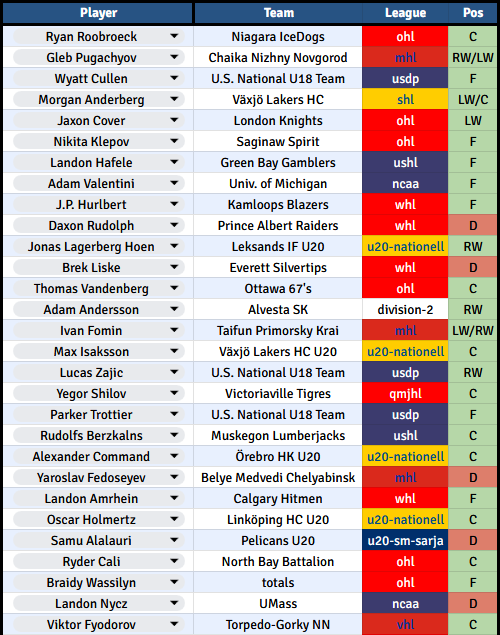
Ryan Roobroeck is a bizarre one. I wasn’t the biggest fan this year, but even I’m surprised with how little I’ve seen out of him this year that I think projects well. He’s huge, but doesn’t push the game enough to give me a ton of confidence. His surroundings aren’t amazing in Niagara, but I haven’t found him to be the one having to swim against the current there.
Gleb Pugachyov is definitely the most “NHL-like” power winger to come out of Russia in a while. There’s skill in his game, but overall results are just shy of being really impressive. So many almost-moments, but he’s interesting and could have a good developmental future.
Wyatt Cullen is very smart. I could easily see him well into my first round if he gets his legs really going, because he’s got skill, smarts and finishing ability that has impressed me going back to last season, as well as being one of the youngest players in the draft.
Morgan Anderberg has stuck around in the SHL for most of this season and it’s pretty easy to see why. Competitive, a really impressive skater with impressive two-way transition impact, Anderberg has found his way to scoring chances here and there at that level and I’ve been curious about him. I could easily take him later than this and others ahead of him, but he has been an interesting one.
Nikita Klepov and JP Hurlbert are certainly flashing abilities well above this group, but I just don’t know if it projects to the NHL. Where Berchild has pace and agility on his side, Klepov and Hurlbert are very skill heavy, and I’m just not sold on high end NHL scorers there. Maybe in the future, but from what I’ve seen, it’s tough to see them as first rounders quite yet. Similar feelings regarding Egor Shilov as well. Insanely good skill, but I do not know about the NHL as he is.
People will be surprised to see Daxon Rudolph in here, but he just really isn’t my kind of defenseman, at least as a top 20 pick. It’s undeniable at times when he’s slinging passes up the ice and whipping shots from the point, but he’s extremely passive and inactive, which I have a hard time seeing work in the NHL. I can’t think of an NHLer that defends the puck standing straight up and getting the puck away from themselves extremely quickly, and Rudolph is just a guy I have a hard time placing in an NHL lineup. He’s scoring a ton on the powerplay of a very talented offensive team, and I’m not sure he’s a first rounder to me at the time of writing.
On the other hand, the more I see of Brek Liske the more I like. Mobile, and very smart, Liske tracks play well, and brings a calm efficiency to the game along some surgically precise slot passing that might fly under the radar.
I’ve had Landon Amrhein as high as the first round this year, but I think I got too pulled in by what could be there in time rather than what’s there now. He’s a slippery, skilled passer with great length and a fluid skating stride, but I am waiting for him to really take over stretches of a game, and just haven’t seen it yet
I can’t not love Ivan Fomin, I’m sorry. I’ve watched a few games of his this year and heard more about him as a person and I just can’t not cheer him on until the end of time. He looks even quicker and more explosive than last year, creating space with the puck way, way more effectively and is currently rocking a 54% involvement in Taifun’s offense. He leads the team in scoring by almost 20 goals and 20 points at time of writing. He’s epic, and if a team were willing to toss pick #224 at me for a succulent Chinese meal, I’d take Fomin just to see what happens in his career… What if it works… What if it works…
Rudolfs Berzkalns has caught my attention constantly, but only insofar as being a fast, skilled gigantic Latvian centre. I’m going to see more soon, but I’ve been very impressed with the package of tools there and projecting a player like him to the NHL.
Jaxon Cover might be the most curious case of all, being a player with very limited hockey experience at all, he’s shown to be a well-rounded winger with some quick feet but a physical edge and really clever playmaking under pressure. He’s coming alive more over time getting plenty of opportunity with London this year, and he may be one to work his way further up my board as the year continues.
Tier 6 - Overagers and Maybes…
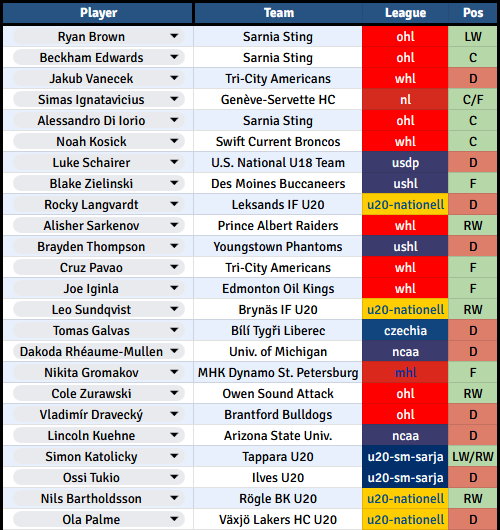
These guys are all not too far behind the previous group, but they all have a bit more uncertainty than the rest without being the pure curiousities on The Watchlist.
Ryan Brown goes and goes. We like that. Beckham Edwards is definitely very smart and nearly got bumped up a tier, but it’s hard to see him as an NHLer right now. It’d be interesting to see it work, but I am unsure of his profile translating without more viewings and confidence.
Noah Kosick is very young and has undergone a huge growth spurt, and if the skating/speed combination can take a jump, he could be a seriously good pickup. He’s going to get plenty of reps with a Swift Current team that is having a very rough go of it lately, and he’s scored plenty, but there’s doubt right now when it comes to projecting him.
We see some more re-entries in here. Rocky Langvardt is captain of his U20 team in Leksand now with some… Rocky… SHL appearances thus far, but his skating looks more improved, and I still think there’s something interesting there. Galvas and Rheaume-Mullen are both dynamic offensive defenders who have continued to impress me this year.
I love Alisher Sarkenov, I just haven’t seen enough to bump him up, and he’s an ‘07-born player which works against him in a sea of other skilled wingers, but he’s dynamic and quick, and is coming off a productive World Junior where Kazakhstan unfortunately fell just short of re-entering the 2027 tournament after a heartbreaking end to their 2026 journey.
Brayden Thompson is a 5’8” defenseman in Youngstown who I just love to watch play, and may end up a Watchlist guy by the end of the year, but his mobility, skill and off-puck anticipation skill are hard to argue against. He overcomes his size deficiency well as he is, and I think he has some really interesting offensive upside if given the opportunity and patience to get there. I’ll watch more of him before the end of the year, and it’s almost a guarantee he goes undrafted, but I think he has a shot at being one that may buck the trend long term.
Joe Iginla is also youngster who I’ve really appreciated. The competitiveness is there, the drive and intensity are good, and I think he moves the puck real well for a smaller guy that lacks a true high end gear. I struggled with him based on my sample but I could easily vault him quite a bit higher if his game evolves like I think it could before the end of the year.
The Watchlist
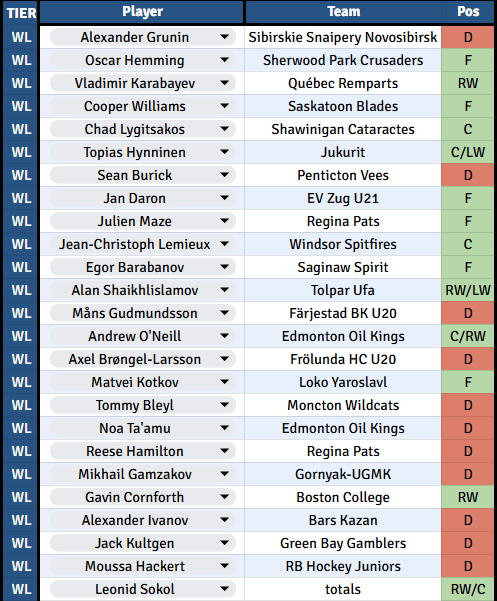
The Scouching Discord Office Hours MVP Alexander Grunin tops the list. He’s awesome. Huge, explosive, mobile, Grunin is all over the ice, driving great results and creating offense for his team. The problem is that he’s playing on a team that is just not returning the favour often enough for him. I want to see more of him, but he’s been a pleasant surprise after being snagged as one to check out in my model.
Vladimir Karabayev has zero points with Quebec, but I really like the upside with a guy like him. He’s got pace, size and skill, and I’m going to see him more in detail soon now that he’s playing a decent run of games.
Chad Lygitsakos is another almost-certain no when it comes to NHL upside, but he’s so skilled and quick, almost like a Mikey Berchild out there. Not sure he’s a pick to me, but I’ve really enjoyed watching him at his best and the numbers back up an intriguing skilled winger.
Sean Burick on the other hand is huge and range-y with intriguing skill for a big man, and might be worth parking and developing in college and minor league hockey. Probably not much more than a low-end minutes eater, but I haven’t heard much about him and have been curious about his potential.
It was unfortunate to see J-C Lemieux not at the CHL/NTDP series, but I wonder of his future. I love the pass vision, raw energy and finishing ability, but he isn’t driving play enough for a level of confidence that puts him on the real list at this point.
Mans Gudmundsson has stuck out a few times this season both in club and international play. Smart, capable defensively with some moments of impressive skill worth further investigation.
Axel Brongel-Larsson is a big meaniepants and I’m sure someone will pick him up and turn him into an NHL level big meaniepants, or at least try.
I’ve gotta shout out Moussa Hackert who was one of very few Germans at the Hlinka Gretzky Cup to catch my eyes with his explosive skating and strong attacking approach. He’s gone on to play for the Red Bull Juniors in the Alps Hockey League and while he’s certainly a ways away, he’s an intriguing one to watch as one of just two 2008-born draft eligibles playing in the Alps League, which has produced NHL picks in the past. He deserves a shout of encouragement, especially after facing a recent incident of racist abuse from fans after a recent game. Unlikely a pick in my eyes right now, I could easily see him be a major role player for the Germans at the U18s in the spring, and from there, who knows what’s possible.
Goalies
I’m no expert, but I think it’s a pretty strong year for goaltending around the world and these are the names I’ve liked in roughly an order in which I’d prefer them:
Dmitri Borichev
Yegor Rybkin
Vladislav Yermolenko
Tobias Trejbal
Martin Neckar
William Lacelle
Marek Sklenicka
Harrison Boettiger
Brady Knowling
Dmitri Ivchenko
Ryder Fetterolf
Xavier Wendt
Pyry Lammi
Frantisek Poletin
Matvei Karbainov
Sergei Gorbunov
Nikolai Skryabin
Scouching’s Final 2025 NHL Draft Rankings
At last we meet again, hockey fans. The 2025 NHL Draft might be one of the craziest and unpredictable ones in recent memory. Things open up extremely quickly, and team philosophy is going to shine through the typical “best player available” discussion almost immediately. The strategy in the NHL is in flux these days and it seems like teams are trying to get on top of it, especially now that the fast, physical and intense Florida Panthers are repeat Stanley Cup Champions, and doing so in largely convincing fashion. Personally I’ve really refined what I look for in players and really do focus on what works in the playoffs. The best in the world play their best when everything is on the line and the nature of the game shifts to something arguably more chaotic and off-puck focused, and the margins can be so small that winning a key battle could mean the difference between winning a series and elimination. I always caution to not try to actively chase something another team has already nailed down, as passing on some very useful talent in favor of something you need can really hamstring your team and leave you wishing you had more offense. That said, this year is a year absolutely jammed full of solid, effective and physical players that can play up the middle of the ice or complement your best players on the wings. There are players with offensive upside but they come with risks. In my opinion, success in the NHL often comes from having a clear strategy with well defined and achievable goals, and filling your staff and lineup who are all devoted to that strategy to maximize buy-in. Look up and down Florida’s roster and look at all the guys who were castoffs from other teams. Sure, Florida has a few picks of their own on the roster, but depth makes all the difference in the playoffs, and their depth played into their strategy perfectly and credit should be given to their management and research staff for being able to put these guys in a great position to succeed. Being creative and sticking to a strong, cohesive strategy matters tremendously in sports, and as such, what I personally value in a player has changed drastically over the last few years.
Some say this class is “weak” but I think there are a lot of names that have a good developmental ceiling as well as others with strong, physically capable floors that might be able to hang in the NHL for a time. Superstars, I’m not so sure, at least it’s tough to see easily, but players? There might be players abound this year.
Before we get into the list, it might be helpful to take the time to briefly outline my philosophy so you can get in my head a little bit and understand where I come from a little better when I see the game. If you take 10 different evaluators, you’ll probably get some differences in priorities and preferences, so knowing what you’re getting into should add to the experience. At my core, I focus on possession. Hockey is a game in two fundamental states. You have the puck, or you don’t. The ultimate goal should be to find players who are as good at gaining and maintaining possession in some way, getting the puck into a desirable location, and getting the dang thing into the net as much as possible. In my view, the priority should be in that order. You can’t have the third aspect without the second, and you can’t have the second without the first. As such, I see speed, tenacity, competitiveness, and quickness as key, both mentally and physically. I don’t care so much about how big you are, how good of a shooter you are, how hard you hit, I just care about what you do on the ice and if you’re moving the needle in the right direction. In my experience, the best young needle movers with regards to competitiveness, pace, and creativity are the ones of who are often hardest to find when they grow up big and strong to be NHL players one day. I value players who elevate who they play with more than anything. They’re dependable every shift, they're focused on the ultimate task of the game situation, and they think creatively to make baby steps happen that ultimately lead to scoring chances, and ideally some goals go in here and there.
I’ll also note that the positions listed are almost universally those from the games I’ve specifically watched and tracked of these players. A defenseman is listed by either handedness or the side of the ice they play on should it be the opposite to his natural shooting side (i.e., RSD is a left handed defender playing on the right side).
Thank you all so much for your support and attention for another great season here at Scouching. It’s a pleasure to be back for my first full season since my recent hiatus, and we’re going to be back bigger than ever next season!
Don’t miss our NHL Draft Live Shows starting at 6:30pm EST on June 27 and 11:30am EST on June 28 and catch every pick with myself and a cast of characters. See you there, and enjoy!
Tier 1 - Same as it Ever Was
-
Some have questioned Schaefer’s claim to the first slot due to his injury issues, but watching my saved video on him from his performances this season really captured just how special this player could be. He’s explosive, dynamic, smart with the puck, more than capable off the puck on the rush, and has size and youth that only bode well for his development curve. He’s been at #1 on my list since around the first week after returning to the OHL, with a strong final month of performances really solidifying just how good a player Schaefer is. I would’ve loved to have seen him in Erie’s surprising playoff run, but any concerns were vanquished on reflection. He’d by my #1 and is a great part to augment the future of any NHL team. A real Dougie Hamilton-type with great offensive tools that really go a long way to patch up his issues here and there with pushing for offense a little bit too quickly and losing a battle along the boards here and there. He drags defenses around the ice with ease, passes and carries the puck with the best of them, and brings so much to the game that anyone could benefit from. A true modern offensive defenseman that in the right system could be absolutely lethal.
-
An injury at the end of the season hampered Misa’s showings in the playoffs and having seen a few of those games, they were less than ideal. That said, Misa is still not too far off from Schaefer in his mastery of understanding the game and picking opponents apart. He makes his plays creatively and quickly, is faster on his feet than you might expect, has an excellent feel for off-puck positioning and anticipation, and can chain his plays together in succession unlike many in the draft class. His ability to work off of pressure, find passing plays through traffic, swing across the ice to change lanes and get a different look at his surroundings, it all projects so well to higher levels and assuming his late season injury isn’t some long term issue, there is huge upside with Misa. If he’s gone anywhere later than this in the actual draft, I would be shocked but not particularly surprised, as his physical game isn’t quite up to par with some others, and it can leave him reliant on the quality of his linemates in order to set the table for him, but boy is he every a great restaurant manager once the tables are set.
Tier 2 - Potential Key Pieces
-
If nothing else, James Hagens will be a fascinating experiment in if traditional smaller, slighter skilled players can still crack it at a high level in the NHL. To his credit, Hagens’ physical game grew immensely, especially after his World Junior Championship victory. He seemed passive, worse under pressure, and cautious with the puck, but you still saw the quick feet, the skill level, and the playmaking potential. His pace of play ramped up, his physical metrics went from 0 to humongous-big, and his passing got quicker and more precise. Hagens may not have had the production people expected, but in my view he was a bit too relied upon to be the principal puck carrier while on the ice, which made him a key target for opposing defenses. He still needs to learn how to penetrate the middle of the ice more, get more scoring chances for himself, and still gain a step of agility and creativity to get around pressure at higher levels, but the ceiling is huge and he’s a prime target of hyperanalysis that might plop him down the draft a few too many slots. There are questions, but in my view those questions got answered more and more as the season went on, especially considering how strong his World Junior performance was while we’re all talking about who shined at a more recent tournament played against other children.
-
Does everyone forget just how good Eklund was for his national team in Ottawa this year? I sure don’t. This kid might not be a Top-10 pick strictly off of his size, and potentially a bit of limited offensive upside at the NHL level, but in my opinion we’re in the game of picking players you win games with. Eklund’s style of play is relentless energy, strong skating ability and a lightning quick shot that he uses almost too often from too many spots. He played a big role on getting his team back into the SHL for next season and looked pretty darn good doing it. Agile, selfless, creative, and admirable, Eklund may not be quite the offensive performer his brother is in the NHL, but I look at players like Artturi Lehkonen, Marcus Johansson, or Evan Rodrigues, and see similarities there. All of those players have been very, very important unheralded parts of very long playoff runs, and bring plenty of value to the NHL game. Eklund may just be the next one that just goes out and plays the game harder than anyone and gets all the benefits from his work. I’d love to see some improved dynamic play with the puck in the offensive zone, setting up plays for linemates more and generating more for others rather than his perimeter chances, but he shows flashes of being able to do that without question.
-
I just keep going back and seeing so, so much upside with Potter. Lots of people rightfully see a questionable upside with regards to his puck management and pass vision, but good lord he is one of the most exciting players available once the first few picks go off the board. An insanely strong combination of speed and skill, Potter’s shooting ability and pace of play work in conjunction to create a lethal individual player in almost every facet of the game. Playing big minutes up the middle of ASU’s offense is no easy task, and he didn’t have the luxury of multiple top 30 NHL picks as linemates. Potter is a player who I believe will only rise to meet the level of competition ahead of him with faster, strong linemates with better finishing ability, but he is not without faults. An elite puck carrier, he can look off easier pass lanes at times and cause turnovers. His defensive awareness of passing lanes is a work in progress, but for a small centre who is 17 and in the NCAA, that is probably understandable. His physical play will never be a hallmark but it is something that needs to be explored further. That said, I can only imagine how much Potter would’ve laid waste to the USHL or CHL this season. I remember watching Logan Cooley at this age, and I simply cannot picture him being better than Potter had he been an NCAA centre in his draft year. I love his potential, and I’m positive he’ll be gone much later in the draft than he should go.
-
There are legitimate questions surrounding Martone’s translatability to the NHL. His size, skill, pass vision and shot quality all go hand in hand to make a lethal offensive force in junior, but the pace of his game fluctuates heavily, the agility and evasion under pressure is questionable, and he isn’t putting his opponents on their heels on the rush as much as I’d like to see in a high end NHL prospect, but I just see so much potential with Martone. He makes excellent reads around the ice, driving exceptional results in so many areas, with excellent dual-threat offensive ability, and a willingness to forecheck and play physical hockey that should only get better as he matures. He’s a great kid with great ability who knows his faults and is working to address them. As a less heavy hitting winger in the draft than the heavier skilled centres available, Martone may slip a bit this year, but I think you’re getting a player who could develop into a gifted offensive playmaker with size, puck protection ability and skill that could take on anyone all over the ice.
-
A player I’ve been up and down on all season long, I think I’ve settled on a solid foundation on what Frondell is. He’s the best option this year for a player who can play with just about anyone anywhere in a lineup and get the job done. Physical, fluid, smart, Frondell thrives when the game is chaotic. He battles for pucks along the boards well, makes plays quickly, fills empty space constantly, and while his analytical picture was not good, it was much better when his role was somewhat more restricted. I mean that in a positive way, to be clear. If you’re expecting a top-6 centre who will carry you to Stanley Cups and win trophies along the way, I’m not sure that’s Frondell, but as a guy who plays on the wing with those players, I could absolutely see. A capable centre you could stick down your lineup in a checking F3 role with a green light to shoot, sure. On the other hand, a flexible, powerful and physical winger who plays heavy with an offensive twist that can work off faster, more skilled and dynamic high end talent, that’s an Anton Frondell I can see playing a lot of minutes one day in the NHL. Development can change that, but based on what he’s shown this season, I’ve come to really respect the flexibility and projectability of his game, even if he may have more mixed results than most when zooming out to the big picture.
Tier 3 - The Blob
-
Welcome to The Blob. The place where everyone in this range could go in any order of any kind and I would understand it. Leading the way is the guy who surprised me the most watching back the video I had on him this year, and one of the players I’ve enjoyed the most in my two seasons of seeing him. Eric Nilson has a foundation of smarts and skill that could’ve bumped him up a tier, honestly. I’ve seen this guy try to throw opponents into a bench, make plays as quickly as anyone, and be arguably one of the best puck managing forwards in this class not named Michael Misa. His shooting instincts and raw ability needs work to say the least, but almost everything else is high-end, and the only question mark is that he needs to get stronger. I’ve said for months he’ll only be as good as he is strong at higher levels. One of the lowest BMI’s in the class at the high end, but not a short player indicates good potential development which gives me confidence. He looked strong in his limited time against men, and it’s no surprise to me that a program as prestigious as Michigan State would look at a player as physical, energetic and intelligent as Nilson. He’s this high on my board simply because I compared my notes, data and video against others here one at a time and he just kept looking like the more interesting option than all of them, and I’m trusting my gut on this one, even if there are conditions on him hitting his upside.
-
Part of my philosophy includes setting aside “risk” in return for upside and talent scarcity. Lakovic is a rare package of length, skating ability, creativity and finishing ability that you don’t really see all that often. Right off the hop, he’s a player that undershoots his physical potential, especially on the forecheck and in the defensive zone, which are issues that will need to be fixed, but if he earns a coach’s trust, look out. He's a smart kid who has really gone out of his way to study how to adapt to what’s in front of him, with strong skating edges to protect the puck and penetrate through opponents. For the faults he has, he still found ways to generate excellent results on a team that didn’t have great results as a whole. Nobody in the class at this level broke 45% involvement in team offense outside of Lakovic. Generally that’s a pretty good trend. I can imagine he goes later than he should, and I can see why, but depending how far he slips, I can’t say I would agree with the concerns past a certain point.
-
I’m never not impressed by Zonnon when he’s on the ice, and I’m relatively confident he has just as much claim to being a great pick this year as any other big, physical centres that are available. The thing I love about Zonnon relative to the others available is the pace of his game. Sure, he isn’t the most beautiful skater out there, but he is absolutely not slow, and absolutely not without skill. Zonnon combines his energy with some really smart pass vision that allows him to command the middle of the ice well, and he has generated some of the best forechecking results of anyone in my data tracking. He only seemed to get more and more comfortable controlling play from the centre position as the year went on, driving more and more pucks to the net, and attacking defenses better and better. Asking around, his projectability as a centre is a bit of a question, which I can understand, but he has one of the strongest floors in the class. He’s competitive, intense, and makes multiple plays in quick succession to drive play well. The more he wants to be involved the better he’ll get at 5v5, and compared to some of the guys a little later than this slot that I’m sure people will question my sanity about, Zonnon just seems to fit the quick, chaotic world of the modern NHL a bit better than the others with the physicality and energy to push back against any opponent.
-
In a similar vein to Bill Zonnon, the modern NHL is quick and chaotic, and a player I continuously believe is maximized when the game is at it’s quickest is Michal Svrcek. An impressive skater with relentless energy, Svrcek worked his way onto his men’s team and stuck, playing solid minutes for months at a time. I feel his U18 production undershot just how good he was there in my view, and if we’re talking NHL capability and floor, Svrcek is right there with the best of The Blob. He has an excellent shot that I’d love to see used from better spots in the SHL, and he has an insane off-puck work rate that suppresses opponents constantly. He absolutely has work to do, as he can overskate himself into problems, and he needs to learn to vary his pace of play a bit more often to get other looks on the ice, but in a north/south world of hockey where your forecheck is what seems to matter tremendously, Svrcek stands out. He certainly needs to get stronger on his feet to have more defensive zone impact, but he’s an annoying, pesky winger with energy all over the ice. Of all the draft eligibles that showed up in the SHL this year, he was the most impressive in many aspects, and to me that counts for something way more valuable than where he’s slated to go in the actual draft. Again, watching my video on him back relative to others in this group, it’s extremely close, but I believe in his floor and track record playing against men just a hair more than those behind him.
-
Achilles injury aside, Bear is a similar story to the names ahead of him. Energy, physicality, forechecking ability and quick execution of ideas are the name of the game for Bear. He’s tall, aggressive, and skilled which automatically makes him an intriguing profile to watch. I will admit his ability to take over a shift or game is a bit of a question mark, but he strikes me in a similar way that Anton Frondell has. A great compliment to some better play drivers with upside to be more than he is. A really strong floor of competitiveness and skill, Bear has flashed some remarkable moments that if he can bring in a bit more of a complete, evasive manner moving forward, could be quite a pickup, especially if teams are sketched out by the injury and we see him available a bit later than this range.
-
Another high floor player, Brady Martin is going to be an interesting one to track. It seems as though he’s going to be a Top 5 pick in this draft, which on the surface seems completely insane to me, but alternatively, I do see the logic. He’s competitive, a great hitter, a smart passer all over the ice, and has driven great results in almost every metric I track. For me, the skating and skill combination just has a long way to go to develop the kind of ceiling I like in a Top 5 pick. To others, I can absolutely accept the logic that there is a greater chance of James Hagens or Porter Martone struggling to live up to their draft slot than there is of Brady Martin, and Martin brings a highly projectable floor that is likely to still be a valuable part of an NHL team. In the right role with the right linemates, Martin could be a tremendous 3rd line centre, but could James Hagens play that kind of role? Probably not. It all comes down to how you value and perceive talent, and while I think Martin has a ways to go to catch up to those at the top of my board, it isn’t impossible, and if he does, he could be a serious two-way issue for whoever he plays against. If he can further refine his willingness and ability to work towards the net in the offensive zone for better scoring chances, then the sky is the limit for Martin, it’ll just be a matter of how far he can get from here, and how far the more skilled and dynamic players can get on their end. There may be a good lesson for me here if Martin is drafted at the top of the class and turns into the next physically dominant 200-foot centre in the class.
-
O’Brien is just a really, really solid hockey player through and through. Skilled, smart, a selfless transition playmaker with a wiry frame and plenty of potential, O’Brien may well be gone significantly earlier than my slot for him. I just haven’t quite seen the same level of energy and pace of play out of him that I have with him as I have of those ahead of him. His passing ability and puck protection make him a pretty strong NHL bet, but to me he invites a lot of pressure on himself with his decisions and confidence. That’s fine, but it’s much more difficult to get away with in the NHL and his offensive upside may be somewhat limited because of it. That said, he plays how you need players to play in the NHL, and has the frame to do it. I wouldn’t look at O’Brien in the top ten, but with his floor and smarts, there’s a strong foundation to work on. He doesn’t waste his shooting opportunities and he sets up linemates well, but I still remain a bit reserved about just how much of a needle-moving player he is at the highest level.
-
Once the puck gets into the offensive zone, there might not be a better playmaker or smarter scorer in the draft class. If he goes Top 5, that’s what you’re getting, along with what appears to be a great interview. Desnoyers is a player who just goes out and generates results over and over and over again and has thrived this season surrounded by heavy, intense physical linemates in Julius Sumpf and Juraj Pekarcik. He’s been deployed up the middle and along the wing, and he does bring a level of flexibility that can go with just about anyone he plays with. Desnoyers brings strong physical intent to his game with somewhat mixed results but the big thing that puts him here for me is his offensive skills translating to the NHL. He’s an exceptionally smart playmaker to say the least, but his skating and skill combination trails the names ahead, especially outside the offensive zone, and his physicality is solid but against the best in the world, it’s a bit of a question mark as he lacks the intensity and pace of play that others seem to have. The wrinkle added at the end of the season of the multiple wrist injuries is a bit of a wrench to consider. Has he been undershooting his true abilities all season? Was an underwhelming Memorial Cup just everything coming to a head? From what I’ve seen of Desnoyers all season going back to last year, I still remain a little bit skeptical of his potential, but hey, if he’s been really playing hurt all season long and still drove results like he did on the ice, a team picks him as high as 2 or 3 and he turns out to be an exceptional two-way top six centre, then so be it! There are just quite a few questions I’ve had for too long that has kept him lower on my list than where many others currently have him.
-
The first solid, steady defenseman, and one who has only gotten better and better over the course of the year. Logan Hensler had a slow, cautious start to the NCAA season and a bit of a tepid World Junior tournament, but in the time since, Hensler has taken strong steps in the right direction towards being a valuable, all situations defender with skating ability, offensive creativity, smart, safe transition passing, and an ability to keep play to the outside often enough to work fine in the NCAA. He needs to generate more power from his lower body on transitions and along the boards as players could drive him wide and beat him clean down low, or win physical battles against him, but these are things you can work on. Hensler is a player that just brings a solid team game that works off of others well, and marches the game in the right direction more often than not. Other defenders have simply shown more questions or longer development paths that increase risk that leaves Hensler in the middle of the first round. Smart reads, simple passing and flashes of some great offensive zone moments along the half wall, Hensler is an ice blank slate that could be a good bet to round out an NHL defense group.
-
Another one of those players with some pros that are among the best in the draft class, and cons that raise big, big questions about his NHL projectability. Kindel might be one of the smartest and most capable passers available, with an insane level of pass vision and creativity on the fly, changing angles and finding multiple complex options that makes everyone he plays with look better. He attacks the net off the puck and earns simple but effective scoring chances like it’s his job… Which I guess it is. A strong playoff performance capped an impressively successful season for Kindel, especially relative to my expectations having seen him in 2023-24. That said, he’s an undersized player who showed his best hockey by far up the middle of the ice in my opinion, and his physical game is almost nonexistent with skating that I wouldn’t consider high-end enough to overcome the physical pressure of the NHL. Kindel is one of a handful of players that I want to love so, so much and there’s so much to love about him. This tier is so, so close and I would love to see him drafted higher than this, but there are legitimate concerns that I imagine will hold him back in the minds of NHL teams. I still have him higher than he’s likely to go because I believe in the passing and upside so much, but doubt is a debt in the NHL draft and he’ll need to make some currency to make it worth a high pick.
-
What a fun player Cootes is. Really compact but a great combination of pace, skill and off-puck awareness that has a nice long term trajectory in my opinion. He was successful offensively on a team that struggled to generate offense around him, with just as much involvement in his team’s offense on average as names like Desnoyers, O’Brien, Reschny, Kindel and Carbonneau. I see a Chandler Stephenson-type player here if people forget about Cootes too much. Flies under the radar, isn’t the biggest guy, but flies up and down the ice just being rock solid with a bit of offense and a bit of defense anywhere on the ice, then people notice when he’s 5 years into his career and he’s seen as highly valuable. I do wonder about his compact nature and off-puck quickness being enough to work against NHL opposition, but Cootes brings so much upside with a combination of skill and a high pace of play that few others have this year. Energetic, smart, and effective, Cootes isn’t perfect, but he’s a solid option likely to go a bit later than he probably should.
-
He said he’s 100% healthy at the combine and did the physical testing. That’s great news for him, but I personally do not believe that this automatically elevates him to the highest echelons of this draft class. He’s gargantuan with an intense skating stride and a clear physical side to him that he’s not shy to utilize, but in my dataset on him he was largely far from effective unless slipping passes through defenders or in wide open ice carrying the puck. He’s got a great skating stride for his size and some great flashes of skill under pressure, no doubt, but in my books, you have a 6’6” player who played hurt on some level for over a calendar year according to some reports, is likely to put on another 30 pounds or so on his frame that has dealt with back problems, and plays a style of play that requires physical intensity. I just have a lot of questions, and the talk behind the scenes during the playoffs was not promising. Going from being shut down during his playoff run capping off an injury-riddled year to 100% healthy in the span of two months is possible I suppose, but I simply feel that drafting him right up at the top of the draft opens yourself up to significant risk.
-
Fiddler is a player whose best moments are really, really good, and some of his worst moments are very problematic. I’ve seen him go end to end in the manner I’ve seen Matthew Schaefer do, with more chances from the front of the net than almost every other defenseman, and he’s got skating ability on the puck that catches your attention. Similar to Hensler, Fiddler needs to work on the lateral mobility and defending with his lower body in transition as he was beaten along the boards and when opponents would cross lanes in front of him more than I’d like, but he has a great frame with the benefit of relative youth that make him an interesting bet. A powerful stride coupled with solid skill is intriguing, I would just love to see some cleaner passing under pressure and more strength added to his play in the coming years. There might be some good upside to Fiddler, but he’s going to need to capture his best hockey more often.
-
I’ve said it since November but if this were an exercise in drafting the most skilled players in the world, Carbonneau would be well into my Top 10. Carbonneau is ruthless on the rush with great side-to-side energy and insane application of his skill to try to create plays for linemates. His shot is lethal and he uses it more often than anyone else in the draft. His best moments are spectacular and he’s a capable player under pressure with the puck on his stick. What’s the issue? Carbonneau in my experience is a volume shooter who needs to work towards the middle of the ice significantly more, and the creativity and passing he displays often goes completely unrewarded as the puck drifts through the slot or off a defenders skate and the puck is coming the other way. Once that happens, Carbonneau’s engagement and energy takes a dip as he’s a player that looks for offense more than anything. My data reflects this with some of the highest playmaking potential percentiles with some of the lowest defensive metrics in the whole dataset. He’s a player with a ton of question marks, but a ton of fun baked into his game. Is he destined to be an NHL All-Star highlight reel top six winger? There’s a chance! There is just a bit of a murky road ahead and NHL teams are well aware of it. He’ll dazzle in rookie camps and probably score a kajillion points next year, but his ultimate test will come when he crosses over to pro hockey one day.
-
The Czech tower finds himself exactly where I had him in March. I see big upside in Mrtka as a defensive player in the NHL, but there will need to be patience and time to get there. A crisp passer outside in many situations, he covers ice well in multiple disciplines with some really impressive moments stepping up from the offensive zone. Mrtka is a little bit sketchy in close quarters defending with opponents sneaking through his coverage too often and allowing quite a bit of dangerous offense in his own end. He’s another big defenseman who can lose more battles than you’d expect along the boards as well, but his development trajectory could alleviate those concerns easily. Mrtka is a bit of a project, but he brings some good traits to the game that NHL teams will covet. In 5 years or so, there could be a solid pass-first middle pair defender who can generate some neat chances in the offensive zone with his misdirection and reach. I could see him jump way up in this tier on draft day, but my reservations leave him a bit behind the market.
-
This guy is a freight train. Words can’t describe my disappointment when he said at the combine that every team only really seemed interested in if he were willing to fight. He said that multiple times, even when asked if he got any fun questions to answer. “Not really, just if I’m able to fight.” This does such a disappointing disservice to his game. Yeah, he’s a big, physical menace, but you see strong finesse in his game from time to time capped with some real highlight goals this year. He drove good offensive metrics to go with his spectacular defensive metrics and my read on him is so far beyond just a giant who will beat you up and knock you out. I mean, I’m sure he’s capable of that, but I can’t help but hope to aim high with Vansaghi. He might need to be a bit more mobile and leaner to really work with his skill more, but I see a real Will Carrier-type here. A guy that goes on deep playoff runs down a lineup that eats important minutes for the rest of the team, with puck skill and scoring ability that pops once in a while to make him more intriguing. Eventually someone locks him up long term and appreciates him for what he is. A competitor, and violent force, and a guy capable of some impressive moments when you least expect it.
-
If drafting were all about raw talent, Smith would be higher. Heck, he was way higher on my list right up until my last few viewings of him and his U18 World Championship performance. I just came to the realization that I was waiting and waiting for something that just hasn’t been there. If anything I’ve felt Smith has tailed off on what makes him so special as the season has worn on. Don’t get me wrong, the skating ability in all directions, speed and skill in open ice, and willingness to challenge opposing defenders is there in spades, but where and when he chooses to do so can be a spin of the roulette wheel. He is so, so talented but gets beaten defensively on the perimeter way too often and is often late to commit to contact which is not what I expected. His offensive game simplified to just popping pucks on net from the perimeter in my last few viewings, and his U18 resume left quite a bit to be desired. He wasn’t pushing the pace of the game, making clean plays to linemates and just wasn’t looking like an elite pick outside of the offensive zone to me. I still love the potential. He might be the highest upside defenseman in the draft not named Schaefer, but he probably has the furthest to go in the toughest realm in which to do it. Luckily a recent commitment to Penn State lends much more confidence in his development than his current situation, so perhaps I’m overly concerned. If he does turn out to be just as good as he could be, I would love to see that happen, I just have to mark him down based on what I’ve seen this season.
-
Ahhh Cole Reschny. I’ve just given up and accepted my appreciation for his game as worth a risk. Some have really overcorrected here with Reschny extremely high and I do believe there’s still some serious risk to his potential but my oh my what a hockey player. I appreciate his smarts and passing ability so much coupled with how hard he works on the ice. His personalty jumps at you as well, and he’s headed to NCAA hockey immediately which is a welcome shift in his future. He is fearless, competitive and makes plays under pressure with the best in the class. Working with almost any player variety, Reschny is going to need to be in the right environment to work, and I don’t think you can expect physical dominance at higher levels, but I buy into the upside so much and I just don’t want to be too down on such a player come draft time. It seems he’s going to go before the slot, and whoever does pick him, godspeed because I hope for the best for anyone who plays like Reschny, I just feel that at the tail end of The Blob, Reschny brings some of the biggest upside coupled with the biggest question marks.
Tier 4 - The Other Solid Dudes
-
On talent alone, Schmidt probably belongs a tier higher, but there are enough doubts in my mind as well as the minds of scouts that he may be one that a team will catch later on than this region. Schmidt is undeniably skilled with lightning quick feet and hands, and an elite wrist and slap shot combination that beat goaltenders all season long. I also felt his playmaking ability in the offensive zone improved year over year with good vision and quick decisions on loose puck recoveries. Schmidt is diminutive and in my view comes with some key issues that might hold him back. His skating is great all around but he still struggles to close the gaps that open up around him and is removed from defensive play far too often. To his credit, he’s tenacious with a great motor and willingness to mix things up, so I do wonder if NHL teams will overcorrect on his valuation come draft day. I know he’s had some level of reputational history to disprove as well that teams were a bit spooked on. Schmidt is a tricky one, but I think he’s going to be gone later than he should, likely on day 2, but could be as good a bet as any, if not better in the range he gets picked. He just screams “The Daniel Sprong of the 2030s” to me, drafted too late for somewhat legitimate reasons, but productive nonetheless and consistently a valuable player to have around. I’m not certain on Schmidt, and he does have his flaws, but the fun factor is off the charts and I think he has the energy and intensity to overcome the issues that come with his size.
-
Reid is going to be another interesting one to watch moving forward. Not the biggest defenseman out there, nor the most creative, but he’s an explosive skater with some of the best rush moments of many of the players available. A capable, safe but effective passer, Reid also does a great job escaping pressure with that speed and energy, with a shooting instinct from the perimeter that occurs a bit too often, but generates good offense for his line. I do wonder what kind of defender he could be in the NHL? His physical game is somewhat unrefined, but he’s solid on loose pucks. He isn’t the most creative or dynamic offensive zone defenseman, but his passing game is still dependable. He isn’t small, but he isn’t big either. Is he a power play quarterback? I’m not sure who he replaces that a team already might have. He’s tough to figure out in my books where I like his brand of play, and his raw tools are very interesting, but what comes out the other end just feels a bit too hazy for me to have him in the tier above.
-
I don’t know if anyone had as much of a roller coaster season as L.J. Mooney this season. I adore this player, but Mooney got off to a slow start, and just when I felt he was getting going again, a brutal knee injury sidelined him at a key time, only to return looking less comfortable than ever for quite a stretch. Only in the last few months have I felt Mooney really hit his stride, quickly catching up to the best scorers on the team with great even strength results with better results than you’d expect as a centre. His U18 was truly special as well with pinpoint passing, aggressive pursuit defense, and some electrifying rushes up the ice… until he got injured again and missed the final game of the tournament. The concern is that he will be injury plagued thanks to his small stature in both height and weight which is perfectly fine, but the upside with Mooney is well… as high as the Moon in the sky. Mooney carries absolutely lethal playmaking skills and a shot he uses far too rarely, but has a level of tenacity and intensity in his game that stands out in this class. If any small guy is insane enough to make it work with raw energy and passing ability, it’s Mooney. In my model, there’s a nonzero chance we see Mooney go completely undrafted, but I simply can’t imagine that being the correct decision, especially in a draft class that many NHL scouts I’ve spoken to actively despise. Mooney must be a solid bet somewhere, right? If he hits, he’s going to hit big, it just might take time, patience and a little bit of luck.
-
Ryker Lee took some time to really take off this year but 54 points in 43 games since mid-November would’ve given him a 77 point full season putting him on par with names like Casey Mittelstadt and Jake Guentzel. Lee is probably the player with the most exciting individual plays in this tier out of anyone. He’s so skilled, able to pull pucks around opponents at high speeds and use linemates to his advantage. At his best, the motor off the puck is admirable, even if he doesn’t cover ice amazingly well, and while that work rate can fluctuate, he still manages to be an offensive threat often. It seems he’s grown since 2023 as well, which could mean he’s still growing into his frame, and he’s a player I would leave in college for an extended stretch anyway and really let him stretch out his development. He’s a high pace, high creativity dual-threat offensive weapon with big upside, but he’s somewhat limited to being a scorer or not sticking in the NHL in all likelihood. Excting, crafty and a high pace scorer, there are plenty of ups with Ryker Lee and his late season push in people’s rankings doesn’t surprise me in the slightest.
-
I can’t believe more people who say they respect “hockey sense” and “IQ” aren’t all over Hillström more. He’s got a great natural frame that absolutely hasn’t filled out yet, with an excellent ability to read play off the puck, close gaps, challenge players quickly and do the stuff in hockey that takes the hardest pure effort well. Hillström doesn’t waste his passing work often, he is an excellent faceoff competitor, and has a lovely skating stride that he used to his advantage more and more. Similar to Eric Nilson, his style of play will need to rely on physical development to be functional in the NHL, and I’d love to see his pass lane awareness improve in speed and timing. He was prone to turnovers quarterbacking play, but he’d be right there to generate more turnovers as time goes on. His SHL play was far from awesome, but you still saw a player pretty comfortable with the pace of play there, even if he was put on the wing when usually a centre in junior hockey. I think Hillström is a fantastic long term bet that may take time to develop, but his end result could be a very useful, smart and refined centre focused on the details of the game and driving good results at both ends.
-
Another one of these rock solid, smart pressure absorbing centres. His pace of play doesn’t project particularly highly in the NHL but he does have an impressive level of strength and awareness on the fly, working passes around opponents with ease and eating minutes. McKinney has plenty of tools to be a dependable centre at higher levels, I just wonder if he will develop the evasive ability to work around pressure in advance of contact, and do enough creating in open ice with enough pace to move the needle in the NHL. This is around the range where if you get anything, you’ve done well with your draft pick, and I think McKinney has one of the stronger floors in this range. A solid centre with physical ability who can play off contact and make good reads with linemates in space is a fine combination, and he will be a perfectly adequate NHL pick come draft day, be it day 1 or early on day 2.
-
I probably have Spence too low as his floor is nowhere near as low as guys like Mooney, Schmidt, or Lee, but I also don’t really know how much upside there is with Spence. He’s a competitive player who has some flashes of puck protection around the perimeter of the ice, with really smart ideas and execution in offensive transitions. He finds a way to get plenty of jobs done while on the ice, but I just don’t know how well it projects beyond the NCAA level. He’s going to a fantastic program and I imagine the pace and skill can improve at Michigan State, but his more advanced age for a first time eligible and somewhat limited pace and speed generation may limit how much he can drive play on his own. I could very easily be wrong, but he’s one of those players where I’ve found a name here and there more intriguing every time I check in relative to Spence, and he lands as a fringe first rounder for me, likely to go earlier than this.
Full writeups on all 107 players ranked are available with a Scouching Subscription of any tier! Check out our options below and get access to exclusive data and more!

Tier 5 - Everyone Else I Guess?
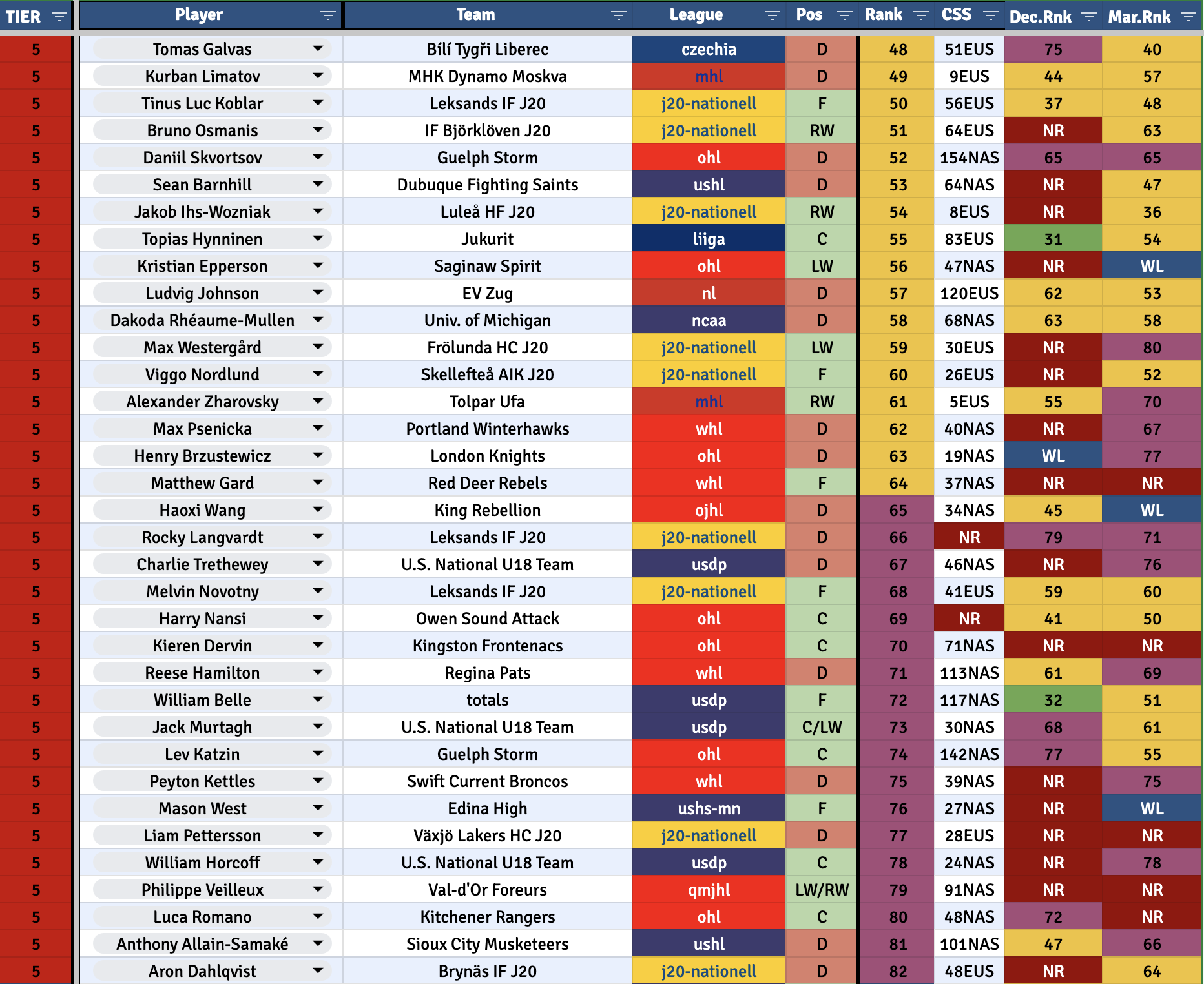
The Watchlist

Scouching’s Penultimate 2025 NHL Draft Ranking
We’re back with new draft rankings! What a day to be alive. It’s been a heck of a season to this point, with nearly 200 players in my tracked database and plenty more who have crossed the radar, and we’re left with around 80 names plus my Watchlist of 25 curiosities to keep tabs on in the future. All in all, I am growing a bit more optimistic about this class as a whole as time goes by. If you’re a team drafting in the first handful of selections, you’re very likely landing a very, very capable NHL player in a key role of some kind. If you’re a team drafting in the next handful of selections, you could very well end up with a very dependable complimentary player who could also fill highly impactful roles. Once we get to the names beyond my third tier, especially as we approach the 20s things open up very rapidly, and my shoulders begin to shrug with more and more vigour. That’s not to say these aren’t desirable players, but the likelihood of reaching a high end role is either quite uncertain, or their potential NHL role may be somewhat limited relative to those at the top end of the board. This isn’t unusual in my experience with the draft, but the 2025 class seems particularly weighed towards very intelligent and well-rounded players who may not bring high end skill or pace of play, but bring plenty of tools to the table that should lead to some kind of NHL gig in the future. What is very interesting about this class is that things do very much drop off heavily in terms of projection and confidence, and much more so than I remember from years prior. I have names on this list that I personally really, really believe in, and they show up much higher than I expected because that line of “this player is very very exciting and that’s worth something” occurs quicker in this draft than I’m used to. I don’t want to say that this draft class is “weak”, but the uncertainty is definitely there, and it feels like we may be looking at a sizable pool of player that have the potential to round out an NHL lineup one day rather than big swings that could find themselves among the best in the game.
Before we get into the list, it might be helpful to take the time to briefly outline my philosophy so you can get in my head a little bit and understand where I come from a little better when I see the game. If you take 10 different evaluators, you’ll probably get some differences in priorities and preferences, so knowing what you’re getting into should add to the experience. At my core, I focus on possession. Hockey is a game in two fundamental states. You have the puck, or you don’t. The ultimate goal should be to find players who are as good at gaining and maintaining possession in some way, getting the puck into a desirable location, and getting the dang thing into the net as much as possible. In my view, the priority should be in that order. You can’t have the third aspect without the second, and you can’t have the second without the first. As such, I see speed, tenacity, competitiveness, and quickness as key, both mentally and physically. I don’t care so much about how big you are, how good of a shooter you are, how hard you hit, I just care about what you do on the ice and if you’re moving the needle in the right direction. In my experience, the best young needle movers with regards to competitiveness, pace, and creativity are the ones of who are often hardest to find when they grow up big and strong to be NHL players one day. I value players who elevate who they play with more than anything. They’re dependable every shift, they're focused on the ultimate task of the game situation, and they think creatively to make baby steps happen that ultimately lead to scoring chances, and ideally some goals go in here and there.
I’ll also note that the positions listed are almost universally those from the games I’ve specifically watched and tracked of these players. A defenseman is listed by either handedness or the side of the ice they play on should it be the opposite to his natural shooting side (i.e., RSD is a left handed defender playing on the right side).
Tier 1 - This is Not What I Expected
-
This is a really tricky start to the list. Schaefer hasn’t played since a brutal collision in the World Juniors which makes a strong evaluation very difficult. I’ve gone back and looked at the tape that is available of his play, and I still feel quite confident that he’s the first name I’d push for in the 2025 class. A broken collarbone is common and almost certainly shouldn’t have long term impact on his overall play. His pure defensive zone play might need some work, but everything else is simply top notch. His pass vision is unmatched by other defenders this season. The way he can open up the ice handling the puck, skating laterally and whipping pucks around the ice makes him a huge threat all over the ice. The puck rushing ability that landed him his injury is still something to really behold when he jumps into the rush. He’s a bit of an unconventional defenseman projecting to the NHL and I’m not sure exactly who he reminds me of. He isn’t Cale Makar, but perhaps a John Carlson? Dan Boyle for all my fellow Millenials and Gen X’ers out there? Someone not shy to step up in the offensive zone, jump into the rush, and run offenses themselves that outpaces any defensive issues. Schaefer has the advantage of being just over a week separated from 2026 NHL Draft eligibility, and at his scoring pace this season, an 88 point OHL season for a defenseman before being draft eligible would be unmatched. Better than Drew Doughty, Ryan Ellis, Chris Pronger, and many other notables. He’s a creative, dynamic offensive threat with scoring and playmaking ability, and between him and my #2 and arguably my #3, it’s a very very very close call and I could go either way.
-
Michael Misa has really grown as a player over the last calendar season in my eyes. It’s easy to see how his game might struggle on the wing, and plopping him up the middle is exactly where he should be. Misa feels the game unlike almost any other player I’ve seen in the last few years. Passes that appear difficult or poorly thought out are cleanly placed through tiny spaces. He has the capacity to wait an extra split second to create better chances and evaluate secondary options. He isn’t a pure sniper, but he’s a diverse and capable scorer. He isn’t a fancy spin-passing playmaker, but he cuts defenses to pieces. He doesn’t move his feet like some of the high motor players out there, but calling him slow would be incorrect. He’s explosive, jumps into space effectively, and picks his times to be quick extremely effectively. His last few games I’ve seen have been a bit quieter than previous performances when it comes to scoring chances for himself, but a large part of that stems from the presence of Igor Chernyshov as a partner in crime. Chernyshov is more of a pure offensive threat with finishing ability that Misa has been able to work off of to great success. Misa elevates whoever he plays with and covers all three zones with great anticipation and remarkable efficiency and likely slots into any NHL team well as a highly effective, but perhaps not a flashy centre that just plays darn good hockey.
Tier 2 - This is Also Not What I Expected
-
I think people have lost the plot a little bit with James Hagens over this season. You look at his production relative to other elite NHL prospects playing in the NCAA and it’s forgivable to think something went wrong, but in my view, Hagens has shown exceptional growth in his game at a difficult level of play in a tough role. Largely centring Ryan Leonard and Gabe Perreault, it seemed like their play styles didn’t quite resonate as expected to my eye. Leonard loves to possess the puck just as Hagens seems to, and it felt like Perreault had issues keeping up outside of being a complimentary give-and-go option with some finishing ability that Hagens was zipping past all night. Play just felt disjointed and strange a lot, but Hagens always looked great with an off-puck forechecking menace in Teddy Stiga just as he did last season at the U18s, and I would imagine those two are reunited next season if Perreault and Leonard jump to the NHL. Hagens specifically has shown consistently excellent metrics in many areas of my work. I would love to see him land more scoring chances for himself as he was one of the more infrequent shooters at the top end, but his wrist shot can be a tough one to stop when it comes out. Where he really shines is as a playmaker, with great success on the rush and in the offensive zone connecting with linemates and moving the puck where it needs to go. He’s quick on his feet, highly skilled, and highly creative. The thing that he’s really improved since he arrived at Boston College is the physical side of the game. The first few games of the season, he seemed completely allergic to chipping in off the puck outside of the offensive zone, but as Christmas approached, something shifted. He’s attacking puck carriers much more directly and throwing hits at a rate beyond names like Frondell, Bear, Martone, Nesbitt, and Desnoyers. He’s come a long way this year, and while I have him a shade behind the best in the class, he’s got a ton of potential to be a flashy, offensive second line centre with a growing level of grind to his game. He may be a bit undersized, but the speed, skill and quick strike playmaking is impressive, and another season in college could do him extremely well to refine the areas that are still a bit deficient.
-
Eklund is one of those players who I didn’t expect to be this high this season, but whenever I check him out, then check out other names in this range, I just come away continuously impressed with his game. I’m not totally sure exactly how much scoring he’ll do in the NHL, but I could very easily see him being an insanely effective possession player that is a thorn in the opponent’s shoes with relentless physicality, pace, and speed that is tough to counter. He’s a heck of a shooter but his shot selection needs work. He’s a heck of a playmaker but his timing and ability to slow the game down a bit is also a little deficient. That said, he still drives very very good results in a pretty big role on a men’s team in Sweden. Continuously controlling about 2/3 of the possession and shot attempts from scoring areas while on the ice, Eklund is effective, hard-working, and will endear himself to fans very quickly. He’s very different to his brother William, but they could offset each other very easily should Victor land in San Jose. He’s an excellent open ice skater with huge efficiency everywhere, and the only real area that needs improvement is in the offensive zone especially with regards to his shooting. This is not an uncommon issue for young players playing in the men’s level, but it’s a roadblock to projectable scoring in the NHL. Nevertheless, I love Eklund, and I know the Djurgårdens crew does as well. I could see him slip on draft day like his brother did, but I could easily see him be undervalued like his brother was.
-
I swear that bumping Martone down to this spot gave me great pain, but Eklund has just been so projectable and so successful at a higher level of play that I had to weigh the coin flip in his direction. Martone is a player I’ve watched and loved for years. He’s a selfless player who might be one of the best overall analytical profiles in my entire database. There’s almost nothing he doesn’t do successfully in good volumes. Scoring chances for himself? Check. Generating chances for others? Check. Offensive transition success? Check. Defensive transition involvement and success? Check and check. Hits? Check. Forechecking results? Check. He just does everything you could ask a player to do, especially as a winger. He is the source of well over 50% of Brampton’s shot attempts with him on the ice, and he earns it. Martone might not be a play driver who can carry pucks across three lines at 40km/h and run a line with anyone, but he is an elite complement to guys like the names ahead of him which is what places him in this slot. He wears the C in Brampton for a reason and it becomes very clear when you watch the team play. He just goes out and plays like someone you want to play with, even if he isn’t an obviously dominant presence. He sneaks around with intelligence and doesn’t overthink the game. I can’t say enough good things about him and simply can’t wait to see where he goes in the NHL Draft. I hope that his landing spot respects his finesse, pass vision and mid-range scoring ability rather than seeing his raw size and trying to make him into a traditional power forward. He brings so many traits to the game that a team needs in the modern era, and while his scoring rate has come back down from orbit a little bit, I don’t think the quality of his play has declined whatsoever. This year’s top 5 is so close to me, and Martone unfortunately finds himself at the back end of it. If he reads this, I apologize and have full faith that he can prove me wrong in the future.
Tier 3 - The Skills to Really Pay the Bills…(Probably)
-
Sneaking his way up one slot, my logic here is that the class evens out extremely quickly, and I always default to players who bring great joy to the game, push pace, and electrify the crowd to get points on the board. Potter is that, and I haven’t found anyone else who consistently brings that kind of energy to this extent. I must stress that he’s a 2007-born playing centre, a position he didn’t play last year, and has grown a tremendous amount in that role. Incredibly efficient pushing pucks up the ice in a variety of methods, driving half of his team’s offense, and chipping in defensively more than you might think, Potter’s overall metrics at 5v5 don’t trail a guy like Hagens that much. The name that has come to mind more and more recently with Potter is Kyle Connor, who potentially like Potter, ended up as a mid-first round pick after a hugely productive USHL season. You can question Connor’s defensive results, but you can’t question the speed, skill and finishing ability he has that continuously puts him among the league’s best scorers. Obviously that’s a high bar to meet, but Potter is explosive and dynamic unlike so many in this class, and I believe his low assist totals often stem from outskating linemates and skating into unwinnable offensive zone situations a little too often. Is that his fault? I’d say at times yes, but surroundings matter in hockey, and again he is one of a small handful of 2007-born NCAA players this season. Every game he excites me, and every game the number of times I wonder what the hell he’s doing has declined over the season. There’s part of me that wanted to put him a tier higher, but I do wonder about how effective he’ll be in the NHL under physical pressure, but if a guy like Logan Cooley, Clayton Keller, Jordan Kyrou or Kyle Connor can make it work successfully, I could see Potter being the next one that does the same at whatever position he lands himself in.
-
Ok so around here in the class is when I have absolutely no clue what direction I’d go, but I’d probably lean towards the players with pure talent and tools that you absolutely need in the NHL. Jackson Smith headlines that group of players, especially after Potter is off the board. Smith is a remarkably fluid skater for his size, covering ice in all directions extremely well, which bodes well for NHL projectability. He’s physical often, almost to a fault as he can fail to follow through on hits and end up a bit leaky on defensive transitions, but his overall results in that area are excellent. I get asked a lot about which players datasets don’t quite line up with my read on them as a player, and Smith is probably the best example of that. While on the ice at 5v5, Smith gets absolutely run over driven largely by completely absent offensive output from Tri-City with him on the ice. He’s not a poor offensive transition player whatsoever but he often relies on passing when those receiving those passes simply can’t finish the job. Of the offense that Tri-City generates, he’s the source of a third of it. There are some really impressive playmaking moments through scoring areas as well, and Smith simply brings an excellent talent profile that good coaches and development staffs could foster extremely well over time. He feels much more settled and comfortable in recent viewings, seeing the ice better and picking better times to push play up the ice, but he isn’t perfect. In this class, he brings big upside and potential which I value, and will be very curious where he goes at the end of the day.
-
I’ll admit that after our interview with Lynden Lakovic, I’m a little bit biased in his favor. He just seems like a kid who sees the game similarly to how I do. Tactically, procedurally, logically and from a bird’s eye view featuring everyone he’s on the ice with. Similar to Martone, Lakovic just drives great results in almost every discipline. I think people are down on him a bit because of his size and clear lack of physicality and hitting ability, but frankly I don’t think that’s a huge hurdle. Sure, he might need to gain a bit more of an edge to be more effective defensively in the NHL, but the skating ability, skill, reach, and finishing ability is undeniable and awesome. Similarly to Martone, I don’t think Lakovic is a central line driver, but he’s an elite complimentary piece working give and goes in the neutral zone well, with great puck touches and anticipation skill before receiving pucks. He rarely takes a poor shot in the offensive zone, protecting the puck well and looking for seams and pathways to better scoring areas, driving some of the best shooting metrics among my highly tracked players. In the offensive zone, he’s simply lights out, with great forechecking ability, strong playmaking metrics and remarkable finishing ability. 56% of Moose Jaw’s offensive output has flowed through Lakovic somehow, and without him that team would be completely different. I don’t know what his NHL future is, but to me if you don’t get a Porter Martone, Lynden Lakovic might not be a bad consolation prize.
-
Frondell makes a huge jump up the list this time around from the mid teens into the late top ten. I am really unsure of exactly how high up a lineup Anton Frondell will find himself, but that’s only because I could see him adequately filling a role on almost any line complimenting almost any other player. He’s physical, he goes to the net, he forechecks well, and his puck touches through the neutral zone are strong. I question the puck carrying and handling ability and how it could limit his potential, but as an off-puck do-it-all type, there’s lots to love about Frondell. He finds gaps and seams well, grinds the game down and does the dirty work you need a player to do. I don’t know if he’s a centre in the NHL and I’ve found his HockeyAllsvenskan play was at it’s best while he was on the wing, but as a great 200-foot 3C down the road, I could see a future there, but as a winger he could compliment just about anyone and be a projectable and effective player able to chip in everywhere you need. I might be cooler on him than many, but there are just a few other names that may be less projectable but bring tools that I think could bring more of an impact in multiple areas.
Tier 4 - The Perennial ¯\_(ツ)_/¯ Tier
-
Around this range of the draft, my logic simply becomes “who do I like the most and who drops the least the more I see them”, and Ben Kindel holds strong in the 10-15 range. Take everything written about Michael Misa, and copy it over and turn the knob down a notch or to and I feel like you have Ben Kindel. Literally every single metric save for one is top percentile-level with Kindel, he just doesn’t look like an elite flashy player and he doesn’t throw hits. That last part might be a bit problematic, but in my opinion you can work around that and not every elite NHLer is known for their physical play. Kindel is a bit small, but his anticipation skill and read of the ice on and off the puck is simply spectacular at times. He always seems to know where everyone is, will be, and how to get them the puck. Huge pass volumes, huge transition involvement, huge efficiency going both directions, great shot selection and volumes, top-end slot pass volume with huge shot assist generation, Kindel is just all around an elite analytics profile from this season. Some of the highest rates of offensive zone turnover generation as well as defensive zone cycle breaks, he just gets in the way of play and marches the puck up the ice with ease. It’s very Tom Brady-like. Not flashy, but against him you probably lose. Projectability to the NHL is still a question that holds him back from being right at the top of my board, but I’m optimistic about his outlook. He doesn’t have escape speed or truly elite puck protection ability, but as a pass-focused supportive centre that is a great 5v5 presence with potential penalty kill potential, I’m a huge, huge fan of what Kindel brings to the table and have greatly enjoyed watching him relative to some of the names behind him on this board.
-
Bear drops out of the top 10, but I wouldn’t categorize it as a “drop”, but there are limits in Bear’s game that hold him back from being right up there with the best of them this season. He’s feisty, competitive, physical, but highly skilled. He’s the source of half of Everett’s offensive output in my sample with great defensive metrics in transition, but his passing vision and timing does need a bit of work. He finds himself forcing his way out of pressure situations a bit too much and would love to see a bit more open ice success from him in the future. His offensive threat metric trails behind his cohort in this range, but similarly to Anton Frondell, I still see a guy who will fit in somewhere on an NHL team. Offensive output might be a question, but he does the things you need to do to win. Hit, skate, handle the puck, go to the net, be competitive, he’s got it all. I don’t think he projects as a centre but as a winger I think his tools are best utilized and project as well as possible.
-
The first likely eyebrow-raiser on the list as Svrcek rockets up to the top 15 after being a second rounder on my December list. The feeling Cullen Potter gives me? Svrcek does the same in so many ways. What changed things was a third viewing of Svrcek at the J20 level where he absolutely ripped apart his opponent, and earned himself a long stint with the SHL team where he most definitely did not look out of place. The SHL is a fast league, and he was right there grinding play and driving good results for a 17 year old at that levels. He’s a fantastic playmaker with great vision but the motor he has off the puck is simply ridiculous. I clocked him as one of the fastest players blueline to blueline in an SHL game and his overall profile looks great. Forechecking, transition involvement, shot volumes from scoring areas, it’s all great. If he can learn to drive into scoring areas a bit more in the SHL he could be absolutely lethal. Between my sampled games in J20 and the SHL, 50% of his team’s offense came off his stick through shots or passes, and he’s undeniably one of the most exciting players likely to be available on day two if you ask me. Of all SHLers at this age, he is the only player who has over a 50% shot differential while on the ice at 5v5 at time of writing, and that is not an easy accomplishment especially when he’s on the ice for playing up to 10 minutes a night at that level. He’s a vicious forechecker with relentless pace, and while he needs to work on his shot release, his skill, playmaking, speed and tenacity are impossible to ignore and I hope that his U18 performance gets him on more radars with a relatively talented Slovak forward group.
-
I had a bit of a revelation a few weeks back while speaking with a devoted subscriber of the project where a lot of the things I really love and a lot of the things people question about Braeden Cootes are similar to the chatter about Marat Khusnutdinov all those years ago. Undersized and not the most productive guy playing centre, Cootes is still an easy case to see playing in the middle of an NHL lineup somewhere. The analytical profile isn’t great, but where it’s good, it’s very good. His speed and off-puck anticipation go hand in hand to make a great defense-first centre who carries the puck very well and has a skill level that he can deploy at a high pace of play. I think there’s a good floor to his future, but I do want to see more out of him. Quicker decisions through his passing, another step of quickness to evade and escape pressure, and more attempts to drive into the middle of the ice for scoring chances, but he has some really impressive moments with a combination of talents that a smart team should recognize could play a competitive role down a lineup regardless of his size.
-
O’Brien moves up a bit on the board, and he leads the crop of smart playmaking centres who may not carry a ton of pace in their game, but simply go with the flow making great reads, adapting to pressure well, keeping pucks away from opponents and driving great possession results with their overall impact. Similar to Kindel, blocking shots isn’t necessarily his forte, but his off-puck results are great. His shot selection is one of the best available, rarely wasting his chances and not shooting pucks from places he won’t score from, and his slot pass numbers are also quite good. He’s one of the best players in the class at finding creative ways through opponents and adapting to play on the fly, I just wonder what his upside is going to be in the NHL as he is. I think there’s plenty to work with though and plenty of traits that I think should help him find a role somewhere in the middle of an NHL lineup.
-
One week, I feel like Cameron Schmidt is a top 15 guy in this class, and the next week I feel like he’s barely a first round pick. Some games I’ve seen he’s electrifying and all over the ice, some others he’s getting absolutely run over by the opponent and is unable to gain any kind of advantage. He’s on the list of most exciting players available in the entire class though, and you can clearly tell that this is a feisty, competitive player, but the odds are stacked against him a little bit. He’s very, very small, taking up very little space on the ice and is very much defensively absent and ineffective in transition. He’s a fantastic puck carrier though with evasive skill and quick footwork to push players back, which is something he’ll absolutely need to do at higher levels. The weird part of my dataset on Schmidt is that his playmaking attempts outpace his dangerous shot attempts. Most often he’s shooting the puck from the perimeter, but that trend has improved since October. Part of me wonders what better surroundings would do for Schmidt as many of his playmaking attempts go unfinished, and he still is responsible for half of Vancouver’s offense with him on the ice. He’s a pure machine gun offensive player who is going to need good surroundings in order to get to his ceiling, and he’ll need patience and encouragement to get there as well, but if he does, he could be an electrifying offensive zone threat. Are we looking at the next Daniel Sprong? Perhaps, but I’m on the record as a Sprong Stan and in the right scenario, you can get some very good overall output from a player like that.
-
I see an NHL player in Hensler, but I’m not sure exactly what he’ll do there. He’s mobile, there’s some skill there, and he’s got some good defensive fundamentals, especially on defensive cycles and on the physical side. His metrics across the board are… fine? He’s a smart, safe passer who has had some eyebrow-raising moments in the offensive zone to create chances, he doesn’t pepper the net with shots to get cheap production, and his defensive transition metrics are solid. As a safe, shutdown guy down your lineup, there’s a future there, but you see moments of something more… I just don’t know what the end result is. He’s gotten better as the year has worn on looking more comfortable at NCAA pace, connecting on more passes and gaining some offensive zone confidence. Wisconsin remains a perplexing team/program so I’m not sure how much that factors into what is holding Hensler back, but I felt his World Junior performance was pretty ho-hum, and I’m always a little bit wary of “good at lots of stuff but great at nothing” profiles projecting to high-end NHL roles. He’s got the size, physical edge, skating ability and simple execution on the puck to find some kind of job, but where he goes in the draft? I have no clue but anywhere in the range of this tier would not surprise me in the slightest. He’s improved over the season quite a lot, looking more fluid, mobile and assertive which is a welcome development.
-
I adore Bill Zonnon’s game and while I think he has a way’s to go to be worth drafting him this high, I see a heck of a team player who is going to shine in the playoffs assuming he gets there at some point. Zonnon is clunky on his feet but he is fast. An aggressive forechecker who drives offensive transitions extremely efficiently, I would love to see Zonnon carry pucks himself a little bit more and control a bit more possession than he already does. His shots tend to come from the most dangerous areas but he also takes plenty of attempts from no-man’s land, and his analytical profile is a little underwhelming on the surface, but you just watch him play and see a guy who could really make a great impact in the NHL. I see him and think William Carrier who was a big, skilled QMJHL forward that was a key forechecking presence on the Vegas Golden Knights as they marched their way to a Stanley Cup victory. I see a bit more finesse and playmaking ability out of Zonnon, but when things get to the NHL level, I think his physicality, speed and raw intensity is what will keep him in the league. He is also underratedly dynamic, stopping up to create gaps and make passes easier but this is something I’d love to see more of in the future. The pace at which he makes plays and participates in forechecks to me is what makes him a more interesting and safer projection than some of the names behind him like Martin, Desnoyers and McQueen. I just would love to see him go over the boards and electrify crowds with his physical, hard-working style of play with moments of skill and finishing ability that could be a very useful combination to have for any roster.
-
It seems that the cat is out of the bag on Nilson, and he’s lower on my list than he was in December, but I think I remain his biggest fan in scouting circles. I adore Nilson so much, but his play and output stagnated a little bit as the season wore on. The last game I saw of his was extremely poor to the point that I have to believe that it was an outlier, but through it all he remains a tremendously efficient player with huge pass volumes and success. Similar to Martin, his off puck metrics are great in almost every discipline. The issues are that I believe he really needs to work on getting better scoring chances on his own with low shot volumes in general and poor shot selection on top of that. Nilson also needs to fill out as he’s gone through a bit of a growth spurt and can be knocked off pucks a little too easily without the quickness and skill to get around forecheckers reliably. He’s physical but it’s hard to project as he is. Djurgården has a ton of young talent and are a threat to be promoted to the SHL but regardless could have an exciting team filled with players like Nilson that could foster good development across the board. He didn’t look out of place in his limited HockeyAllsvenskan time, but physical pressure stopped him from being a consistent difference maker. His intelligence, defensive ability and creativity passing the puck is remarkable and I think there’s a ton of developmental headroom to Nilson that could make him a potential steal down the road.
-
I finally have seen the light on Brady Martin, but only insofar as seeing that he has a very, very projectable NHL floor, and the bar for that type of profile in this draft class being valuable is quite low. He’s got a good frame to work with he drives very good metrics in transition and off the puck, and is perfectly adequate at creating offense for others in the offensive zone with good shot assist rates. He shoots from everywhere and I absolutely need to see a better ability to get to the net and drive pucks into scoring areas himself in order to project as a truly offensive weapon, but he shows all the signs of being perfectly capable to do so. He hits opponents a ton, blocks defensive zone cycles and causes turnovers in the offensive zone at a rate that makes him impossible to not value in this class. I do think his skill level and ability to generate speed could be a developmental hurdle, but at the very least you have a player who is determined, physical and confident in all the ways you need an NHL centre to be down the lineup. There are an assortment of players in this draft that I think could slot in as 3rd line centres in the NHL and Martin is definitely one of the ones I could see being quite good in that role.
-
Desnoyers is a bit higher on my board but considering many now have him in the 5-10 range it almost doesn’t matter. He’s going to go before I would take him and that’s fine. I’m willing to see how things go with him and if I’m wrong in my analysis, I’m wrong in my analysis. In many areas his analytical profile is very strong with great playmaking ability, great shot assist generation, landing a lot of scoring chances on his own and running play up the ice well. He’s physical and benefits from offensive zone turnovers with the best of them. Analytically the only hole there is his shot selection with 56% of his attempts coming from the perimeter, so I’m sticking my neck out here a little bit. I just believe that translating him to the NHL is a tough thing to do and I’m not sure what I’d be comfortable doing with him there if not a third line centre, but a very good one at that. I find that Desnoyers isn’t particularly proactive but is very good at being reactive, and in my opinion that limits your NHL potential, especially on the defensive side of the puck. His skill is good but not great, he’s decently quick but doesn’t really escape from pressure well, and I find that he greatly benefits from linemates and sloppy opposition through his apt positioning and quick thinking. I have seen him a ton this year, and it may just be that he doesn’t check the boxes I look for and if I’m incorrect there is some reflection to make, and perhaps I should just depend on my data a little bit more, but Desnoyers has not looked like a top 10 pick in this class to me and we’ll just have to see how things play out from here.
-
From unranked to top 20, Hillström has significantly grown on me the more and more I see him... Obviously. I’m not sure there’s a centre in this draft who combines off-puck intelligence and pure skating ability in this class outside of the top group. He’s just pasted to opponents in the SHL, getting involved in play often showcasing flashes of skill that elevates his game and those he plays with. He’s a little bit outmatched in the SHL as he is, but he’s also been playing on the wing in my viewings which is not where he has been playing for the junior team. He’s a long term bet in my view as he could fill out, add another gear and gain some more offensive confidence, but the SHL is a great place for him to develop and learn. He’s got a solid frame to build on, and while I think he’s going to end up a few slots lower on my board at the end of the year, he could be a really great bet to make at the end of the first round this year. In reality he could go significantly later than he should, but plays the centre position exactly how I would want it to be played. Good skill, exceptional smarts with a skating ability to always be in the right places, and offensive headroom to develop, but likely brings a good 200-foot impact to the game that could pair with almost any kind of player on his wings.
-
I really struggle with what to do with Radim Mrtka. I think he’ll be a player drafted before I would take him, but that’s only because I have more doubts about just how valuable he could be to an NHL roster. Don’t get me wrong, he’s got the size, mobility and reach to make it work, and he’s a hard, crisp passer who defends well in transition and I think he’ll make a good middle pair defenseman who can kill penalties and eat good minutes. If his name came up over a name like Bear, Cootes, or Svrcek, I could very, very easily be swayed to go after Mrtka, his defensive zone impact in pursuit of puck carriers relies too much on his raw reach which feels like a limitation, and I don’t buy his offensive zone play as projectable to the NHL. Going back to last year though, I see similarities to names like Levshunov and Silayev here where there are good tools that are deployed okay but the results and offensive upside are a bit questionable. It’s a tough one for me with Mrtka but I’m very very malleable on this one. He stays where he was in December but this range is remarkably close and there is an argument for him to be the guy at 10 as much as there is for him to be here depending on what you value and what you’re looking for.
-
As a passionate subscriber of ours puts it: “RYKER YEEEEEEEEEEEEEE!”. Not much is needed to explain Ryker Lee. The first few games I saw this season, I simply did not see a high end prospect there, but he looks more and more comfortable and confident in the USHL as the year has worn on with point production that has just gotten better and better. He’s one of those high excitement players on the wing that is a pretty simple projection to being a very, very talented college scorer with potential NHL upside. He needs to improve his shot selection, but his skill level and work rate are impressive to say the least. He’s a great forechecker, with excellent offensive instincts, feeding teammates passes in dangerous areas with ease and driving a ton of offense for his team. He has the work rate, skill, creativity and finishing ability to be an offensive leaning finisher if he develops well, and in this range of the draft if you want to swing for a bit more upside and offense, he’s a great option with less questionable downsides. He’s just plain fun, and a very exciting player and in this tier, he’s a reasonable addition in a sea of safer, simpler profiles.
-
So, I’m not Bob McKenzie or anything, but through the grapevine, things are not looking awesome for Roger McQueen. It’s unclear if his injury is still nagging him somewhat, and reading up on what spondyolysis is, it is essentially a fracture in the part of your spine that prevent one vertebrae from slipping forwards on a vertebrae below. They are essentially struts behind your spinal column that brace the vertebrae from behind. Generally these injuries stem from stretching motions common in volleyball, gymnastics, rugby or ballet. It seems quite unpleasant and in the past it has withheld athletes from pursuing their sports into adulthood. Fun fact, according to Wikipedia, Matt Smith, the 11th Doctor Who was on a path to be a professional soccer player but this same injury forced him out. Now, I’m not saying it’s impossible for McQueen to turn into a great NHLer. I would never do that, but it does add a significant level of risk to the equation especially if you’re considering picking him with one of the earliest picks in the draft. He’s a very big kid, he’s likely going to be putting on more weight from here which adds to spinal concerns. Hockey is a physical sport with plenty of spinal attacks, and twisting motions that are known to aggravate the vertebrae. I didn’t think McQueen was particularly elite in the summer watching him last year, when he was apparently battling injury. I didn’t think he was particularly great before missing time to this injury, and I haven’t thought he’s been great since returning, and all in all, for me it’s just too much risk to really put him higher on the board. Behind him, there are players with risks to hit upside, or pitfalls that might really limit NHL potential, and it’s hard to ignore what McQueen could become if all goes well. He’s a physical player with some great pass vision and moments of high end skill for a big man, but I’m not sure what his projection really is, and it may be because I haven’t seen him play fully healthy in a very very long time. Where he goes in the draft? Not a clue. I’ve been told that drafting him top 10 would indicate you’ve lost your mind, but that’s probably not a universally held belief. He may very well be a player a team throws a flyer at around where I have him ranked but I have absolutely no clue how to come down in his case at this point.
-
I said it in December and I’ll say it again. If the NHL were a one-on-one or two-on-two league, Carbonneau is likely a top five pick. This is not that, however. Carbonneau is a very skilled, very confident offensive player with huge slot pass volumes and dangerous shot attempts. He’s a very good offensive transition player in transition, especially carrying the puck, but my god are there holes in his game. Those slot passes are often directed at nobody. His raw pass volumes and success are very poor for a scoring forward. He’s ineffective defensively and leaky on backchecks that I just have so many questions about. Similar to Cam Schmidt, he’s everywhere on my list given the week, but he can be simultaneously so interesting and so frustrating and in a sea of players with a bit more confidence to reach important NHL roles, it just knocks him down a few pegs in this tier.
-
Malcolm Spence has been essentially the exact same read for me from October through today. He is a pretty easy to project player who could slot in as a physical bottom six winger with some good puck protection skill and forechecking ability. His shot threat is legitimate from mid-range, his offensive transition results are perfectly adequate, but I just don’t know how high he’ll get up an NHL lineup. If he keeps his playmaking simple, he can be successful, but his overall offensive threat level trails others in this class, and his defensive impact has been underwhelming in transition and on defensive zone cycles. I think he’s a relatively safe and projectable pick for almost any team with the physical tools he brings and how he can play under pressure with the puck, but I just wonder about his NHL upside and haven’t been able to craft an argument that would put him in a potential top-6 role with good point production.
Tier 5 - Some Pretty Solid Options Too
-
This is another player who I’ve gone back and forth on every single time I’ve seen him. I was a little bit down on where others had Boumedienne to start the year, but in this class, he quickly becomes an intriguing project to build on that could be a good development case that matures into a solid possession-focused defenseman with great skating ability who really thrives in the offensive zone. His range allows him to gather pucks quickly and effectively, he’s got some interesting tricks to pull off in order to push into the neutral zone, and the skill level is pretty good for a defender in this class. That said, his defensive results and video evidence are a mixed bag. While on paper he isn’t getting filled in in the defensive zone, he struggles on the rush with his backwards skating and mobility, and there just isn’t much of a physical edge to his defending as of right now. Like Hensler, it is very difficult for me to project exactly what Boumedienne could be, but if I had to put money on it, I could see a mobile bottom four defender that I might experiment with on the power play who carries some issues tracking defensive rushes, but uses his footwork and speed to win races and defend through his positioning. Time will tell, and I’ll see him at least a couple more times before the end of the season, but he’s moved up quite a bit here and has become an interesting curiosity in this class.
-
There’s a bit of a pattern with players around this part of the board. I just don’t really know exactly what kind of realistic NHL ceiling there is. In Vansaghi’s case I do see a player who has an obvious style of play that is definitely needed in the NHL, and in limited usage he does drive very good results in important areas of the game for a great NCAA program. He’s a main generator of offense while on the ice with 42% shot attempt creation, he’s one of the most active physical players in the draft, he has great forechecking results, and gets a very good share of his own chances from right in front of the net. I still just don’t know how much he’ll be able to make an impact on NHL teams with the puck without some great development from here. His skating is fluid in open ice and forechecking but clunky when anticipating and getting through defensive pressure. He’s had some impressive flashes of skill and powerful net drives, but it hasn’t been particularly consistent. All that said I still believe he’s a pretty safe bet to translate into some kind of depth physical menace who can chip in offensively here and there, and I could see a player willing to go over the boards and just attack the opponent in an checking role. He’s lower than he was to start the year, but it’s only because his profile has remained relatively stagnant and somewhat limited, but very focused. I could see him go earlier than this, but he could be a nice auxiliary piece for a team to add on day two.
-
I’ve seen Reid in person a number of times this season and tracked a good sample on him datawise, and I keep finishing games thinking that Cameron Reid is a very good player at this level, but wondering what he is going to be in the NHL leaves me wondering who he reminds me of. To me, Reid is at his best when doing two things: Skating forwards and attacking defenders head on, and short to medium distance passing. His timing, patience and vision are all very very good, able to keep things safe and smart all the way up the ice more often than not. The defensive side of the game is more of a question mark. Yes, his volume of shots against from scoring areas is quite low, but I think that’s more a testament to the hard skating group that fills Kitchener’s roster helping him out, as his rate of breaking up defensive zone cycles is low, he isn’t a particularly physical defender, and his involvement in defensive transitions is relatively low. His success in those situations largely depends on sitting back and letting play come to him, with relying on stick checks and positioning to gain possession back. I’d love to see him work on his gap control to make his stick checking more present and effective. With Reid though, I go back to wondering what he does in the NHL with his style of play. I don’t know if he has the offensive tools to outperform the potential defensive holes in his game, but when the puck is on his stick, he can really shine. There are echoes here of Thomas Harley to me a little bit, but Harley was essentially just a bigger, more offensively aggressive version of Reid. I could see Reid be a curious talent-based flyer a team takes in the 2nd round and fans scratch their heads a little bit, but Reid strikes me as the kid of defenseman that NHL teams might balk at a little bit. I could be wrong, and he’s a first rounder to me, but I think back to my notes and thoughts on a name like Luca Cagnoni, and I definitely felt there was a bit more of a projectable NHL style of offensive defenseman there than in Reid.
-
I might regret having Fiddler this low in the future, and if I were working for a team and his name came up in the 20s somewhere, he’d be worth discussing, but every game I’ve seen him, I just see a player who is well-rounded, safe, and carries the same playstyle that NHL scouts seem to be looking for these days, but whenever I track data on him, things just come out looking a little differently. There are times when Fiddler really pops with a great offensive rush, or jumping into a rush with others and pushing play to the net with some of the highest rates of dangerous shot attempts of defensemen in this draft, but everything else is pretty mixed. He’s moderately physical, moderately successful breaking up defensive cycles, has huge pass volumes with acceptable results, even if there are questionable decisions at times, and his transition efficiency is perfectly fine as well. He’s a bit too passive for my preferences, especially offensively, but I’m sure that can be changed. He’s young, and he’ll get plenty of rope to develop with so perhaps I have him too low, but I’ve also seen a player who can be beaten by faster, more aggressive players at this level especially on the rush. He’s a player that I think will play NHL games, I just believe there are swings you could take that might find their way higher into an NHL lineup, but at the end of the day, all these names might come out in the wash based on their play style, strengths and areas of improvement.
-
A player I definitely have seen the light on in recent months. I’ll admit it took some folks to point me in the right direction but once I started analyzing McKinney, I haven’t looked back. Now, I don’t think he’s destined for NHL greatness, but I do think he’s destined for the NHL, and in a valuable role. There were times where I had him higher on the list and I could take him earlier in the first round for sure, but there are definitely questions. What isn’t in question is his resilience and ability to think under pressure. He’s a major driver of offense for the NTDP, and I believe he’s a major source of where Jack Murtagh’s offense has come from. McKinney is a natural centre who sucks in defensive pressure and defuses that pressure with ease, and to me that is very, very valuable. If you love guys like Brady Martin and he’s off the board, McKinney is a solid consolation prize. A very, very efficient transition player with great stick checking ability and a capable carrier, passer, and off-puck receiver through the neutral zone, McKinney has a little bit of everything is a good way from what I’ve seen. I don’t know if I see more than a bottom two line centre here, but getting that on day two is a successful pick and something tells me he might be a guy that moves up the board as more and more people see more of him, especially at the U18s.
-
Benjamin Kevan is a little bit of a boom or bust player, but every time I’ve seen him, I’ve seen some very interesting potential. There’s a ways to go to get there and his offensive game is very difficult to project to the NHL, but he’s an impressive skater on the forecheck and creating gaps to make himself a breakout pass target. He’s one of the less active passers with the puck in transition, and he’s going to need to get stronger to fight off and evade pressure at higher levels, but he drove play up the ice very successfully more often than not. He’s one of the worst in the class when it comes to shot selection, peppering the net from all over the offensive zone and not really generating offense for linemates while on the ice. All that said, I can’t help but feel like there’s something more to Kevan in the future. Working dump and chases a bit more, making quicker decisions in the offensive zone to generate shots from other players he’s on the ice with, and coaching down the shot-based tendency he has a bit. He’s one of the most active transition threats of all wingers in this class, and he brings a great flow to his skating stride, but he’s a work in progress likely to need a good college stint to be a likely NHL projection.
-
Another player I had completely unranked, but was on my radar after first seeing Michal Svrcek earlier in the season. I’m surprised there hasn’t been any attention pointed towards the Brynäs boys, considering all three in Svrcek, Hillström and Sundqvist have all worked their way into the SHL, played for more than 60 seconds in a game, and have landed production on the team that finished first in the league this year. All three haven’t looked out of place at that level of play and are likely to be there for extended looks next year considering how this season has gone. Sundqvist is about two things: Go Fast, Score Goals. He is quick, can get away from pressure easily and is a ruthless finisher once in the offensive zone. In the SHL I clocked him as one of the fastest players in the draft on the rush off the puck, and his SHL data, especially on the offensive side of the puck has been very impressive, albeit in a short sample. He has landed a silly number of scoring chances for a player in the SHL, he’s generating offense for his linemates at a steady rate, he’s underratedly pesky and physical with very high defensive transition involvement, and while I think there’s a bit of a tough road ahead, I could easily see him being one of the most exciting options in this class very quickly. He’s very compact, and needs to work on his puck control, especially settling pucks on receptions in the neutral zone, but there’s so much to be curious about in his game that has really surprised me. Since October he’s been a glitter player I’ve been curious about, but once I saw him and the other Brynäs Boys in the SHL together, they’ve all really shown some great potential to bet on long term.
-
Every time I see Quinn Beauchesne, I go out of my way to go “ok maybe this is the time where I really fall off the train”, and I finish the game, look at my list, and simply cannot move him anywhere. I really love this kid, and he plays such an effective, modern and underrated style of defending that I think could be more visible in the NHL in time. Beauchesne may not be big, but he’s also not small at all at 6’0” and almost 190 pounds. With three points in 13 games going into the CHL/NTDP Challenge series, Beauchesne has steadily become more productive with 17 points in his 27 games he’s played in 2025, good for a 22.4% involvement in Guelph’s offense over that time. If he had kept that pace for the full season, he’d be near a 50 point performance with higher involvement than Cameron Reid, and we’re talking about Cameron Reid being ranked in the middle of the first round. Obviously I’m cherry-picking here, but Beauchesne has really seemed to regress into what I thought was there when I saw him early in the year. He sees the ice extremely well, clearly seeing options, and while his pass execution isn’t always great, when he’s really on, he’s a great juggler of options in the neutral zone. He’s often deceptive, faking various options and keeping opponents guessing. I’ve seen him try some really impressive passing ideas in the offensive zone as well, and he just seems like such a great personality to have around on top of it all. I’ve watched so much of him this year because he’s one I want to be sure about considering I’m on a bit of an island with him. He’s mobile, tactically precise and effective defensively, physical when you need him to be, and has some offensive upside that I’d love to dig into over the next few years as the Guelph Storm hopefully work their way up the OHL standings.
-
I’ll admit that at time of writing I watched the Victoria Royals in the playoffs last night and Reschny tore a hole through the net on a 3rd period goal he scored against Tri-City, so it pains me extra to have him this low. Let me be clear, I love Cole Reschny. I really, really want him to be an NHL player because he just does so, so much to earn everything he gets on the ice. 92 points this year were hard-earned through battling under pressure, thinking creatively on the fly, and just showcasing high end cerebral traits that made him a huge, huge threat that has rejuvinated a Victoria Royals organization that has had zero players drafted off their team go to the NHL. Is Reschny the first? I so, so badly want him to be. He’s small, but plays a big man’s game so well at this level. Resilient, adaptive, smart and efficient, he’s anticipating play well, getting plenty of scoring chances from mid-range, and thrives as a playmaker in the offensive zone. A fantastic puck carrier who just doesn’t get much of a chance to carry pucks as much as I’d like, he does lack a level of speed and agility that a player his size likely will desperately need in the NHL in order to producer. To me, it’s a make-or-break level hurdle, but I’m cheering for him the whole way. I could easily see a guy like Reschny slip in the draft into the 3rd round or something and similar to Cameron Reid be a curiousity that could develop into something in time. Last year, Clarke Caswell was the highly intelligent, creative and precise player that was tough to project but was a personal favorite and he fell all the way to the 5th round. If something similar happens to Reschny, he could very easily find his way onto Team Scouching as the second or third name taken off my list
-
Ihs-Wozniak has really taken a turn this season in my opinion. I don’t know if someone had a talk with him or what, but over the course of this season Ihs-Wozniak has really found a competitive and intense brand of play that has led him to great success. His analytical profile is very good across the board, and there isn’t much I can poke holes in, but I’d love to see him have a bit more resistance to physical pressure to generate more dangerous scoring chances for himself, and I think his skill level and raw pace needs to improve in order to really hit a good ceiling. In the SHL he seemed to showcase a bit of an inability to keep up and stay ahead of the flow of play, getting closed in on quickly without creating a solution, but he’s still got a good frame to build on, with smart offensive instincts that may not always be remarkably flashy, but they’re effective. He’s become more punishing along the boards and is applying himself on forechecks much better, so we’ll see where he goes from here. I’ve grown to enjoy his game, and I think he could develop quite well from here, but he just finds himself slipped behind players who show a little bit more right now that I could bet on more easily.
-
Part of me is thinking that there’s been a bit of an overcorrection on Adam Benak, but it is also pretty clear that he has had to reprogram a lot of how he plays the game while in the USHL. His first few performances I saw were legitimately troubling as he looked like he was working his tail off trying to be a major focal point of the team and just couldn’t get anything going, especially with the puck. As time has worn on, I think he’s become much more comfortable in a more limited but concentrated role as a more complimentary play facilitator on the rush while coming alive a bit more in the offensive zone with a bit less overall responsibility. He’s quick, but I don’t think he has the speed necessary for a small forward in the NHL yet. He’s got skill, but his frame is so small that pulling pucks around opponents doesn’t really help him as much as it does at lower levels. To counter that, making passes quicker, being more aware of open space and using his quickness to pop in and out of play has been a benefit. He’s still responsible for half of Youngstown’s offense and I’d say his profile is more promising than a player like Kevan’s, but the concerns are greater with a bit more of a questionable map ahead. I still believe in Adam, and if teams overcorrect and he’s a player you could take a flyer on in the middle rounds, you could be rewarded in the future, but I’ll admit the chances may be lower than I thought they’d be to start the season.
-
A big, straightforward power winger, Eddie Genborg goes over the boards and does his thing. He hits, he forechecks, and he goes to the net. Skills training definitely could unlock a bit more offense at higher levels like we see a little bit more in the J20 level, but I think he projects much more simply as a hard skating, powerful player who is relatively easy to see in the NHL doing something someday on a wing. He just does things coaches need players to do, and does them pretty well, while also being a pretty effective puck carrier which is always a bonus. I hate to be so brief with Genborg, but he’s just an archetype that is very necessary, but also very straightforward. A good, resilient and physical force who keeps his game simple and effective that should translate to North America just fine. Where he goes from there might just be up to what coach needs someone like him somewhere in a lineup.
-
I go up and down on Gästrin every time I see him. If this were a competition of “who has the most incredible highlight”, he might be very high on the list. He’s extremely efficient in transition with excellent puck carrying ability, good skill on the fly to control pucks, and is a massive volume passer in scoring areas to drive massive amounts of MoDo’s offense. I just wonder about his lack of a physical game, and being much, much more active on the offensive side of the puck with possession than on the defensive side without it. He comes and goes, is opportunistic waiting for offensive opportunity, but still a huge offensive driver for his team. I don’t know if he projects as a centre in the NHL, but a good, offensive leaning winger is possible, especially if he gains a bit more pace and physical edge in his game. I found his SHL tape illustrative of some issues in his game long term, but that doesn’t mean he’s a non-option. He’d be a great, fun upside option early on day 2 that might find his way into day 1, but he’s a bit of a wild card to me.
-
The first re-entry on the list this year is one of my favorites from last year in small defender Tomas Galvas. Yes, he’s a bit small and physically underdeveloped, and I was skeptical of his improvements going into the World Juniors this year, but I thought that he was a fantastic part of the bronze medal winning Czech roster, and relative to many other defensemen in the tournament who had been drafted, let alone in the early rounds, I didn’t think he looked out of place whatsoever. If I were king of an NHL team, he would’ve been a draft pick last year, but he’s back this year and looking like another intriguing option. He’s skilled, shifty, creative, and mobile, with great production this year, especially internationally at the U20 level. If he gets picked, it’ll be to a team willing to think outside of the box who thinks there’s nobody projectable left in the draft, but to me, I think Galvas is just a defenseman who is unconventionally successful that is hard to weigh against his issues. The draft gets wide open real fast this year, but Galvas remains a good option who is likely to be a key focal point in his third World Junior tournament in December.
-
I’ve cooled off significantly on Drott since the beginning of the season, but only because other players have looked more intriguing as the year has gone on and it just knocked him down a little bit at a time. I still believe he’s one of the more underrated players in the draft, driving half of his team’s offense while on the ice, with huge transition involvement with great offensive success, and showing a bit of a physical edge that could be fostered in the future. He’s very shot-heavy and I would love to see him diversify his offensive game a little better, slowing down a bit, taking a look and utilizing linemates a bit more, but he’s a fluid-footed player who can generate speed effectively. He needs to work on the finer points of his skill level, especially at higher speeds, and improving his shot release likely leads to converting on more of his attempts. The data on him is mixed but more positive than negative, the video I have is very similar, but I believe there’s something there worth betting on that you can stash in Sweden for a few years. He’s a guy who gets his scoring chances in a variety of ways, which projects well, but he never comes across as particularly dominant relative to the other Swedes higher up on my board. An interesting player for sure, and I’ll be very interested to see where he lands in the draft, but he’s a bit of a ways away from an NHL projection.
-
I’m still so upset at the injury L.J. Mooney was handed earlier this year. Just when I thought he was finding his legs and confidence, he explodes and misses a length of time with a knee injury. I saw the first couple games he played on the mend and he just did not look the same whatsoever and my hopes of him being a favorite in the class were somewhat dashed. Since January 1, Mooney has landed 18 points in 16 games and my last few games have been a huge step up from early in the season. Mooney is incredibly exciting, hard-working and dynamic and the last handful of performances I’ve seen have been a ton of fun. Surprising to many, he’s one of the most physically involved players in the whole draft class, being relentless with applying pressure all over the ice and doing whatever he can to outperform the questions he faces about his size. He’s still very much a complimentary offensive player, but one heck of an exciting option at that. His quickness, agility, skill level, and playmaking creativity is simply wonderful, and he has the work rate to do his best to overcome his size limitations. He’s another player who I think people will overcorrect on and let fall in the draft, and while he’s a longshot to be an NHL player, if he hits, he’s going to be awesome. His style of play requires near perfect execution and constant effort, but I just can’t not believe in the guy.
-
Everyone’s favorite new giant Russian has hit the stage. Prokhorov has been a curiosity of mine for most of the season after early viewings of other MHLers. He’s enormous, with a great shot he uses very often, and certainly gets the puck into scoring areas a ton. Many of the numbers I’ve tracked so far are real, real good, with physicality, forechecking ability, huge transition involvement, and strong dual threat offense. He is a player that I believe is going to be a bit of a project though. He struggles to gain separation from opponents with his skating ability at the MHL level, and his skill level while good in one on one confrontations is a bit more questionable in transition on pass receptions. Finding targets to hit with passes is also a bit mixed, with questionable pass vision and quick decisions leading to turnovers. I need to see more on him and track more data, but he’s an interesting package of tools that I could see a team take much higher than this and leave in Russia for a time. If his name came up earlier than I have him slotted, I could take the chance on him, but I’m not sure as I’m sold as others on him at this point.
-
I’ll shout out my Puck Preps colleague and Regina-based pal Joel Henderson for flagging Cole Temple early in the year. I did like what I saw of him with the Pats but he really had very little to work with while on the ice. Funnily enough, he gets swapped to one of the best WHL teams we’ve seen in a while in the Everett Silvertips who play with the energy, creativity and drive that Temple brings and he immediately fit in well and while he last stretch of games haven’t been as productive, you still see plenty of potential and upside in Temple’s game. He’s fast, aggressive and a slippery playmaker once the puck is in the offensive zone. He does seem to struggle actually generating shots on net from threatening areas, which is a roadblock, but he’s remarkably effective moving the puck up the ice in any fashion with good defensive involvement. He’s an excellent forechecker as well and is a little bit similar to my read on Ben Kevan. There are signs of something more, but it will take time and work to get there. He’s no guarantee, but he’s a hard worker who is an admirable player that has some issues that could hold him back.
-
Another gigantic project, Nestrasil has been somewhat mixed on paper but shows plenty of potential when you watch him. He throws himself into contact and forechecks well, and has moments of great creativity, pulling pucks around opponents, using footwork to change angles on opponents and create options for himself. He’s got a great release on his shot and his play has steadily improved over the course of the season. Muskegon struggles to generate dangerous offense with him on the ice, as he can be a little bit careless with passes in transition and finding ways through opponents with puck possession, but there’s potential here. Big, range-y, with good skill and an impressive wrist shot, he has traits that you need, and traits you can build on long term. If he goes much higher I wouldn’t be surprised. This tier is huge for a reason, I just see other players with a bit of a clearer profile a bit higher than Nestrasil, but he’s an interesting curiousity to keep track of.
If you’d like detailed writeups for everyone else ranked, subscribe to Scouching today and you’ll get access to the full article at any tier, plus plenty of other goodies!
Tier 6 - A Bunch of Neat Swings and Meanies

Tier 7 - Fine Fellas and Longshots

The Watchlist

Thanks for reading and perusing! If you have any thoughts, definitely reach out at any of my social media links, or swing by Scouching Live, Monday nights at 8pm EST or Thursday afternoons at 2pm EST! We take all your questions and answer as many as we can, and it’s always a ton of fun!